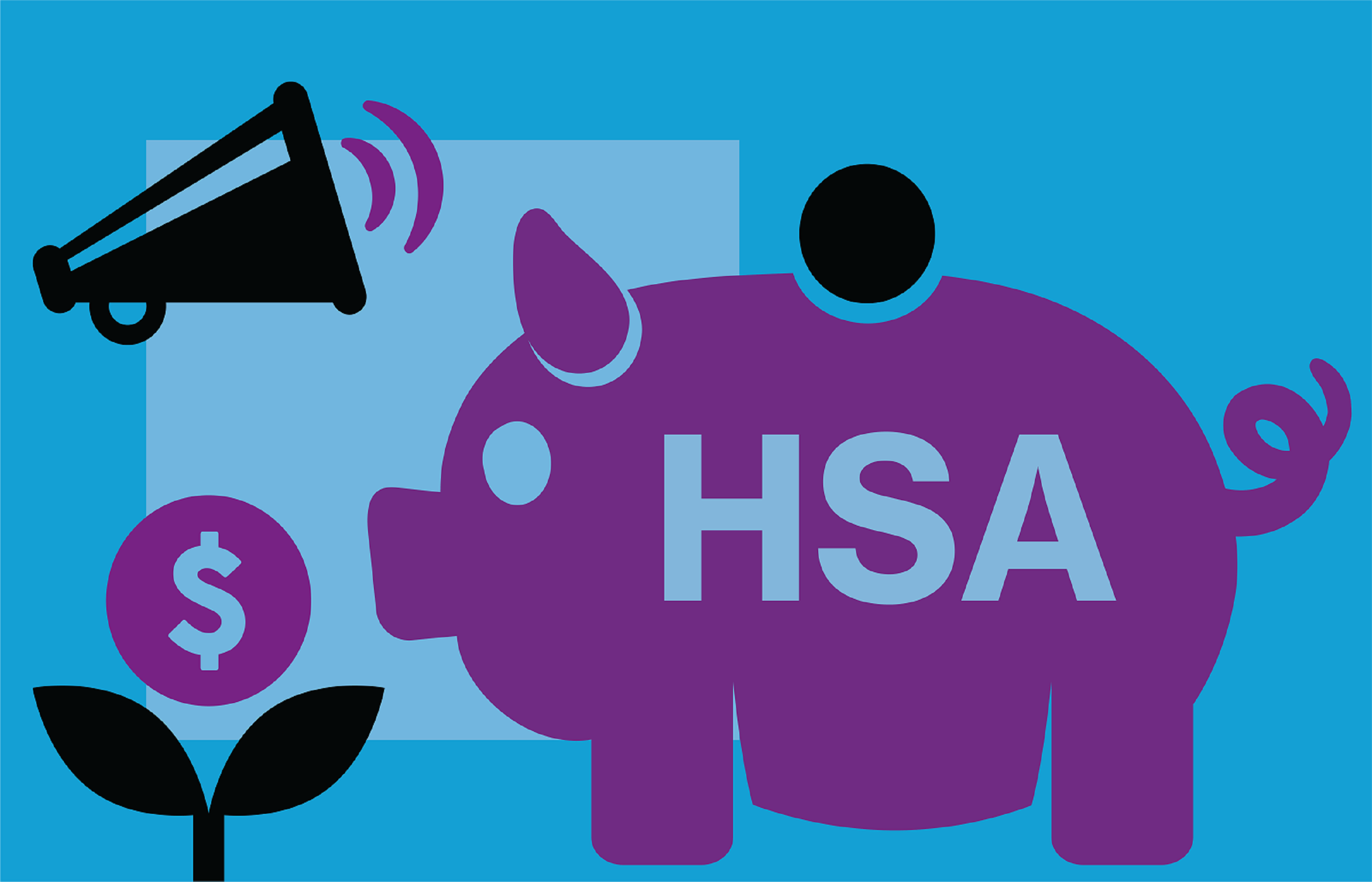
A Health Savings Account (HSA) is a tax-advantaged medical savings account available to taxpayers enrolled in qualified high-deductible health plans. Contributions to an HSA are made with pre-tax dollars, which can reduce an individual’s overall taxable income. The funds in an HSA can be used for a wide range of qualified medical expenses, and any unused money rolls over year to year, allowing for long-term savings.
Why consider HSAs?
- Tax advantages: HSAs paired with a high-deductible health plan can offer significant tax and retirement savings opportunities to your employees.
- Ownership and control: Employees manage their HSAs, deciding how and when to spend (or save) their healthcare dollars to improve both health and financial wellbeing.
- Investment potential: HSAs allow tax-free contributions that can be invested and saved to cover healthcare costs needs later in life. Any interest earned over time is also tax-free.
Key Features of HSAs

Eligibility qualifications
- Employees, retirees or self-employed individuals covered under a qualified High Deductible Health Plan (HDHP) as of the first day of the month qualify.
- Medicare-entitled individuals cannot contribute to HSA but can use HSA balances tax-free for qualified medical expenses.

Tax benefits
- Contributions to an HSA are tax-deductible
- Interest and investment earnings grow tax-free
- Reimbursements for eligible expenses are not taxed

2027 HSA dollar limits
- Contribution limits for single coverage: 1/12 of $4,500 ($4,400 in 2026)
- Contribution limits for family coverage: 1/12 of $9,000 ($8,750 in 2026)
- Minimum annual deductible for HDHP for single coverage: $1,750 ($1,700 in 2026)
- Minimum annual deductible for HDHP for family coverage: $3,500 ($3,400 in 2026)
- Maximum annual out-of-pocket expense limit for HDHP for single coverage: $8,700 ($8,500 in 2026)
- Maximum annual out-of-pocket expense limit for HDHP for family coverage: $17,400 ($17,000 in 2026)
- Pro-rata contributions not required; the entire maximum annual contribution may be made on the first day of the year.
- Individuals aged 55+ (not enrolled in Medicare) can make “catch-up” contributions of up to $1,000.

Qualified medical expenses
Include doctor visits, prescription medications, dental care, vision care and certain over-the-counter items with a prescription.
Portability
HSAs are portable, and the account remains with the individual even if they change jobs or health plans.
HSAs offer a versatile and tax-efficient way to manage healthcare expenses. By providing significant tax advantages, ownership and control over healthcare funds and investment potential, HSAs empower individuals to take charge of their health and financial future.
Download
| Title | File Type | File Size |
|---|---|---|
| Via Benefits HSA Cheat SheetPDF | 1MB |