
California’s SB 261 requires large companies doing business in the state to publish a report on their climate-related financial risks and risk management strategies by January 1, 2026, and every two years thereafter. If your organization earns over $500 million in annual revenue and does business in California — even without being headquartered or incorporated there — this law likely applies to you.
The law mandates disclosure aligned with the Task Force on Climate-related Financial Disclosures (TCFD) framework. But what does that mean in practice — and how simple can your effort be while still complying?
The bare minimum
To meet the legal threshold, your disclosure must include a description of:
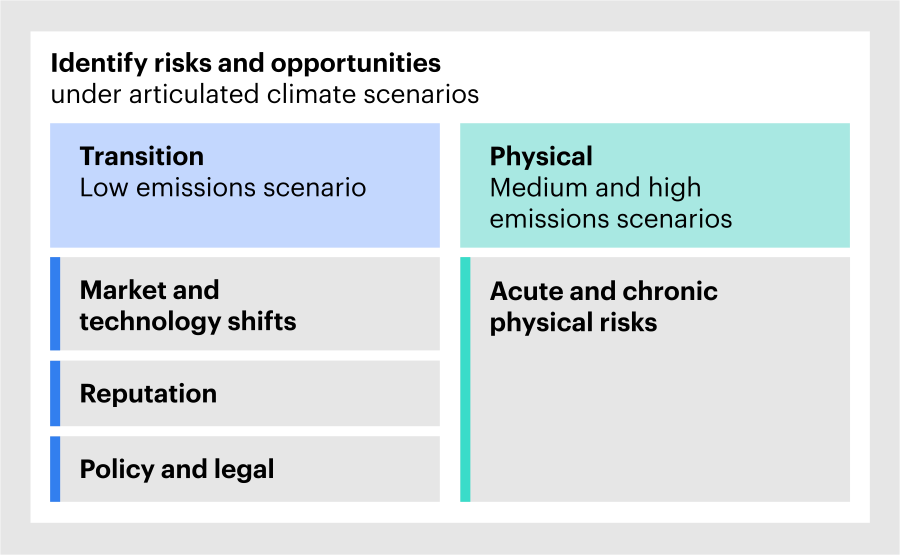
- The climate-related financial risks and opportunities that are material to your business, including both physical risks (e.g., wildfire, flood, extreme heat, sea level rise) and transition risks (e.g., regulatory changes, shifts in consumer preferences, technology developments).
- How you identify and assess these risks: You must consider short, medium and long-term timeframes and multiple climate scenarios
- The business impacts of material risks and opportunities, metrics used to assess them and any associated targets.
- How the organization will govern climate-related risks and opportunities, and how it will address or mitigate climate related risks.
You can put the disclosure on your website as a PDF. You may also need to put a link to the disclosure document on a Calfornia-hosted register. No third-party assurance or quantitative modeling is required.
Is the minimum enough?
While this “check-the-box” approach may be sufficient for compliance, it comes with trade-offs. Without deeper analysis, many companies miss critical insights into how climate risk could affect their capital planning, insurance strategy, or long-term resilience. Legal, EHS and risk teams may struggle to prioritize adaptation actions or defend the adequacy of risk management to boards, investors, or regulators.
For some companies, starting with a light-touch approach and expanding over time may be appropriate. But even basic compliance requires coordination across functions and credible documentation. SB 261 may be a reporting obligation — but it’s also a signal to build climate risk into the business conversation and plan for long-term resilience.
Why you might want support
Climate risk disclosure is still a relatively new requirement for many companies, and SB 261 introduces added complexity given its alignment with TCFD. Even for organizations aiming to do the minimum, practical questions quickly appear: What qualifies as a “material” risk? How do you tie climate impacts to financial performance? How much documentation is enough — and how do you avoid creating legal exposure?
Support can help ensure alignment across internal functions—legal, EHS, risk, sustainability — and provide access to established frameworks, market benchmarks and technical data that streamline the process. In many cases, external partners can complete assessments faster and more cost-effectively than in-house teams. For example, WTW’s climate tools and proprietary data sets can quickly identify location-specific physical risks and model financial impacts — saving significant time, reducing internal burden, and improving the quality of results.
For companies looking beyond basic compliance, expert support can also help evaluate CapEx and OpEx exposure, run scenario analyses and prioritize resilience investments in line with enterprise strategy.
Whether your goal is to meet baseline requirements or build a more future-ready risk program, external perspective can help make the process more efficient, credible and actionable.