Sub-Saharan Africa (SSA) accounts for approximately 30% of all known critical mineral reserves, many of which are essential for the 'green transition' that will increasingly define the global economy over the coming decades. These abundant reserves bring with them many opportunities, for both the region itself and those involved in the extraction process.
However, the SSA’s unique and diverse political and security landscapes contain an abundance of challenges for commercial organizations. Operators must account for and mitigate these obstacles to ensure the safety of personnel and assets, protect their reputations, and foster a positive impact on local environments. The following summarizes many of these threats and analyzes specific case studies that underscore both the risks and rewards facing those planning a long-term presence in the region.
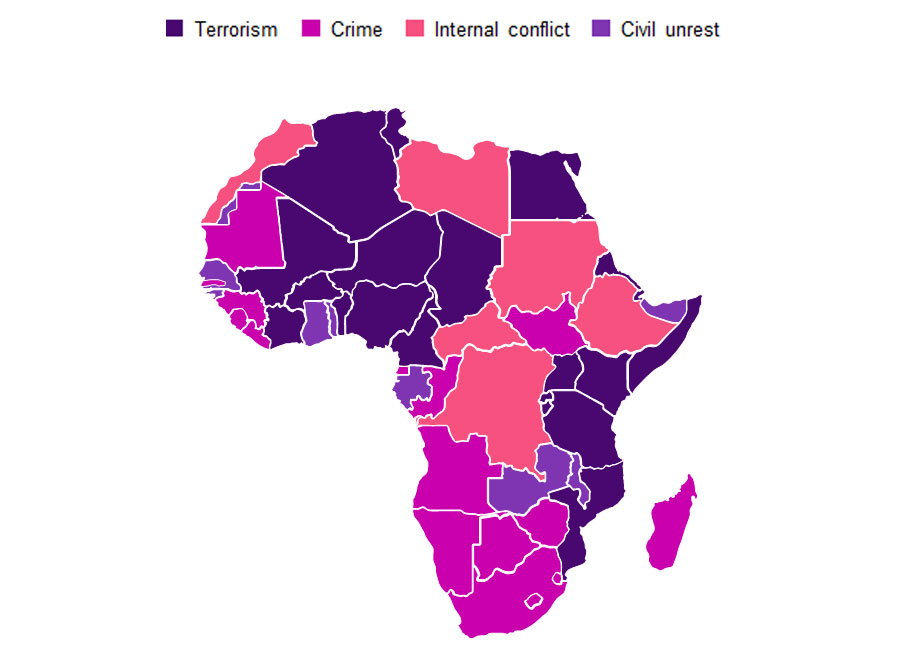
Map of SSA
Highlighting the most prevalent threat each country in the region faces
In this article:
- Escalating violence and instability in the Democratic Republic of the Congo
- Insecurity in Mozambique impacts miners and neighboring states
- Violent extremists permeate through West Africa
- Coups complicate the Sahel’s operational environment
- Illicit mining exacerbates insecurity in Ethiopia
- Kidnappings and nascent risks challenge operators in South Africa
- Resource nationalism adds legislative and bureaucratic challenges
- Navigating the risk
Alert:24
Alert:24 is WTW’s specialist security and crisis management advisory practice delivering intelligence, consulting, and training solutions that help identify, monitor, and manage security risk.
Related content
Escalating violence and instability in the Democratic Republic of the Congo
The Democratic Republic of the Congo (DRC) – home to vast deposits of diamonds, gold, copper, cobalt, tin, tantalum, and lithium, collectively estimated to be worth tens of trillions of dollars – is among the region’s most resource-rich nations. The DRC is notorious for its perennial political instability, high levels of violence and conflict, corruption, and often inadequate infrastructure.
Nowhere are these problems more acute than the country’s eastern regions, where dozens of armed non-state groups are active, often attacking operators, their assets, and their personnel with lethal effect. Freedom of movement is also perilous, with armed groups frequently attacking and blocking key roads and trade routes. Faced with these conflict-induced obstacles, many mineral shipments must now be re-routed via longer and more costly routes.
Levels of violence and insecurity in the eastern DRC have elevated considerably since M23 rebels launched a resurgence in late 2021. The Rwanda-linked group now controls swathes of Congolese territory, mostly found in North Kivu province, where it has seized towns and settlements such as Rubaya, which possesses over 70% of the world’s coltan reserves – a material vital for the production of electronic devices.
M23 rebels ostensibly re-emerged several years ago due to persecution of the Tutsi community, but their offensive campaign over the past three years has shown that gaining control of the region’s minerals reserves – mainly gold, tin ore cassiterite, coltan, cobalt and diamonds – is among their primary objectives.
Over the past 12 months, the group have increased their territorial control by as much as 70%. While an Angola-brokered ceasefire deal in August raised hopes of bringing an end to the conflict, violence has escalated once again in recent months. This January, M23 seized the strategic towns of Minova and Sake before advancing on Goma, the capital of North Kivu, which now seems to be completely under their control – marking the group’s most significant victory since its resurgence.
M23 has shown a remarkable ability to capture valuable land over the past year and appear unlikely to halt their advances soon. The loss of Goma has piled intense pressure on Congolese President Felix Tshisekedi, who has threatened all-out war with Rwanda. Meanwhile, massive protests have engulfed Kinshasa following Goma’s fall, with demonstrators specifically targeting the embassies of the U.S., France, Belgium, Uganda, Rwanda, and Kenya. Protesters have looted and attacked diplomatic facilities, due to their perceived complicity in the ongoing conflict in eastern DRC, while also causing major disruptions to travel in and out of the city.
A protracted conflict in eastern DRC will not only escalate violence and create space for other armed groups, such as Islamic State (IS), to expand their presence, but it may also lead to mining operators becoming increasingly targeted across the country. The recent protests in Kinshasa are a clear reflection of rising anti-foreigner sentiment, with outraged citizens potentially seeking to hold international operators and business personnel accountable for their perceived association with a struggling government, or with countries believed to be benefiting from the ongoing crisis.
Insecurity in Mozambique impacts miners and neighboring states
The growing strength of violent non-state groups is threatening mining industries across swathes of Africa. Mozambique is battling a resurgent Islamic State offshoot in its resource-rich Cabo Delgado province; at the height of the group’s operational strength between 2020-21 it forced the construction of Total’s LNG project, Africa’s largest foreign direct investment, to pause for over two years. Mozambique’s ruby industry – which constitutes over 80% of global supplies – was also often targeted or threatened by IS-Mozambique (IS-M) during this period.
The growing strength of violent non-state groups is threatening mining industries across swathes of Africa.
While there has been a reduction in militant violence since the Rwandan security mission arrived in Cabo Delgado over three years ago, rising levels of inequality and dissatisfaction with the uneven distribution of profits from natural resource extraction have allowed IS-M to maintain a foothold in northern Mozambique. Recent events have shown that discontent with the current status-quo is being felt nationwide by broad sectors of society. Indeed, following the announcement of Daniel Chapo – the ruling Front for the Liberation of Mozambique (Frelimo) candidate – as the victor of the 9 October presidential election, large protests have engulfed the capital and much of the country since 21 October.
Alleged irregularities with the vote have served as a spark that has ignited decades of building socio-economic discontent. The government and state security forces have cracked down harshly on the protestors, reportedly leaving hundreds of people dead. Aside from demonstrations, there have been significant internet and telecommunications blackouts, workers have gone on strike, and neighbors, South Africa, closed their side of the Lebombo border on a number of occasions. Last year, 53% of the chrome ore and concentrate exported by South Africa left via Maputo through this border crossing, meaning minerals and other supplies awaiting export have been stranded for weeks due to the unrest.
IS-M are likely to continue their attempts to establish a lasting presence in the Cabo Delgado province, potentially targeting those involved in the extraction of the region’s natural resources. However, should the new Frelimo government, which was sworn in on 15 January despite enduring protests, fail to capitalize on the country’s economic opportunities, it will likely continue to face serious opposition across society. Further large-scale unrest resulting from this could have significant repercussions for organizations present in the region. A number of mining operators were targeted or forced to shutter sites in recent months due to the protests, while others operating in neighboring countries faced significant supply chain disruptions.
Violent extremists permeate through West Africa
The ability for insecurity and instability to permeate across borders in Africa is perhaps best exemplified by the Sahel region, where steady proliferation of Islamist extremist groups linked to al-Qaeda (AQ) and the Islamic State (IS) saw the Central Sahel account for over half of all recorded terrorist-related deaths globally last year.
In Burkina Faso – one of the countries most impacted by terrorism globally and once Africa’s third largest gold producer – acute levels of insecurity have coincided with at least seven mining companies ceasing operations in the country over the past two years. And while those who have stayed have enjoyed a rise in revenue thanks to recent increases in the price of gold, the World Bank has indicated that acute levels of terrorism have contributed to a decline in industrial gold mining and production since 2022, with Burkina Faso producing 57.3 tons in 2023 compared to 66.8 tons in 2021.
In neighboring Mali, the country’s mining industry has been affected in different ways. Despite also being among the most impacted countries by terrorism, its output has not been dramatically changed. This can be explained in part by the geographical location of many of the country’s formal extractive projects, which are found in the southern and south-western areas of Mali, away from its more violent central and northern regions.
However, a recent attack in the capital Bamako underscores that terrorist groups may more routinely threaten safer havens and business hubs across the region. As a result, incidents like the 2015 attack on Bamako’s Radisson Blu hotel, that reportedly targeted foreigners and saw mining industry figures affected, and the similar 2016 attack against Ouagadougou’s Splendid Hotel, could be repeated in the Central Sahel, or potentially in countries nearby.
Indeed, the Central Sahel’s status as a global epicenter of terrorism is beginning to have ramifications for the wider region. Groups in the Sahel are believed to be seeking to expand into the Gulf of Guinea states, with Benin, Togo, Ghana, Côte d’Ivoire, and Guinea assessed as being the most exposed. Should these violent extremists follow a similar expansionist playbook to the one used almost a decade ago, embassies, hotels, restaurants, and other locations frequented by foreigners and business travelers may be targeted in some of West Africa’s major cities over the coming years.
This threat will have to be monitored diligently by those involved in some of the sizeable and burgeoning mining industries of Côte d’Ivoire, Togo, Ghana, and Guinea, as even comparatively low increases in violence could pose additional costs and obstacles for operational security and logistics.
Coups complicate the Sahel’s operational environment
Rising levels of militant violence have been a key factor behind the five successful coup d'états in the Sahel since 2020, accounting for more than half of the overthrows in Sub-Saharan Africa’s recent wave of coups. Almost all of these forceful regime changes came amid growing discontent with security infrastructure, quality of governance, as well as perceived lack of economic and social returns from the extraction of natural resources. Consequently, nascent governments in Guinea, Gabon, Niger, Mali, and Burkina Faso all made or proposed changes to their mining sectors and associated legislation.
The juntas in Mali, Burkina Faso, and Niger embarked on the most drastic reforms, making sweeping adjustments to their mining codes and utilizing 'terrifying' tactics against international organizations. Burkina Faso also nationalized at least two gold mines, while Niger temporarily halted the issuance of new mining licenses for over six months and revoked at least two uranium mining licenses – including at one of the world’s largest concessions. As these extreme examples in the Central Sahel demonstrate, many recent post-coup environments in SSA have been more hostile to foreign mining entities – even for those that have operated in and invested billions over decades.
Recent developments in Mali perhaps best exemplify this. The arrest of four senior Barrick employees in Mali for alleged 'financial crimes' made international headlines this September. These detentions are widely believed to be linked to disagreements over the profits generated from the Loulo-Gounkoto mining complex, which yielded the company’s second-highest gold output in 2023. The junta has made other companies renegotiate their existing contracts since it took power, albeit using less escalatory methods.
The military government’s desire to extract maximum profits from its deals with foreign entities was showcased again in November, when Australia’s Resolute Mining – majority owner of the Syama gold mine – agreed to pay over $160 million after its CEO and two of its employees were detained by Malian authorities the week prior.
The economic impact of these unprecedented detentions was felt by both entities, shortly after the detention of the Barrick employees, when shares dropped by 2%. But for Resolute Mining, the repercussions were far more severe, with its shares dropping by 32% on what was its worst trading day in 16 years. The unresolved dispute has led Barrick to pause operations in the country, prompting the government to recently seize around $245 million from the Loulo-Gounkoto complex in a severely escalatory move.
The Malian government has obtained over $1 billion worth of concessions from foreign companies by employing these coercive tactics. These rewards may make such methods appealing to others in the region – particularly those with more autocratic regimes like Burkina Faso, Niger, and Guinea. The ongoing disputes in Mali have demonstrated that coercive tactics can lead to severe outcomes, such as the halting of operations at major projects, the detention of personnel, and the loss of hundreds of millions of dollars' worth of minerals. These tactics can also have a significant impact on the supply chains that support operations, affecting companies that have made substantial investments in the region.
Almost all of these forceful regime changes came amid growing discontent with security infrastructure, quality of governance, as well as perceived lack of economic and social returns from the extraction of natural resources.
Illicit mining exacerbates insecurity in Ethiopia
Escalating levels of violence and conflict in West Africa has been linked to the prevalence of illicit mining, something that Nigerian President Bola Tinubu drew attention to last year. Evidence of the link can be found in contexts across the continent, including Ethiopia. The country’s northern Tigray region continues to face huge challenges with illicit mining, which sees as much as six tons of gold smuggled out of the country annually via armed groups. Similarly, in other insecure regions such as Benishangul and Oromia, official production is significantly lower than government projections due to illegal extraction.
Escalating levels of violence and conflict in West Africa has been linked to the prevalence of illicit mining
The list of potential challenges facing those in Ethiopia is exemplified by the difficulties one organization encountered during a project in the town of Kurmuk, where access to the site was prevented by militant violence, interference from regional authorities, and encroachment by illicit miners.
Prime Minister Abiy Ahmed will need to clamp down on illicit mining as his government pushes to transform the national economy over the next five years. This drive is centered heavily around making its mining sector one of the country’s largest contributors to GDP – something the leader reiterated his desire for at the recent inauguration of the Segele gold mine. Ethiopia is attempting to navigate an intense economic and political turbulence, which peaked with the Tigray conflict several years ago. This war left hundreds of thousands dead, saw rebels march on Addis Ababa, and stalled mining operations in Tigray over two years.
However, it is perhaps ongoing conflicts between the state and ethnic militias in the Amhara and Oromia regions that currently pose the most significant challenges to the country’s long-term internal stability. Aside from waging insurgencies, armed groups in these regions are driving Ethiopia’s soaring kidnap for ransom rates, which have impacted foreign-owned companies on a number of occasions recently.
Militants are also increasingly targeting Ethiopia’s major roadways leading in and out of the capital, including the only road to the port of Djibouti – Ethiopia’s main trade artery. The country’s Oromia region, found in the center of the country surrounding Addis Ababa, is a particular hotspot. Foreign businesses seeking to benefit from Ethiopia’s drive to expand its mining industry may find themselves increasingly targeted by armed groups as they travel in and out of the capital – particularly if they appear to hold affiliations with the central government.
Kidnappings and nascent risks challenge operators in South Africa
Elsewhere in the region, kidnapping for ransom is also a major, yet growing threat in South Africa – one of the region’s most prolific producers of minerals. The country saw a surge in kidnapping cases in the 2023–2024 fiscal year, continuing a pattern that has seen the number of kidnappings rise by nearly 200% over a decade-long period. The country’s Gauteng province – hosting mines that account for 25% of the country’s total mineral production and the nation’s commercial capital Johannesburg – serves as the epicenter for this crisis.
South Africa’s high kidnap risk is well-known, but a unique, industry-specific kidnapping threat has recently emerged in the country. Over the past year, there have been at least two instances where hundreds of workers have been taken hostage underground by their colleagues; they were not released until their captors’ demands were met by management. This new phenomenon has been heavily linked to the reduced demand for South Africa’s sizeable reserves of platinum, diamonds, coal, and more as the global economy shifts towards minerals necessary for the so-called ‘green energy transition’.
This declining appetite has led operators to make cuts to maintain profitability, also leading to an uptick in work-related unrest. Recent incidents have seen hundreds or even thousands of miners protest underground for days over pay and benefits, including at the Bafokeng Rasimone Platinum Mine, as well as at the Modder East Mine in Springs.
Protests, illegal sit-ins, and stoppages continue to occur across the country on a semi-regular basis; this emerging pattern suggests that unrest and industrial action are both likely to continue impacting operators in South Africa as metal prices fluctuate and international demand ebbs and flows.
Resource nationalism adds legislative and bureaucratic challenges
This potentially new trend adds yet another bureaucratic challenge facing those operating in SSA, with a host of governments having recently introduced major regulatory and legislative reforms aimed at their mining sectors. Cameroon, Namibia, Tanzania, Madagascar, Uganda, and Zimbabwe have all reformed their mining regulations over the past two years. Others such as Zambia, Kenya, Senegal, and South Africa are reportedly considering changes of their own.
This trend of reforms has been attributed in part to increased demand for the region’s minerals. But it has also been credited to ‘resource nationalism’, which is seeing countries become more protectionist of their minerals in order to better profit from their increased importance to the global economy.

Map of SSA
Highlighting which minerals each country in the region is protecting and the risk level of each country.
Many of these reforms have posed fresh challenges to investors and operators in SSA, particularly when they have been applied to active projects. New legislation can require enhanced monitoring and enforcement tools to ensure compliance and security, as well as increased local content obligations. Some of the more comprehensive changes have seen existing mining licenses revoked or stakes reduced, leading to more drastic outcomes such as international arbitration cases against governments and drops in share prices.
Navigating the risk
Ultimately, the coming decades present an enormous opportunity for the region, as international revenues from the extraction of copper, nickel, cobalt, and lithium alone could increase the region’s GDP by approximately 12% by 2050. Therefore, the diverse and complex range of risks facing mining operators within SSA must be navigated efficiently to remove the potential for reputable, legal, economic and personnel losses but to also ensure profitability and demonstrate to employees a clear duty of care. To assist with this, it is imperative that mining companies present within the region develop robust security risk management frameworks to support in-country operations and ensure the protection of their assets and personnel. These security risk management frameworks must be extensive and flexible to allow them to mitigate and respond to the myriad of risks that are present in SSA.
These security risk management frameworks must be extensive and flexible to allow them to mitigate and respond to the myriad of risks that are present in SSA.
Risk assessment
To develop a robust security risk management framework it is integral that any mining operations in SSA, existing or proposed, are continually risk assessed. An effective threat evaluation should not only consider the physical security infrastructure of any site, which should be done at project inception and then on an annual basis by security experts, but also the wider risk environment and how it is likely to evolve in the short, medium and long term. Given the dynamism of the SSA political and security landscape, to effectively evaluate emerging threats, mining organizations should ensure they have consistent access to a range of intelligence sources, which provide reliable and accurate threat updates, delivering informed forecasts of how these changing threats could impact mining operations within the respective jurisdiction.
Security planning
Whilst risk assessments of all aspects of mining operations are vital, they should be accompanied by a suite of comprehensive site-specific plans, protocols and procedures which will not only help the company prevent a security incident from occurring but in the event of a real incident, how to respond. These policies and procedures should cover all the risks likely to be encountered by the site but should coordinate with the company's wider corporate crisis management frameworks. These themselves should be regularly reviewed to ensure they are reflective of industry best practices and are relevant for the organization’s current risk exposure and accompanying threat environments. The increasingly difficult legislative environment in some SSA states, combined with the protruding security risks, denote that these security and crisis management frameworks are becoming increasingly important, with companies needing to ensure they have the appropriate insurance and contingency measures in place to not only survive a potential incident, but also fully recover.
Security infrastructure
Having appropriate security and crisis management frameworks in place is one component of developing a leading security infrastructure at each mining facility, a prerequisite when operating in SSA. As outlined in the preceding analysis, threats in SSA can manifest in a myriad of ways, therefore mining sites' security infrastructure should be composed of a combination of physical and technical controls. Technical security infrastructure should encompass all the aforementioned frameworks as well as access to reliable intelligence sources. The level of physical security apparatus required should be determined following a comprehensive risk assessment and should be constantly reviewed throughout the project’s construction and operation phase, to ensure security measures are commensurate with the risk environment. Site Security & Vulnerability Risk Assessments (SVRAs) are the most effective way of review and should be conducted at least annually to account for natural degradation, malfunctions or illicit activity. SVRAs should be comprehensive, accounting for both physical and technical security measures and should be aligned to relevant security standards. For the majority of mining locations in SSA, physical security infrastructure should be advanced but also pragmatic, allowing operations to continue with as little disruption as possible, but also protecting staff and assets. Principles, such as of deny, detect, delay, deter, and respond should be implemented to support the application of a holistic and layered security program and the capabilities of threat actors should also be considered in the design of physical security measures.
Training and exercising
Undoubtedly, developing/reviewing the relevant frameworks is a crucial step for extractive companies in not only SSA but globally, however, unless employees are orientated on these frameworks and their individual responsibilities, they can often be null and void. Indeed, it is evident that risk-aware employees are likely to incur a reduced number of incidents compared to those that do not receive training, thus basic security/training should be provided to all staff members. The need for this training is even more acute in the higher-risk regions of SSA, where employees are exposed to a plethora of extreme-risk events that have potentially life-threatening consequences if encountered.
Whilst the training of general staff is vital to increasing organizational resilience as a collective, management teams both at site-level and corporate level are likely to have the most interaction with the relevant security risk frameworks and thus must be trained/exercised on how these should be applied in practice. Familiarity with roles and responsibilities allows effective response in the event an incident is incurred and limits the potential detrimental impact on the organization. In SSA, where the risk environment is constantly changing, it is advised that training takes place at regular intervals to ensure the most pertinent risks, political and security, are addressed accordingly.
For more information on the mitigation or contingency measures outlined, please contact our team.
Disclaimer
WTW hopes you found the general information provided here informative and helpful. The information contained herein is not intended to constitute legal or other professional advice and should not be relied upon in lieu of consultation with your own legal advisors. In the event you would like more information regarding your insurance coverage, please do not hesitate to reach out to us. In North America, WTW offers insurance products through licensed entities, including Willis Towers Watson Northeast, Inc. (in the United States) and Willis Canada Inc. (in Canada).
Authors


Contacts