
Key takeaways
- Sophisticated tools apply rigor and governance to building a robust risk financing strategy the supports companies’ clean energy goals now and into the future
- These insights enable risk and finance leaders to pinpoint the optimal balance of risk retention and transfer to use capital efficiently
- Optimized risk strategies can help to free-up capital for investment in clean energy technologies while ensuring critical assets are protected
Although investment in clean energy increased by 34% from the end of the financial year 2024-25[1], challenges in securing financing persist for the natural resources industry. Financiers are facing contradictory pressures of an escalating appetite to build clean energy risks into lending portfolios, while also applying stringent eligibility criteria which narrows the pool of suitable candidates for lending. These challenges were reflected in the responses to our latest Global Clean Energy Survey, where only 38% of natural resources companies are using debt financing to fund clean energy strategies.
The spotlight is on internal financing. A large proportion of respondents are confident about their ability to raise money through the business, with two-thirds (66%) using cash flow generated from the business, and almost as many raising capital through divestment (59%) and equity investment (55%). Natural resources companies – even well-capitalized majors – will need to carefully consider the financial values at risk in the event of failure, and how best to support business continuity and balance sheet strength.
To make smart financial decisions underpinning clean energy strategies, companies first need to consider their risk tolerance and then thoroughly understand their clean energy exposures and associated risks. These risks should not just be considered in isolation - building a sustainable and resilient risk strategy will depend on taking a view of the risk portfolio as a whole.
Put your clean energy risk strategy on the right path from the start
The pace of change is unrelenting for the natural resources industry. When it comes to clean energy, conflicting priorities can complicate decision making across all levels of the business.
As of Q1 2025, our survey revealed that clean energy strategies are driven predominantly by corporate strategy and sustainability teams[1].
But these teams may not be focused on building a robust and resilient risk strategy that takes into account how a clean energy future impacts the business as a whole.
Setting a company’s risk tolerance is the foundation to building a robust risk financing strategy. Companies are complex, and there are financial and operational intricacies and interdependencies that risk and insurance managers may not have at their fingertips, but that financial and functional leaders across the business do. Defining and implementing risk tolerances needs to be a collaborative venture.
Risk tolerance definitions should be free from biases and provide a fair and robust platform for risk retention and insurance decisions. The support of sophisticated tools can help to apply rigor and objectivity to the process of setting risk tolerances.
Having involved financial and functional leaders in a collaborative process to establish the company’s risk tolerance, sophisticated tools – such as Risk Tolerance Clarified – enable these leaders to test the appropriateness and impact of proposed risk tolerance metrics. Engaging with this structured, data-driven process enables financial leaders to examine the impact of risk tolerance levels on earnings, share price and other key metrics that have been agreed with debtors and stakeholders, and demonstrate robust governance protocols.
Decision making cannot exist in a risk/insurance manager silo. As clean energy technologies add new complexities to a company’s risk profile, applying governance to decision making is essential. Armed with risk tolerance thresholds, risk and insurance leaders now have a quantitative foundation on which to build their risk finance strategy and for those risks that they insure, risk tolerance metrics to guide deductible and limit decisions.
Optimize and economize: Take a portfolio view to pinpoint opportunities
Having set their risk tolerance, leading organizations are reassessing their risk financing strategies to ensure that capital is deployed efficiently.
Looking at all your risks across different scenarios can help prioritize mitigation efforts to get the best results from your risk management spend.”Kevin LittleSenior Director, Strategic Risk Consulting
“You can identify, quantify, and prioritize major risks, and connect risk management decisions to corporate financial performance with risk and analytics,” says Kevin Little, Senior Director, Strategic Risk Consulting. “Looking at all your risks across different scenarios can help prioritize mitigation efforts to get the best results from your risk management spend.”
The insurance industry traditionally segments risk into specific lines of business, but companies themselves are a portfolio of risks. One of the biggest shifts that helps companies drive sustainable growth is moving away from treating insurance as a collection of individual policies and instead taking a portfolio view of risk finance.
Taking a portfolio approach means:
- Assessing risk tolerance and financial resilience – established fossil fuel companies that are gradually transitioning to clean energy may be able to retain more risk than they realize. In contrast, new, standalone clean energy businesses will usually need to place a greater reliance on insurance to protect their balance sheet
- Prioritizing risk transfer where insurers offer good value, while retaining risk where markets overcharge, freeing up capital for more strategic uses
- Recognizing that while some risks are interconnected, most are diversified in an average year
Risk and analytics specialists guide natural resources companies through the development of individual and portfolio-based financial risk models. These allow for risk diversification in expected loss scenarios versus the potential for risk aggregation in extreme loss scenarios. Applications such as Connected Risk Intelligence generate a band of options that balance risk retention and transfer, aligned with the company’s risk tolerance. This band of ‘efficient frontier’ optimized options enables risk and finance leaders to pinpoint the right balance for their business.
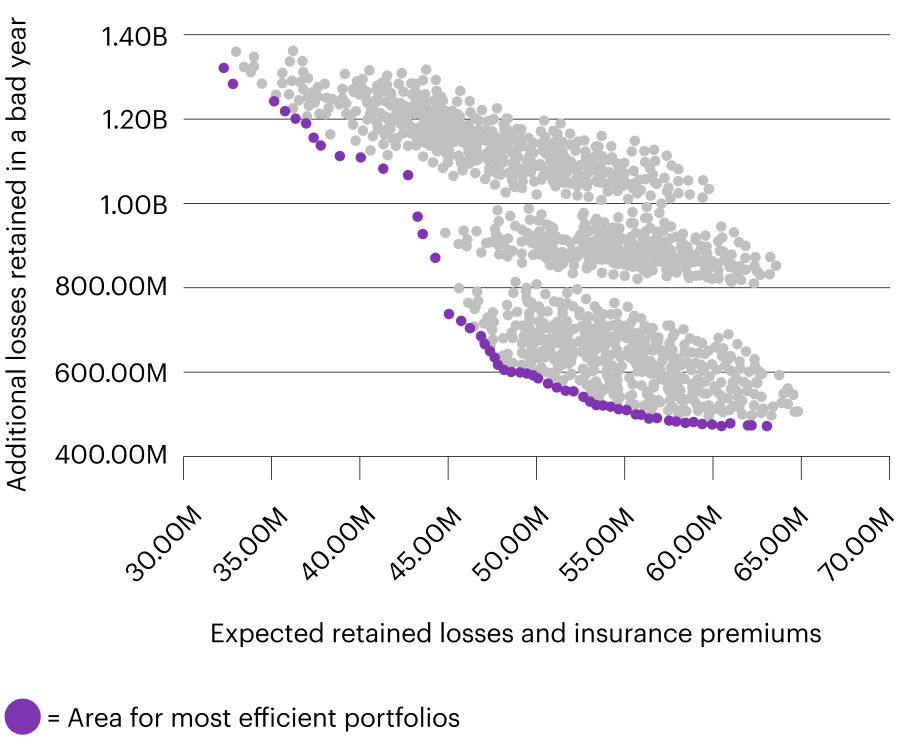
Figure 2: Demonstrating optimized capital efficiency and lowest total cost of risk, compliant with group risk tolerance
Source: Cutting through 59,049 options: How natural resources companies are optimizing their risk strategy
These insights are helping natural resources companies make smart decisions about building a resilient and sustainable risk financing strategy in a changing clean energy future.
For emerging and uninsurable risks - such as political risk, regulatory changes, or supply chain disruption - that may have greater financial impact than insurable risks, risk and finance leaders should collaborate on capital deployment to ensure they are investing in risk mitigation, resilience and growth. This could include harnessing innovative solutions, such as:

Related content
- Captive insurance strategies, where companies self-insure certain risks that traditional markets overprice, potentially due to uncertainty on risks associated with new clean energy technologies
- Parametric insurance which pays out based on objective triggers, such as wind speeds or solar radiation levels to protect clean energy assets in exposed geographies
- Alternative capital sources, such as insurance-linked securities, to help finance emerging risks
Take steps on your clean energy journey with confidence
Although investment in clean energy increased by 34% during the 2024–25 financial year according to our survey[1], an extra $500 billion per year will be required to meet the IEA’s Net Zero Emissions by 2050 scenario[2]. Filling this gap equates to a doubling of current annual spending on clean energy generation, grids and storage by 2030[2].
As companies across the industry evolve their clean energy strategies, Inti Gomez, Head of Risk and Analytics Latin America, advises that “with a more stable finance strategy, leaders can look to deploy capital in initiatives such as investments in technology or growth ventures with clarity and confidence.”
More resilient companies should explore using risk financing more strategically to leave funds free for investment in growth ventures as part of the energy transition.”Charles BarderHead of Risk and Analytics International
Charles Barder, Head of Risk and Analytics International, adds that “on their clean energy pathway, natural resources companies with a lower risk tolerance should assess the cost/benefit of insurance as a mechanism to protect their asset values, revenue streams and share price, while more resilient companies should explore using risk financing more strategically to leave funds free for investment in growth ventures as part of the energy transition.”
Demand more from your risk finance advisor. Future-ready companies are strategic about how to optimize risk spend to protect critical assets and operations and build financial stability to move ahead with confidence in a clean energy future.
Protect and grow your business. Contact us to find out how you can optimize your risk financing strategy.
Footnotes
- Global Clean Energy Survey Report 2025, From 450 natural resources respondents. Return to article
- IEA World Energy Investment 2024. Return to article
Disclaimer
WTW hopes you found the general information provided here informative and helpful. The information contained herein is not intended to constitute legal or other professional advice and should not be relied upon in lieu of consultation with your own legal advisors. In the event you would like more information regarding your insurance coverage, please do not hesitate to reach out to us. In North America, WTW offers insurance products through licensed entities, including Willis Towers Watson Northeast, Inc. (in the United States) and Willis Canada Inc. (in Canada).
Natural resources contact
Risk and analytics contact

“With a more stable finance strategy, leaders can look to deploy capital in initiatives such as investments in technology or growth ventures with clarity and confidence.”Inti GomezHead of Risk and Analytics Latin America