When Claims insights get dismissed as “anecdotal” – and what to do about it
Claims leaders know this moment well. When a concern is raised – rising severity, increasing representation, or shifts in claimant behavior. Heads nod. Then comes the familiar response: “Do we have data to support that, or is this anecdotal?”
The irony, of course, is that claims is already one of the most data-rich functions within an insurance organization. Claims represent roughly 70% of an insurer’s premium and involve thousands of individual claims. Every loss comes with structured fields, unstructured narratives, documents, invoices, and dozens of adjusters’ decisions – all data points.
The issue is not a lack of data. It is a lack of accessible, usable, and trusted analytics, driven by fragmented legacy systems, inconsistent data structures, and reporting processes that make it difficult to turn raw claims data into timely insights.
As many carriers move to modern Claims management platforms, these barriers are finally coming down, unlocking opportunities that were previously out of reach.
This blog outlines a practical way to think about the Claims analytics journey – how claims experts can move from anecdotal insight to evidence-based decisions, and how that foundation enables more advanced analytics, including predictive, generative, and agentic AI.
The Claims analytics journey framework
To shift from anecdotes to analytics, Claims organizations need more than isolated dashboards or one-off models.They need a structured progression that builds capability over time while delivering value, such as improved cost control, reduced cycle time, and enhanced customer experience as market dynamics change.
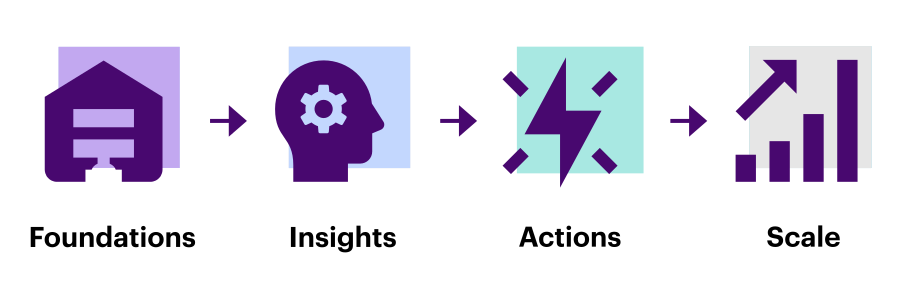
As a Claims leader working with insurers across the U.S. and Canada, I typically see successful Claims organizations progress through four phases. While the pace and sequencing vary, skipping steps almost always creates adoption issues that later lead to low adoption and unrealized ROIs.
So, how can a claims leader transform the Claims organization to be truly data-driven?

Phase 1: Data foundations – making claims data usable
This phase is about answering a deceptively simple question: Can we see what’s happening in claims?
Key steps:
- Gaining reliable access to core claims and vendor data (e.g., Guidewire, estimating software, TPA)
- Structuring raw transactional data into analytics-ready tables
- Defining a consistent set of core KPIs (e.g. cost, cycle time, quality)
- Building foundational dashboards and scorecards
Use cases:
- FNOL dashboards showing inflow, backlog, and aging
- Auto, Property, Liability and Workers’ Compensation scorecards tracking cost and timeliness
- Vendor performance dashboards
- Automated leadership reporting replacing manual, Excel-based summaries
What success looks like:
- Claims leaders trust the numbers
- Basic operational questions can be answered quickly and effectively
- Reporting is repeatable and automated
- Analytics is viewed as enabling clarity, not adding complexity
Key sign you’re ready for Phase 2:
Teams stop asking “Is the data right?” and start asking “Why is this happening?”

Phase 2: Proving value with insight and early wins
Once data is usable, the focus shifts from visibility to credibility. The goal is to use analytics to solve visible, high-impact claims issues and demonstrate tangible value early, earning trust by solving real problems and influencing behavior.
Key steps:
- Segmenting claims to surface cost concentration
- Introducing oversight dashboards that change behavior
- Supporting Claims leaders with diagnostic insights, not just reporting
Use cases:
- Identifying a small subset of claims driving a disproportionate share of cost
- Highlighting adjuster or vendor variability for targeted coaching
- Daily or weekly exception reporting on stalled claims
- Root cause analysis of chronic delays or rework (e.g., supplements, rentals)
What success looks like:
- Analytics shifts attention to high-impact areas
- Claims teams can explain why certain claims or vendors cost more
- Leaders can prioritize interventions without relying solely on experience
- Early savings, efficiency gains, or cycle time improvements are visible
Key sign you’re ready for Phase 3:
Teams begin asking, “Can we flag these cases earlier?”

Phase 3: Embedded analytics – from insight to action
In this phase, analytics becomes part of the workflow itself. Insights guide decisions in real time rather than being reviewed after the fact. The emphasis shifts to operationalizing insights within adjuster workflows.
Key steps:
- Embedding predictive models into triage, assignment, or settlement workflows
- Combining structured and unstructured data (notes, documents)
- Delivering explainable recommendations rather than opaque scores
- Establishing model governance, monitoring, and refresh cycles
Use cases:
- FNOL triage models identifying complex or high severity claims early
- Litigation propensity indicators for auto BI and GL claims
- Early severity or escalation indicators supporting reserving and strategy
- Explainable “next best action” recommendations embedded in claims systems
What success looks like:
- Adjusters see analytics inside their normal tools, not in separate dashboards
- Models are explainable and trusted, not black boxes
- Senior expertise is applied earlier in the claim lifecycle
- Claims outcomes become more consistent across similar cases
Key sign you’re ready for Phase 4:
Analytics is routinely referenced in claims decisions – not just leadership reviews.

Phase 4: AI & agentic enablement – scaling expertise
This phase builds on embedded analytics and introduces agentic AI to reduce friction and increase consistency at scale.
Explore where AI can create measurable value in claims.
Key steps:
- Deploy 10+ AI models to assist with decision-making across operations
- Introducing agentic AI to coordinate tasks, surface recommendations, and support adjusters
- Defining clear guardrails and human-in-the-loop controls
Use cases:
- AI extraction of signals from claim notes, documents, and correspondence
- Continuous reassessment of claim risk as new information arrives
- Agentic workflows that surface issues, request inputs, or draft summaries
- AI assisted claim reviews for handoffs, audits, or escalations
What success looks like:
- Claims professionals spend more time deciding and less time searching
- Insights are delivered proactively, not on request
- AI operates within clear guardrails, with humans firmly in the loop
- Expertise is consistently applied – even amid staffing constraints
- Effective management of the real estate of AI models and agents
Key sign you’re getting it right:
AI improves speed and consistency without undermining trust or judgment.
Putting it all together
Claims organizations often operate in multiple phases at once, but long-term success relies on respecting the progression:
Move from anecdotal observations to evidence‑driven action.
Strengthen your analytics to improve decision‑making, efficiency, and outcomes.
When insurers skip steps – especially jumping straight to AI – the result is often low adoption, rework, skepticism, and unrealized benefits.
Those who build deliberately transform claims from being seen as “anecdotal” to becoming a credible, data‑driven engine of organizational performance, delivering:
- Lower loss costs
- Faster cycle times
- Better customer outcomes
- More consistent decision‑making
Where to begin:
- Be honest about where you are today: identify the capability gaps preventing progress.
- Invest first in the capabilities that unlock adoption, not just technology itself.
The journey typically takes two to three years of deliberate effort, and it’s not strictly linear. Foundations are revisited, models are refined, and use cases expand as conditions change. But building a strong analytics foundation is essential for the next‑generation claims operating model — and the best time to start is now.
Author

Radar ™ for Claims
Cut costs, fight fraud and boost service with AI-powered analytics.