


The sixth edition of WTW’s life insurance industry mortality study (TOAMS 6) provides our latest comprehensive analysis of mortality experience, covering the calendar years 2018 to 2022. Notably, this study provides our first detailed analysis of the impact of the COVID-19 pandemic.

Study overview
- 17 companies
- Ordinary individual life insurance products
- All attained ages
- An estimated 1.1 million deaths, $100 billion in death benefits, $25 trillion of face amount exposure
- Generalized linear model (GLM) built to predict raw mortality rates (Qx)

Selected findings
Calendar year and attained age
One key focus of TOAMS 6 is the impact of the COVID-19 crisis, since this is our first study to include data from the pandemic period.
These results are innovative in their use of predictive modeling methods, which allow for the ability to isolate the excess mortality impact of COVID while controlling for typical life insurance differentiators (including face amount, smoker and risk class, duration and more).
The data reveals how the pandemic has skewed traditional mortality rates, with those below age 50 most heavily affected across all years studied.
Mortality rates for individuals below age 70 reached their highest levels in 2021, with older age groups experiencing peak mortality in 2020.
Risk class and attained age
TOAMS 6 identifies persistent differences in mortality experience across risk classes and attained ages. The data supports the industry consensus that while the benefits of preferred underwriting persist, they diminish by age.
For nonsmokers, the relative mortality of the two-class preferred and residual standard categories does not converge even by age 90; in other words, different levels of mortality risk are sustained. The preferred class, meanwhile, shows more of a gradual “wear off” than the rapid “wear down” of the residual standard class.
By contrast, mortality rates converge cleanly by age 70 across the various smoker risk classes. This segment clearly exhibits more predictable mortality patterns.
Product type
Product type continues to be a significant predictor of mortality with the impact varying by attained age
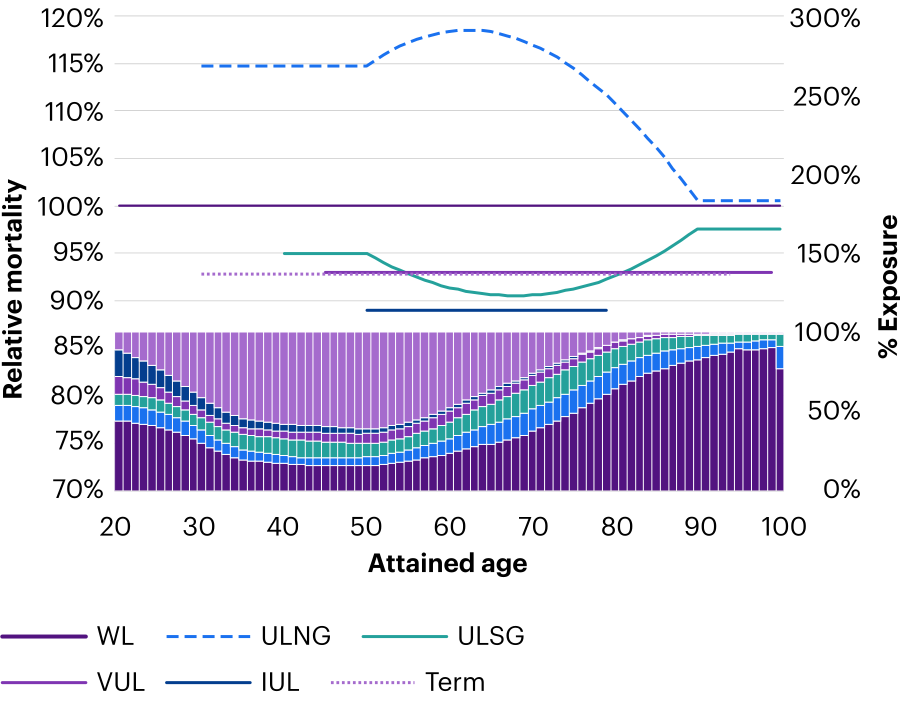
Figure 4: Mortality by product and attained age
Whole life (WL) insurance provides us with a baseline for product comparisons. Against this baseline, universal life with no guarantees (ULNG) policies consistently demonstrate the highest mortality experience across all ages, peaking at around age 60. This repeats our findings from the TOAMS 5 study.
By contrast, universal life with secondary guarantees (ULSG) policies have lower mortality than WL, particularly between ages 65 and 70; thereafter, these policies start to align more closely with WL outcomes.
Notably, indexed universal life (IUL) policies demonstrate lower relative mortality experience among all product types, suggesting favorable outcomes for this newer product design.
Company-level insights
In order to assess variations at company level, our study compares actual-to-expected (A/E) ratios to both the 2015 VBT and the TOAMS predictive model
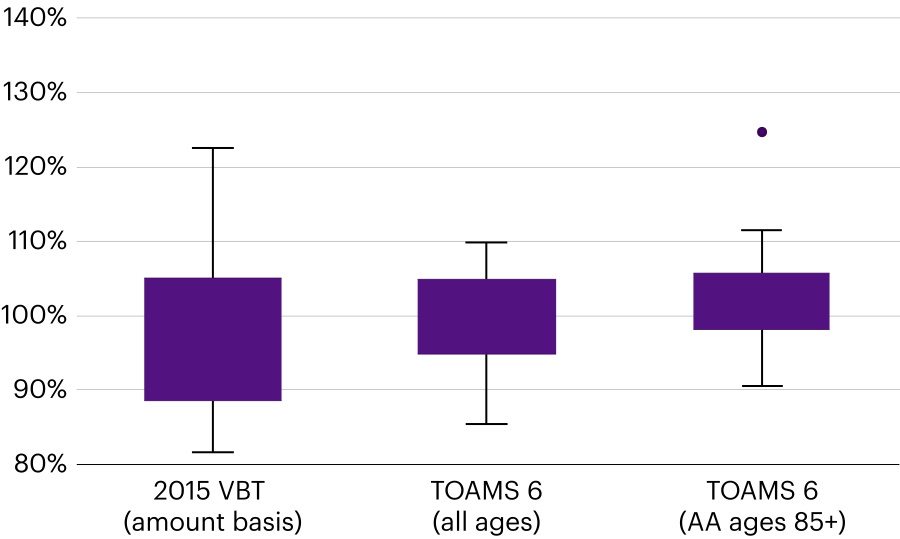
Figure 5: Mortality differentials by company
These comparisons show that the interquartile range and overall range of A/E ratios are significantly narrower when using TOAMS as the expected basis. This indicates that much of the variation in mortality experience across companies can be attributed to distributional differences in common variables.
That said, a notable residual differential remains. This is likely to reflect factors not captured in the TOAMS 6 data set — for example, underwriting criteria, adherence to those criteria, distribution channels and target markets.

Final takeaways
The mortality trends identified in TOAMS 6 should be viewed as descriptive rather than prescriptive. While many findings confirm and quantify prevailing industry viewpoints, they are not intended to dictate future assumptions or practices without appropriate expert judgment.
The full version of TOAMS 6, which includes a much broader set of findings than those discussed here, is available for purchase. Future research will explore additional topics such as the impact of policy lapses and surrenders as well as joint-life mortality.
Download
| Title | File Type | File Size |
|---|---|---|
| TOAMS 6 Results reveal emerging mortality experience in U.S. individual life insurancePDF | .8MB |
Author

TOAMS 6 study
Contact us