Institutional investors are facing an increasingly complex landscape. The year 2025 was marked by significant developments that continue to shape the investment environment. Geopolitical tensions, including shifting trade alliances and Middle East instability, remained a concern. Meanwhile, sweeping legislative changes, such as the 2025 U.S. Budget Bill, permanently altered the tax landscape, incentivizing industrial development and reshaping investment opportunities.
Regulatory reform also played a crucial role. U.S. regulatory agencies are providing clearer guidance on digital assets, opening new doors for innovation. Recent and pending legislation is also laying the groundwork for asset tokenization, while executive orders promoting private assets drew renewed attention to defined contribution (DC) plans. Despite these changes, capital markets have remained resilient as inflation stabilized, the Federal Reserve began to lower rates and questions about economic growth came to the fore.
The changing environment has created new investment opportunities as we look ahead to 2026. Institutional investors face a landscape that demands agility, specialization and a holistic view of portfolio construction. With that in mind, it is important for investors to:
01
Traditional portfolio construction often relies on asset class silos, which can lead to a fragmented approach that neglects the interconnected nature of today's markets. Traditional models emphasize “filling buckets” rather than achieving portfolio-level outcomes.
TPA offers a more effective alternative. By starting with portfolio objectives in mind, investments can be evaluated based on their contribution to overall goals—whether through return, liquidity, diversification, or resilience. TPA requires a shift in mindset and governance, demanding deeper analysis and cross-functional collaboration.
Our work with global institutions has demonstrated the effectiveness of TPA in achieving better investment outcomes. Specifically, TPA has been shown to:
TPA offers a robust framework for navigating the complexities of 2026 and beyond.
02
Investors are navigating a complex investment environment where depth often trumps breadth. The most compelling opportunities often come from firms with a singular focus, bringing sharper alignment, deeper expertise and a stronger incentive to deliver results.
Focusing on specialized strategies can foster innovation and accountability in a portfolio, particularly in private markets where niche approaches can unlock value. Institutional investors are likely seeking managers who can refine their edge and build differentiated strategies.
Generalists can still have a place too, providing access, liquidity and lower fees. But a balanced approach that combines high-conviction, specialized strategies with generalists can better help investors and can:
By incorporating specialist strategies, institutional investors can drive better outcomes and achieve their investment objectives.
03
Market concentration is at historic highs, with the top five U.S. tech giants now making up 17% of global equities. This creates a challenge for investors: how to stay exposed to market leaders without becoming overly dependent on them.
A balanced portfolio approach—combining passive, smart beta and high-conviction active strategies—can help manage this risk while preserving return potential:
Equity allocations are central to client portfolios and U.S. equities remain top of mind for global investors, but their dominance demands thoughtful diversification. By blending these approaches, investors can build resilient portfolios that navigate concentration risk without sacrificing performance.
04
Fixed income is no longer just about ballast, it’s about opportunity. With interest rates still elevated, all-in yields across credit markets remain compelling. But accessing these returns requires looking beyond traditional corporate bonds and embracing a broader spectrum of credit. Private market strategies have been one of the hottest topics for fixed income investors lately. However, private market valuations have become compressed as competition has driven credit spreads down. Despite this, private credit remains a powerful tool for investors seeking higher yields and uncorrelated returns.
Redesigning your fixed income portfolio to broaden your exposures in public markets can offer attractive income and diversification, with the added benefit of improved liquidity. And with spreads in direct lending compressed, it’s important to ensure locking up capital is worth the liquidity trade-off.
We think other areas of private credit are more attractive today and can offer differentiated exposures and asymmetric return profiles that diversify income streams. Specifically, we believe investors should:
Accessing these opportunities requires specialized expertise. Manager selection plays a critical role in navigating the nuances of each market, especially as credit conditions evolve. In today’s environment, it’s more important than ever to understand what you own and to ensure you are being paid for the risk you are taking.
05
Real assets are regaining momentum, driven by stabilized market pricing and attractive valuations in commercial real estate, as well as long-term secular drivers supporting infrastructure investments.
Changing regulation in the U.S., particularly the 2025 U.S. Budget Bill, has introduced sweeping changes to depreciation rules and tax subsidies, creating opportunities for investors to:
These regulatory changes, combined with long-term themes such as changing demographics and growing energy demand, make real assets a strategic allocation for long-term resilience and inflation protection. Investments with strong, recurring, inflation-linked cash flows can offer stability, income and diversification, particularly in a total portfolio approach.
The combination of long-term secular trends and improved valuations makes real assets an attractive opportunity, providing a unique blend of income, diversification resilience to support long-term return needs.
06
Investors face complex market environments where managing risk and enhancing returns is crucial. Liquid diversifiers can play a vital role in achieving these objectives.
Liquid diversifiers can generate alpha across market cycles, making them valuable tools for institutional portfolios. To create diverse exposures and exploit inefficiencies across asset classes, investors can:
By understanding and leveraging these liquid diversifier options and their role in the overall portfolio, investors can better navigate market complexities and achieve their investment goals.
07
Liability-driven investing (LDI) is evolving to become a more integrated component of a Total Portfolio Approach (TPA) for pension plans. This involves evaluating how interest rate and credit spread exposures interact with other asset classes and portfolio objectives.
For defined benefit plans, changes in liability value represent uncompensated risk with significant consequences. Mitigating this risk requires thoughtful implementation aligned with the plan's funded status and goals. To manage liability volatility, investors should:
LDI is not a one-size-fits-all strategy. It should reflect each plan's funded status, risk tolerance and long-term objectives. Embedding LDI within a TPA framework enables sponsors to build more resilient, efficient portfolios that manage liabilities holistically and support better outcomes over time.
08
The private equity landscape has undergone a significant transformation, with the number of public companies in the U.S. declining from 6,500 in the late 1990s to roughly 3,500 today, while the number of large private companies has surged to over 11,000. This shift highlights the growing importance of private markets in capturing economic growth.
Middle market private equity can offer compelling opportunities due to lower entry valuations and greater potential for operational improvement. It also benefits from the dry powder raised by larger private equity firms, creating a robust exit environment. Although rising interest rates have slowed exit activity, they have also created openings for new entrants and expanded the opportunity set for secondary transactions, emphasizing the need for selectivity. Middle market co-investments can offer a path to high-conviction opportunities and exposure, where investors can:
By leveraging these opportunities, investors can achieve long-term success in a dynamic and evolving market.
09
The rise of semi-liquid alternatives is transforming how investors access private markets, offering exposure to traditionally illiquid strategies with more flexible liquidity terms. Semi-liquid funds offer several benefits compared to traditional LP structures, including:
Interval funds exemplify this structure, allowing monthly subscriptions and quarterly redemptions at the fund's NAV, subject to cap, while maintaining a liquidity sleeve to support redemptions. This bridges the gap between daily liquid mutual funds and long lock-up private capital vehicles.
By blending traditional private market strategies with more liquid components, investors can achieve better outcomes. They can retain exposure to differentiated return streams while maintaining flexibility. As the semi-liquid alternatives market continues to mature, these investments will expand the portfolio construction toolkit and play an increasingly important role in institutional portfolio design.
10
Recent regulatory changes are paving the way for broader adoption of private assets in defined contribution (DC) plans. Professionally managed solutions – such as target date funds and managed accounts – are one of the most effective way to access private assets in DC plans, and can:
The industry is seeing significant momentum and innovations, driven by strategic partnerships and new vehicle designs. These developments are breaking down barriers by improving transparency, liquidity and fee structures, making it easier to incorporate private equity, private credit and private real assets into DC plans. As a result, private assets are likely to play a growing role in DC portfolios as plan sponsors seek to improve participant retirement readiness.
11
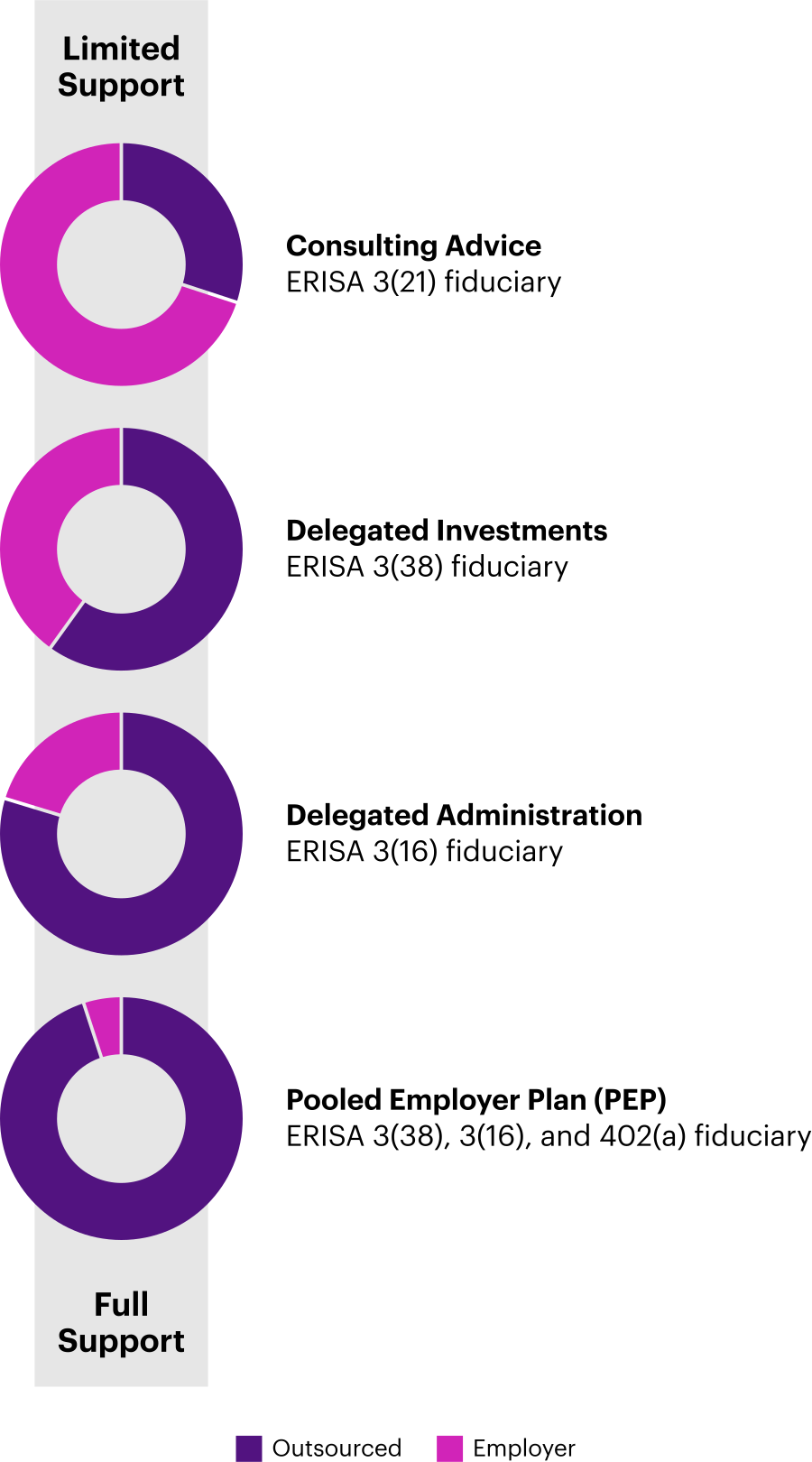
With the ever evolving DC landscape, managing a defined contribution plan is increasingly complex. Regulatory changes, litigation risk and operational burdens are pushing sponsors to seek greater support and more efficient solutions. Enter the Pooled Employer Plan (PEP)—a structure that allows plan sponsors to outsource the majority of plan management and fiduciary responsibilities to an independent professional fiduciary – including investments.
PEPs provide access to professional oversight and scale that can be a win-win for both employers and plan participants in the form of streamlined effort, risk mitigation, lower plan costs and improved retirement outcomes. For example, WTW’s LifeSight PEP acts as both 3(16) and 3(38) fiduciary, relieving sponsors of most administrative and investment oversight responsibilities. Sponsors retain control over plan design but gain relief from day-to-day operations. With scale and expertise, PEPs will also be at the forefront of innovative and investments solutions.
With over $25 billion in expected assets by the end of 2025—up from $10 billion just two years ago1—PEPs are gaining traction across industries and plan sizes. As litigation risk continues to rise, we believe PEPs will become the prevalent choice for many sponsors seeking simplicity, scale and fiduciary protection.
Source: Georgetown, “Are PEPs Reshaping the Retirement Plan Market?”
It features four donut charts:
This document was prepared for general information purposes only and does not take into consideration individual circumstances. The information contained herein should not be considered a substitute for specific professional advice. In particular, its contents are not intended by Towers Watson Investment Services, Inc., and its parent, affiliates, and their respective directors, officers, and employees (“Willis Towers Watson”) to be construed as the provision of investment, legal, accounting, tax or other professional advice or recommendations of any kind, or to form the basis of any decision to do or to refrain from doing anything. The information included in this presentation is not based on the particular investment situation or requirements of any specific trust, plan, fiduciary, plan participant or beneficiary, endowment, or any other fund; any examples or illustrations used in this presentation are hypothetical. As such, this document should not be relied upon for investment or other financial decisions and no such decisions should be taken on the basis of its contents without seeking specific advice. Willis Towers Watson does not intend for anything in this document to constitute “investment advice” within the meaning of 29 C.F.R. § 2510.3-21 to any employee benefit plan subject to the Employee Retirement Income Security Act and/or section 4975 of the Internal Revenue Code.
This document is based on information available to Willis Towers Watson at the date of issue and takes no account of subsequent developments. In addition, past performance is not indicative of future results. In producing this document Willis Towers Watson has relied upon the accuracy and completeness of certain data and information obtained from third parties. This document may not be reproduced or distributed to any other party, whether in whole or in part, without Willis Towers Watson’s prior written permission, except as may be required by law.
Views expressed by other Willis Towers Watson consultants or affiliates may differ from the information presented herein. Actual recommendations, investments or investment decisions made by Willis Towers Watson, whether for its own account or on behalf of others, may differ from those expressed herein.