
What is digital infrastructure?
According to IBM, 90% of the world’s data was created in the past two years. To facilitate this exponential growth, a global network of interconnected physical assets enable the flow, processing, and storage of data, which is collectively referred to as the digital infrastructure sector.
The key subsectors include:
- Data centers (i.e., data storage) serve as the backbone for cloud computing and artificial intelligence (AI) workloads, offering scalable compute and storage capacity.
- Fiber networks (i.e., data transport) provide high-speed, low-latency (i.e., low lag time) connectivity across cities, countries, and continents, including subsea cables.
- Wireless infrastructure (i.e., mobile access), including cell towers and small cells, supports mobile data transmission and the rollout of 5G and beyond.
- Smart infrastructure refers to the integration of digital technologies—such as sensors, data analytics, and automation—into physical infrastructure systems (e.g., transportation, energy, water, buildings) to enhance efficiency, sustainability, and real-time decision making.
Together, these subsectors form a resilient and scalable foundation for the digital economy and represent the key segments of the investable universe.
Capital markets interest
Institutional investor interest in digital infrastructure started gaining momentum in the early 2010’s, initially focused on cell towers and data centers due to their stable cash flows and utility-like characteristics. As the digital transformation accelerated—driven by cloud computing, AI, and 5G—investors expanded into fiber networks, edge computing, and subsea cables, recognizing their long-term growth potential and essential role in the digital economy.
Over the past decade, capital deployment has shifted from passive ownership to active platform creation, with pension funds, sovereign wealth funds, and infrastructure managers backing large-scale buildouts, carve-outs, and greenfield projects across global markets. The opportunity is vast as cumulative infrastructure spend is expected to reach $106 trillion by 2040, with the digital sector representing nearly a fifth of that total[1]. Over the near term, the digital segment is set to remain in favor among allocators as shown in Figure 1.
Supply-demand fundamentals
It is predicted that the total volume of data produced, recorded, transferred, and used worldwide will reach 394 zettabytes in 2028, up from 149 zettabytes in 2024[2]. Demand within digital infrastructure subsectors is primarily driven by the exponential growth of data from cloud computing, 5G, internet of things (IoT), digital services, and most notably, AI. Each demand driver requires scalable, low-latency, and high-bandwidth connectivity. Enterprises, governments, and consumers increasingly rely on data centers, fiber networks, and wireless infrastructure to support digital transformation, remote work, and smart technologies (see Figure 2).
On the supply side, infrastructure deployment is shaped by capital availability, regulatory frameworks, and access to land, power, skilled labor and semi-conductor chips. While hyperscalers (e.g., AWS, Alphabet, Microsoft, Meta, Oracle) and telecoms lead investment in core assets, institutional investors are increasingly funding greenfield builds, platform expansions, and open-access models to meet rising demand and capture long-term returns.
The scale of the increases in both demand and supply in recent years makes the return outlook somewhat uncertain. The fragility around both demand and supply is illustrated by the somewhat circular investments and contracts made by numerous companies in the technology and AI supply chain.
Indirect ways of accessing the data center theme include investments in power or electricity grids. This is because of the significant energy demands created by data centers for continuous power.
Figure 2: Both AI and non-AI workloads will be key drivers of global center capacity demand growth through 2030
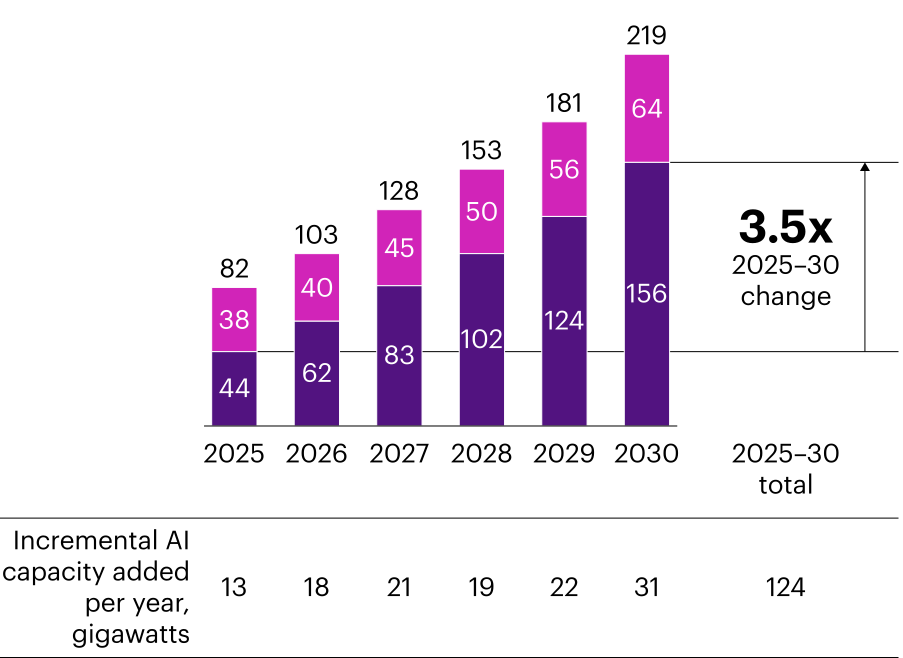
Estimated global data center capacity demand, ‘continued momentum’ scenario, gigawatts
Total capacity grows from 82 GW in 2025 (44 GW AI workload, 38 GW non-AI) to 219 GW in 2030 (156 GW AI, 64 GW non-AI), representing a 3.5× increase. Incremental AI capacity added per year rises from 13 GW in 2025 to 31 GW in 2030, totaling 124 GW over the period. Both AI and non-AI workloads are key drivers of demand growth, with AI contributing the largest share of capacity expansion.
Source: McKinsey & Company
Role in the portfolio
Digital infrastructure can potentially check multiple boxes for an investors’ objectives – income, diversification, return enhancement, and inflation mitigation. For example, a “powered shell” data center investment (i.e., landlord owns building + power + fiber with tenant responsible for costly servers + internal buildout) includes a long-term lease (e.g., 10-year) with annual rent escalators and an investment-grade tenant. Likewise, cell towers’ revenue models are 5-10-year contracts with wireless carriers and annual revenue escalators of c. 3-4%. Contrast these income-producing types of investments with a data center development project, where targets returns will be substantially higher and predominantly composed of capital appreciation, given relative risk undertaken will be much greater.
Outlook
The outlook across digital infrastructure subsectors remains strong, driven by sustained data growth and technological innovation.
- Data centers are expected to expand rapidly, especially hyperscale and edge facilities, fueled by AI workloads and cloud adoption.
- Fiber networks will continue to see robust investment as governments and private players push for universal high-speed connectivity, with open-access and wholesale models gaining traction.
- Wireless infrastructure, including towers and small cells, will benefit from ongoing 5G densification and future 6G planning.
- Edge computing is poised for accelerated deployment to support latency-sensitive applications like autonomous systems and industrial IoT.
- Satellite and alternative connectivity will grow in relevance for bridging underserved regions, particularly through low-earth orbit constellations.
Overall, the sector is expected to remain a high-priority investment area for institutional capital seeking long-term, resilient returns. However, the growing uncertainty around the circular nature of investments and contracts in the data center supply chain make investment manager and strategy selection critical. Further, indirect ways of accessing the data center theme around power could provide more resilient returns. We believe that investors need to carefully pick their spots in the data center space.
Glossary
- Cloud Computing - Using the internet to store and access data and programs instead of your computer’s hard drive.
- Latency - The time it takes for data to travel from source to destination (i.e., lag time).
- Small Cells - Tiny cell towers that help improve mobile signal, especially in crowded places.
- Edge Computing - A distributed computing model where data processing happens closer to the source (like a device or sensor) rather than in a centralized cloud. This reduces latency and improves performance for time-sensitive applications.
- Internet of things (IoT) - A network of physical devices—like sensors, appliances, and vehicles—connected to the internet. These devices collect and exchange data, enabling automation and smarter decision making.
- High-Bandwidth - A fast internet connection that can handle lots of data at once.
- Hyperscaler - A company that provides cloud computing infrastructure and services at massive scale, typically using thousands of servers across global data centers.
Footnotes
Disclaimer
This document was prepared for general information purposes only and does not take into consideration individual circumstances. The information contained herein should not be considered a substitute for specific professional advice. In particular, its contents are not intended by Towers Watson Investment Services, Inc., and its parent, affiliates, and their respective directors, officers, and employees (“Willis Towers Watson”) to be construed as the provision of investment, legal, accounting, tax or other professional advice or recommendations of any kind, or to form the basis of any decision to do or to refrain from doing anything. The information included in this presentation is not based on the particular investment situation or requirements of any specific trust, plan, fiduciary, plan participant or beneficiary, endowment, or any other fund; any examples or illustrations used in this presentation are hypothetical. As such, this document should not be relied upon for investment or other financial decisions and no such decisions should be taken on the basis of its contents without seeking specific advice. Willis Towers Watson does not intend for anything in this document to constitute “investment advice” within the meaning of 29 C.F.R. § 2510.3-21 to any employee benefit plan subject to the Employee Retirement Income Security Act and/or section 4975 of the Internal Revenue Code.
This document is based on information available to Willis Towers Watson at the date of issue and takes no account of subsequent developments. In addition, past performance is not indicative of future results. In producing this document Willis Towers Watson has relied upon the accuracy and completeness of certain data and information obtained from third parties. This document may not be reproduced or distributed to any other party, whether in whole or in part, without Willis Towers Watson’s prior written permission, except as may be required by law.
Views expressed by other Willis Towers Watson consultants or affiliates may differ from the information presented herein. Actual recommendations, investments or investment decisions made by Willis Towers Watson, whether for its own account or on behalf of others, may differ from those expressed herein.