
Executive compensation serves as a powerful tool for communicating and reinforcing the goals and core values of an organization and aligning the company’s long-term interests with those of its owners. For employee-owned organizations, this means aligning management’s interests with those of their employees to create an executive compensation structure that stands apart from other private and publicly traded companies.
An employee-owned organization, often set up as an employee stock ownership plan (ESOP), is a private company where employees hold a significant stake of the business through a trust. This differs from traditional private companies, where ownership is usually concentrated among a few individuals, and public companies where shares are held by external investors.
To understand the distinct structure of executive compensation in ESOP companies, WTW surveyed 74 members of the Employee-Owned S Corporations of America (ESCA) about their executive compensation strategies. The results provide a specialized look at the executive pay practices and program design among ESOPs.
At its core, executive compensation is like a stool held up by three legs, namely base pay, annual incentive program (AIP) and long-term incentives (LTIs) (Figure 1).
Figure 1. The three-legged stool of executive compensation
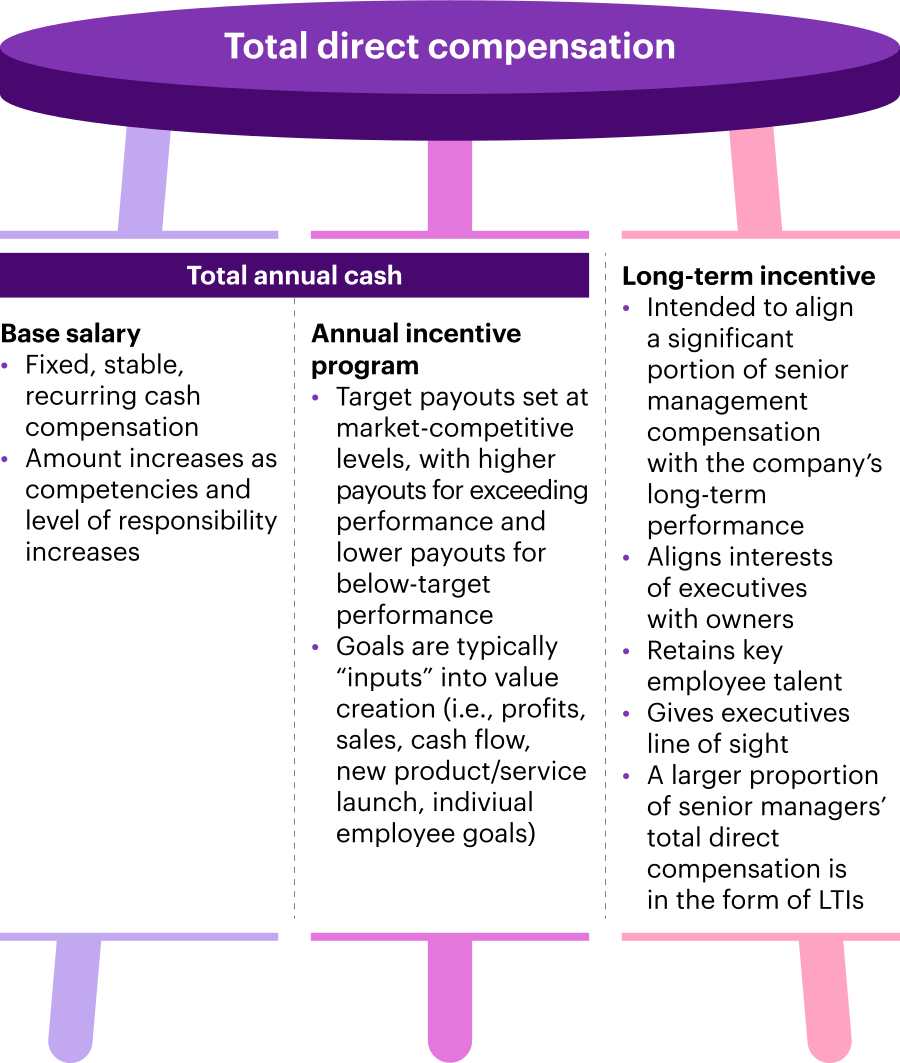
Executive compensation in any organization is like a three-legged stool supporting total direct compensation.
Graphic showing the three-legged stool of executive compensation. The two legs fall under Total Annual Cash. First, Base Salary: Fixed, stable, recurring cash compensation. Amount increases as competencies and level of responsibility increase. The second leg is Annual Incentive Program: Target payouts are set at market-competitive levels., with higher payouts for exceeding performance; lower payouts for below-target performance. Goals typically represent "inputs" into value creation, such as profits, sales, cash flow, new product or service launches, and individual employee goals. The third and last leg is Long-Term Incentive: Designed to align a significant portion of senior management compensation with the company’s long-term performance. Aligns the interests of executives with those of owners. Helps retain key employee talent. Provides executives with line of sight. A larger proportion of senior managers’ total direct compensation is in the form of LTIs.
Each leg plays a crucial role in maintaining balance. Organizations that do not offer these components find it difficult to align executive performance with the company’s key priorities. Based on the results of the survey, this article examines how two of the legs — AIPs and LTIs — work in organizations with ESOPs.
Annual incentive plans in employee-owned companies
Prevalent among public and private organizations alike, AIPs often are reserved for senior professional and management positions. However, in our study, 52% of ESOPs extend AIP eligibility to all employees. This compares to only about one-third of private and public companies (Figure 2).
The simplicity and focus of AIP metrics in ESOPs also are notable. Most ESOPs (63%) have only one or two performance metrics vs. more complex scorecards in private and public companies often using two to four metrics (Figure 3).
Figure 3. Typical number of performance metrics in ESOP vs. private and public companies
Profitability is the most common metric in annual incentive plans at employee-owned companies, with 90% of respondents using them as their only performance metric. This focus reflects the importance of financial health and sustainability in these companies. Revenue growth (29%) and strategic objectives (19%) are the next most common metrics, supporting a balanced approach to performance evaluation.
AIP programs in ESOP companies also are unique in that:
- Nearly half use individual performance metrics for executives, while only about 20% of private and public companies do so
- There is less focus on sales growth, most public companies use these metrics
- As in private companies, ESOPs place more emphasis on employee satisfaction and engagement vs. environmental, social and governance (ESG) metrics historically featured in public companies’ AIP performance scorecards
Long-term incentive plans in employee-owned companies
Most employee-owned companies offer LTI programs, but not to the same extent as public companies where LTIs are virtually universal. The prevalence of LTIs among ESOPs are more aligned with that of private companies at approximately 80%, compared to 99% among public companies.
In ESOP organizations, LTIs are typically offered only to executives, which is also aligned with the practice of private companies. In public enterprises, LTIs are available to a broader group of employees, often starting at the director level, depending on industry. It is also important to keep in mind that ESOPs are designed to help employees share in the financial success of the companies through all-employee participation in stock ownership via ESOP shares.
For executives, most ESOPs (77%) tend to use only one LTI plan, which is similar to other private companies. This is a stark contrast to the “portfolio” approach seen in public companies that often use two to three plans as LTI vehicles (Figure 4). This singular focus allows ESOPs to maintain a clear and consistent message regarding long-term goals and rewards.
Figure 4. Number of LTI vehicles in employee-owned vs. private and public companies
Another notable aspect of LTI programs in ESOPs is the use of stock appreciation rights (SARs), a less common approach in both public and private companies. SARs are almost twice as prevalent in ESOPs compared to other private companies, while barely a quarter of public companies use SARs/stock options in their LTI programs.
This preference for stock appreciation-based awards underscores the importance of share value appreciation in the ESOP model. Public companies, on the other hand, tend to favor full-value shares and performance-based equity. Private companies also use SARs but often opt for cash-based long-term performance plans (Figure 5).
In the ESOP model, share value is the most common LTI payout determinant. For ESOPs that use metrics beyond share valuation, the majority rely on profitability metrics. In contrast, 51% of public companies use total shareholder return (TSR) as the primary performance-plan metric, followed by strategic measures and return on capital measures (both 22%). The emphasis on share value and profitability reflects an ESOP’s unique governance structure and the importance of aligning executives’ interests with those of employees.
LTI program vesting schedules in employee-owned organizations are similarly aligned (Figure 6). Despite being the most common among public companies, a four-year vesting period is less prevalent in ESOPs.
Figure 6. Typical vesting periods in ESOPs vs. private and public companies
Maximizing executive pay in ESOP companies
While the three legs of employee-owned companies’ executive pay structure may be different from those of private and public companies, they are designed to achieve the same goal: equilibrium. To fully leverage their executive compensation strategy, ESOP organizations need to make informed decisions that are tailored to the company’s unique needs.
By capitalizing on high-quality and relevant data combined with expert advice, ESOP companies can ensure their executive compensation programs and policies not only appeal to top talent but also underscore the company’s dedication to equity and employee ownership. In this way, you can create a mutually beneficial environment in which executives drive company success and employees are committed to a shared vision.
Authors