


At first glance, the development and life cycle of Storm Éowyn followed a familiar pattern for a wintertime North Atlantic extratropical cyclone.
Forming off the west coast of the United States on January 21, 2025, Éowyn intensified rapidly as it tracked eastward across the Atlantic. The associated strong jet stream fueled its rapid cyclogenesis[1], enabling Éowyn to arrive in the eastern North Atlantic as a very severe storm, producing extreme wind gusts.
When Éowyn passed over Ireland and the U.K. on January 24, it delivered a maximum recorded gust speed of 51 meters per second at Mace Head,[2] surpassing the previous maximum set by ex-Hurricane Stephen on December 26, 1998, to become the strongest on record for Ireland.
...this near-miss can help us understand the potential risk from Éowyn-like events by looking more closely at what made Éowyn remarkable in the first place.
Although Éowyn set meteorological records, its insured losses were relatively modest at around 620 million euros, a figure within the range of losses typically seen once per year across Europe[3]. This apparent disconnect between record-breaking winds and moderate losses is largely due to the strongest gusts affecting quite sparsely populated regions. However, this near-miss can help us understand the potential risk from Éowyn-like events by looking more closely at what made Éowyn remarkable in the first place.
A meteorological outlier: Rapid cyclogenesis and low pressure
Beyond setting a new gust record, Éowyn also ranks among the most intense winter cyclones recorded in the British Isles since the 1959 – 1960 season, based on minimum mean sea level pressure (MSLP) over the U.K. and Ireland.
Éowyn had a minimum MSLP (from ERA5) of 940.6 hectopascals, with only eight cyclones recorded as deeper (Figure 1[a]). It was also the second deepest storm since the turn of the 21st century.
The extreme peak intensity of Éowyn was achieved through an equally impressive rate of intensification. Typically, cyclones deepen over the Atlantic, aided by the jet stream. However, Éowyn underwent rapid cyclogenesis, with its pressure dropping from 991 to 940.6 hectopascals in just 24 hours[1] — double the threshold used to define rapid cyclogenesis, often termed a bomb cyclone (Figure 1[b]). This places Éowyn in the top 1% of all winter cyclones for intensification rate.
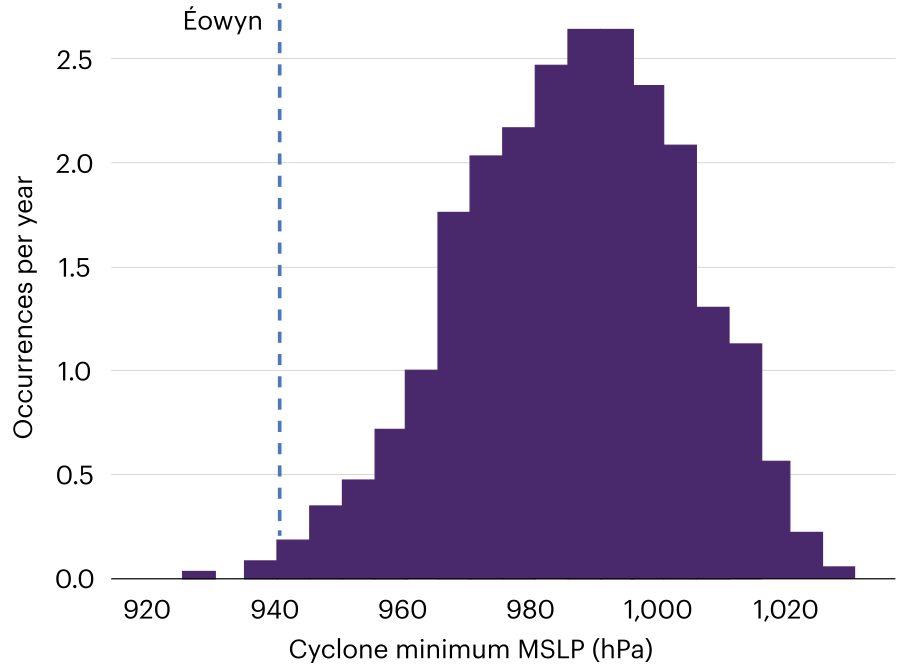
Figure 1(a). Distribution of minimum mean sea level pressure (MSLP) of historical extratropical cyclones that have impacted the U.K. and Ireland (48°N – 62°N, 12°W – 5°E) during winter (December to February).
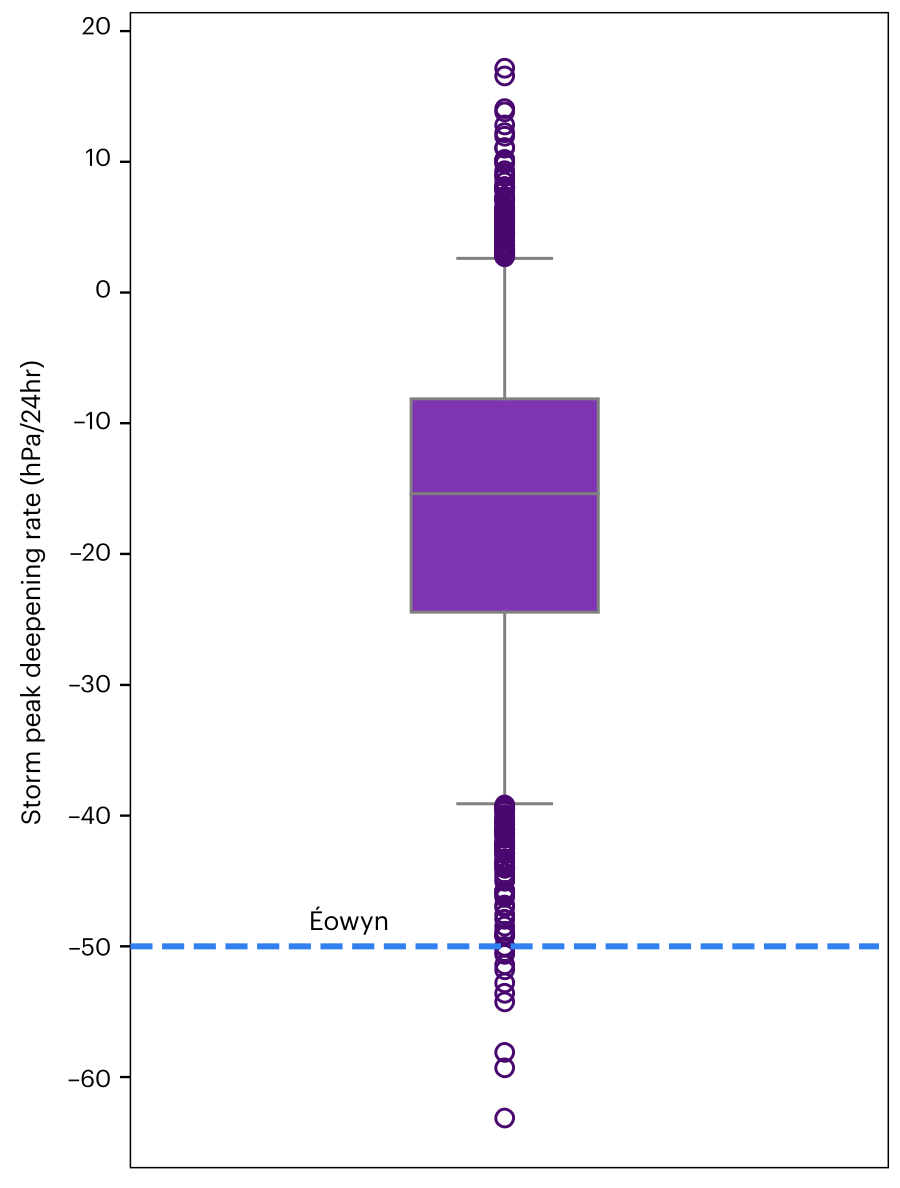
Figure 1(b). Boxplot of maximum deepening rates for cyclones impacting the U.K. and Ireland. Rapid cyclogenesis is defined as a pressure drop greater than 24 hectopascals in 24 hours. Whiskers extend from the 5th to the 95th percentile. Data from ERA5 for DJF 1959/60 – 2024/25.
A broad footprint of strong winds across northwest Europe
Éowyn’s high intensity translated into widespread strong wind gusts. Gusts exceeding 20 meters per second (approximately 45 miles per hour) affected the entire British Isles, parts of northwestern France and western Norway (Figure 2).
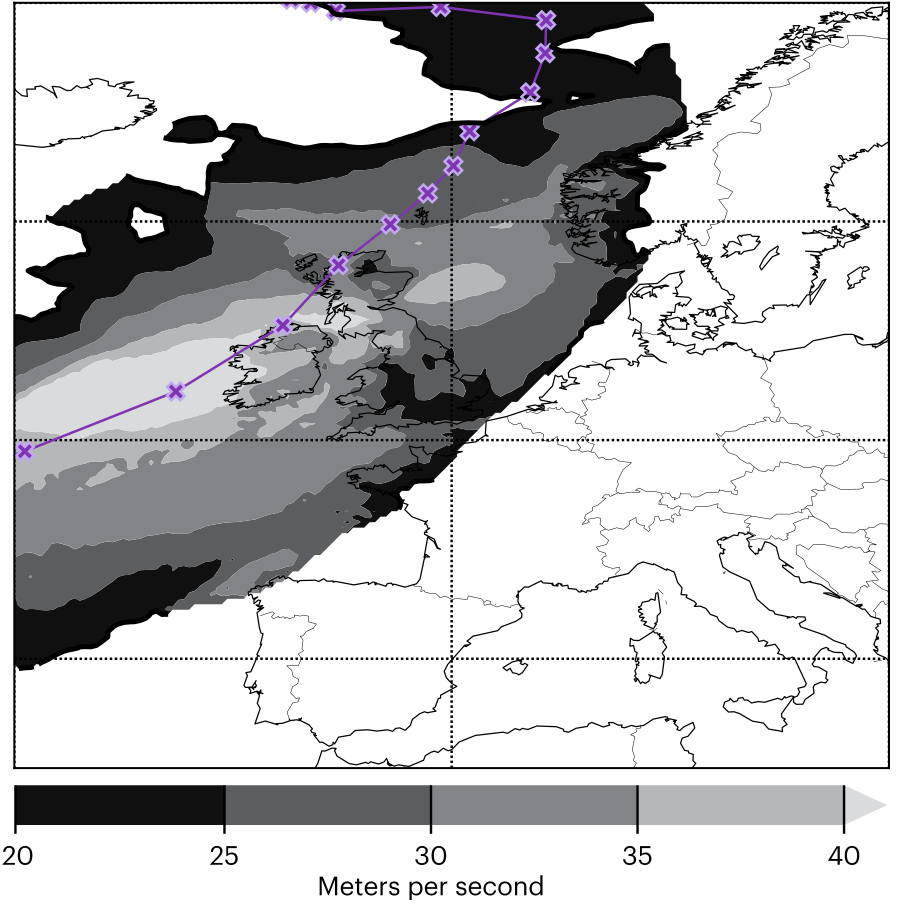
Figure 2. Maximum three-second gust footprint of Storm Éowyn in meters per second at each gridpoint from January 25 to 28, 2025. Data are from ERA5 at 25 kilometers resolution. Violet crosses indicate the cyclone’s track.
The strongest gusts were concentrated near the storm’s center, particularly to the west of Ireland. In the most exposed land regions, ERA5 data show gusts greater than 40 meters per second, including near Mace Head, where the maximum observed gust of 51 meters per second was recorded. Similarly strong gusts are also found in ERA5 between Ireland and the southwest of Scotland, impacting the Isle of Arran and the Firth of Clyde.
Éowyn’s winds caused widespread power cuts to nearly one million people[4] as well as damages to infrastructure[5], property[3] and forestry[6]. There were also significant coastal impacts associated with storm surge and high waves; however, due to the timing of Éowyn at a low/ebbing tide, the impact could have been significantly worse had it occurred during a period of higher tides.[7]
Natural Catastrophe Program 2025
For 2025, we feature top experts sharing their views on the leading perils affecting the industry and factors acting to raise risks worldwide.

Related content
Even so, the modest overall loss reflects that fact that Éowyn’s strongest gusts struck relatively sparsely populated areas, while major cities such as Dublin and Belfast experienced only moderate gusts (20–30 meters per second). If gusts the strength of Éowyn’s had occurred over more populated regions, the impact could have been significantly higher, highlighting the need to continuously understand these counterfactual scenarios for the current climate.[8]
Record-breaking gusts, but within historical bounds
Breaking Ireland’s national wind gust record[2] naturally raises questions about rarity. Using a database of windstorm tracks and a windstorm return period model developed at the University of Exeter,[9] Éowyn’s gusts, although the strongest in the ERA5 windstorm database for Mace Head (46.1 meters per second),[10] were found to be not entirely without precedent.
Several historical storms delivered gusts above 40 meters per second, meaning that while Éowyn was exceptional, it fits within the known envelope of extremes for exposed coastal regions.
The estimated return period of Éowyn’s gust at Mace Head (using ERA5 data with 25 kilometers resolution) is around 45 years (Figure 3). Due to there being several other storms of comparable strength in the historical records, the return period of Éowyn could be as low as 15 years. Using the return period estimates, the modeled 200-year return level at this resolution is about 51 meters per second, suggesting a potential for gusts stronger than Éowyn for this region.
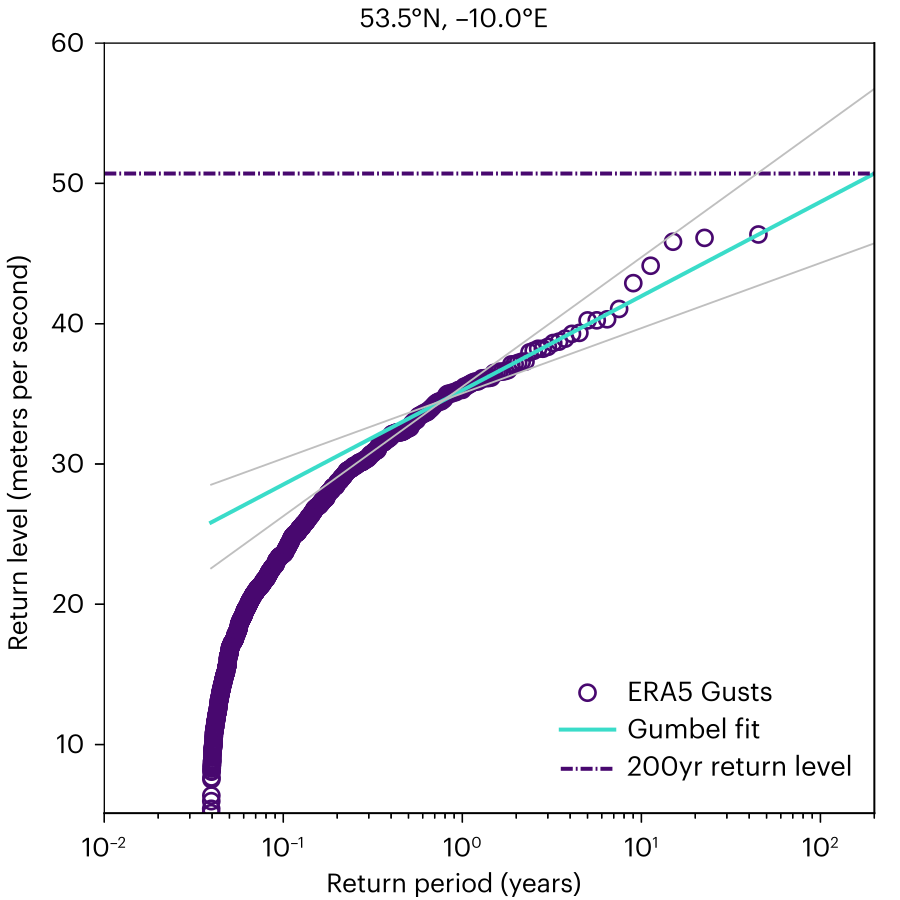
Figure 3. Return period of gusts at the location of Mace Head (53.5°N, 10°W). Violet circles are the ERA5 windstorm gusts, with the blue line being the model fit. Light grey lines are 95% confidence intervals, and the 200-year return level is indicated by the dot-dash line.
An indication of future severity?
Although Éowyn set new gust records and underwent rapid cyclogenesis, its characteristics largely fall within the range of historically observed extremes for the British Isles.
Recent research suggests that annual windstorm severity may increase by around 3% per decade due to climate change,[11] implying that storms like Éowyn could become more frequent or intense in future decades.
By studying the drivers, footprints and consequences of extreme storms today, we are better equipped to refine models, improve resilience strategies and anticipate how European windstorm risk may evolve in a changing climate.
However, Éowyn itself does not, in isolation, signal a definitive shift in windstorm risk. It reflects what is already possible within the bounds of natural variability — a reminder that extreme events can occur even in cooler or less anomalous climates.
Critically, events such as Éowyn offer valuable opportunities to strengthen our understanding of risk. Even though this was a near-miss event, windstorms such as Éowyn may cause catastrophic damages and losses. By studying the drivers, footprints and consequences of extreme storms today, we are better equipped to refine models, improve resilience strategies and anticipate how European windstorm risk may evolve in a changing climate.
References
- Met Office. Storm Éowyn, 24 January 2025. (2025). Return to article
- BBC. Storm Éowyn brought record breaking winds to Ireland. (2025). Return to article
- PERILS. EUR 619M — FIRST PERILS INDUSTRY LOSS ESTIMATE FOR WINDSTORM ÉOWYN. (2025). Return to article
- The Guardian. Storm Éowyn: Man killed and 725,000 properties without power in Ireland. (2025). Return to article
- STV News. £22m leisure centre roof damaged in Storm Eowyn remains ‘fragile’. (2025). Return to article
- The Irish Post. Full extent of storm damage to forests of Ireland revealed. (2025). Return to article
- University of Galway. Tidal research reveals power of Storm Éowyn and unfathomable near-miss. (2025). Return to article
- Dixon, M. et al. Counterfactual analysis of Storm Ciarán from an insurance viewpoint. Weather, 80(4), 108–111. (2025). Return to article
- Priestley, M. D., K., et al. Return levels of extreme European windstorms, their dependency on the North Atlantic Oscillation, and potential future risks. (2023). Return to article
- The reason for this discrepancy to the recorded gust is due to the ERA5 resolution (25 kilometers), compared to the point observation of the weather station. Return to article
- Priestley, M. D., K., et al. Forced trends and internal variability in climate change projections of extreme European windstormfrequency and severity. (2024). Return to article
Authors

Contact

If gusts the strength of Éowyn’s had occurred over more populated regions, the impact could have been significantly higher, highlighting the need to continuously understand these counterfactual scenarios for the current climate.