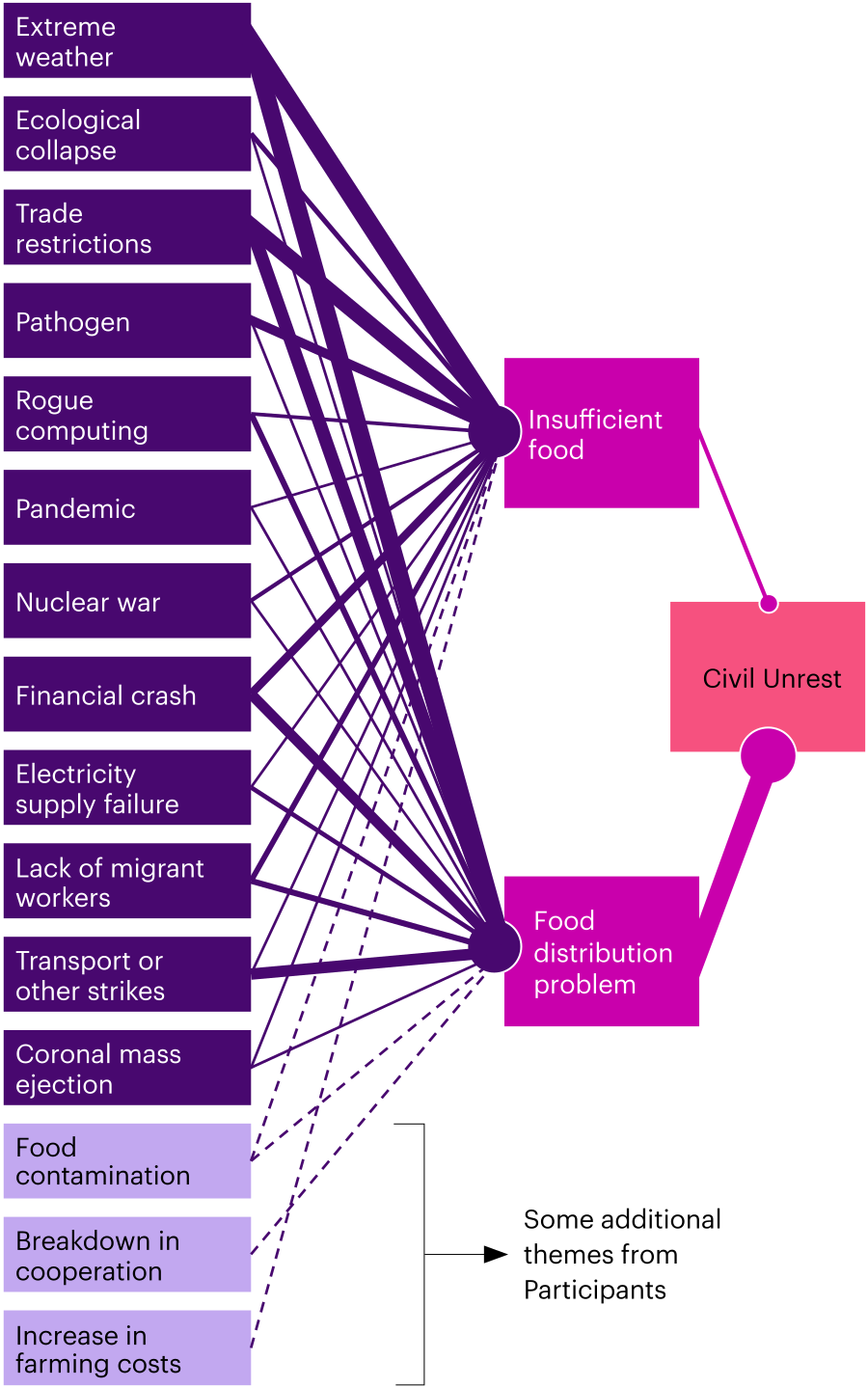
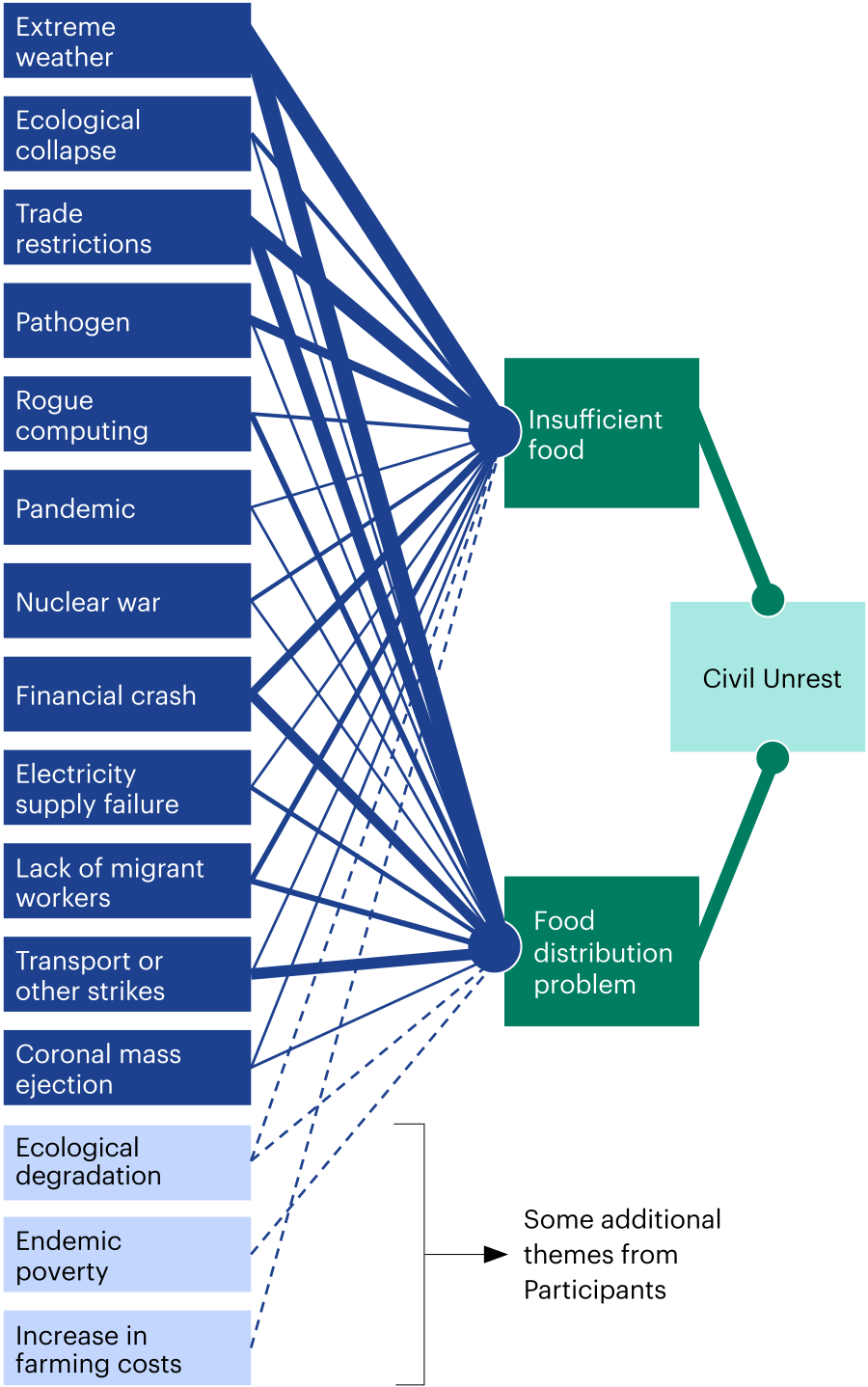
To explore how these end pathways might be reached, experts were queried using a backcasting approach to ask how each Food System Scenario might have arisen. Multiple-choice options were provided based on the list of drivers from a conceptual model of plausible UK catastrophic risks, with the experts asked to choose up to 3 as the most likely cause of the food system scenario, noting that the causes might have occurred individually or in combination.
“Backcasting is a scenario approach that starts with and end state and offers a number of different strategies to reach this situation. It can enable stakeholders to introduce more imaginative new ideas — opening up dialogue on risk and challenging assumptions.”
Lucy Stanbrough,
WTW Research Network
Key insights
“Extreme weather (including storm surges, flooding, snow, drought)” was the most common response across both Scenarios and timescales, with over two thirds of participants choosing it in every case. Over 85% of participants chose this option as the cause of insufficient UK food over 50 years. We note that extreme weather disruption can apply to both domestic production and imports although no separation was made in the categorisation in relation to this.
Insufficient UK food scenario
- For Scenario 1 (insufficient UK food) the next most popular cause was ‘trade restrictions or protectionism’, which was also a common response for the 50 year time period. This likely reflects the relatively high import rate of UK food (estimated at 46%) and the risk of this being curtailed in the event of geopolitical instability or other international food scares.
- On the 10 year timescale about a quarter of participants also cited ‘animal or plant pathogen’ and ‘financial crash’ as being likely causes in the event of insufficient UK food.
- The fraction of participants selecting ecological collapse as the cause of insufficient food over the next 10 years was around 20%, but this rose to over 60% for the 50 year timeframe.
UK food distribution problem scenario
- For Food System Scenario 2 (food distribution problem) and the 10 year time period, 40 to 50% of participants selected “trade restrictions or protectionism”, “transport or other strikes” and “financial crash”, in addition to the 67% who selected “extreme weather”.
- Around 20% chose “lack of migrant workers”, “breakdown of electricity supply” and “computer virus, rogue AI or similar”. It was perhaps surprising that only around 10% of participants chose “pandemic” despite the disruption that arose during Covid-19, perhaps because of the adaptations that already occurred in the food system as a result of the pandemic e.g. product consolidation and legislation responses to modified labelling.
- For Food System Scenario 2 (food distribution problem) and the 50 year time period, 9 of the causes were selected by around or above 20% of participants, with “ecological collapse”, “animal or plant pathogen” and “pandemic” becoming important relative to the 10 year period.
Challenge perspectives
The survey provided space for experts to list other potential causes, beyond those provided in the multiple-choice list. Within the 10 year timeframe several participants highlighted food contamination events (biological, natural chemical or artificial chemical) as a particular concern. Such events have immediate impacts on food availability but also can create wider indirect impacts across the food system. For example, previous food contamination events such as diesel fuel in Spanish olive oil, melamine in Chinese milk powders, or e-coli in organic bean sprouts created direct health impacts on consumers, and alongside other contamination events such as horse meat in meat supplies, lowered trust between consumers and food suppliers.
Over a 50 year timeframe many participants highlighted similar issues to the 10 year timeframe although ecological degradation (as opposed to ecological collapse) including soil depletion, insect populations and water storage were added as a key area of concern. However, both ecological collapse and degradation were seen as regionally specific although if located in areas of high significance for food production they can have a significant impact.
COVID-19, Brexit and the cost of living crisis have shown the UK is already exposed to certain risks. The food system faces significant challenges. We are experiencing an increasing number of extreme weather events, many driven by climate change. It is entirely possible that in the coming decades extreme weather will cause major crop yield failures across multiple breadbaskets. We need a food system designed not for optimal efficiency, but for resilience.
Professor Sarah Bridle Chair of Food,
Several participants highlighted causes arising from wider societal risks including endemic poverty, increased population (through immigration) and an ageing population. Consumer responses during food system catastrophes such as panic buying or hoarding can also act as a feedback on the scale of impact. In addition an increase in the costs of farming inputs (energy, feed, labour), difficulty in securing labour, a move to use land to service carbon or biodiversity markets, or the impacts of trade deals that undermine domestic production, could see a reduction in UK domestic production as farmers leave the industry.
Interconnected and compounding risks
Finally, several participants highlighted that a single causation acting as a trigger by itself is less likely than a number of the causes acting in an interconnected as well as cascading (one cause can then trigger another) way, and scenarios can be compounding. An extreme weather event, for example, could lead to ecological collapse or impact transport infrastructure, and the likely pathway to catastrophe will include feedback between events with unrest building up over time. As one participant highlighted “something happens, markets panic, governments panic, debt/inflation goes up, geopolitical tensions ramp up then when the next thing happens everything is more jittery”.
Key inputs in the food supply chain are diverse and interface with an array of different markets. Causes for our food supply scenarios are, therefore, not entirely independent; extreme weather events could, for example, affect the availability of migrant labour as well as crop yield. It may also be that extreme weather only threatens food systems
when compounded by other, independent hazards. That is, weather events of a magnitude that may have historically generated little detectable influence on food systems could be catastrophic if occurring alongside war or a pandemic.
Disruptions to UK CO2 supplies occurred both in 2018 (as a result of unexpected maintenance and operational challenges for fertiliser plants) and 2021 (as a result of complex economic factors ultimately caused by an increase in the price of natural gas), with impacts felt across the food and drink industry including: abattoirs, chilling, fresh produce packaging, greenhouses, and drinks manufacturers.
All of the survey results were combined into a “backcasting map” (Figure 3) where the line thicknesses are proportional to the number of participants choosing the causal connection. This illustrates the significant shift in perceptions on the 50 year timeframe and the strong focus on extreme weather.
While participants did rank the causes, with extreme weather, ecological collapse and trade restrictions all deemed important, it is clear from the responses, and in particular the free text responses, that participants felt that it is a combination of factors, rather than a single driver that would cause disruption. Additionally, some participants felt that both scenarios (an absolute lack of sufficient calories in the UK and a food distribution problem) are mutually reinforcing. The knock-on from one causal factor to another can create cascading risks, with particular combinations of factors such as extreme weather and degraded ecosystems being reinforced through economic and demographic instability, resulting in trade restrictions and protectionism. Therefore, we see that the conceptual model of the food system from our expert participants involves a complex system with multiple interdependencies and connections.
How can I prepare my organisation?
Governments and businesses need to be ready for multiple scenarios, reactive when the exact situation doesn’t unfold as scripted, and awareness of the art of the possible. The WTW Research Network believes access to research is essential to building resilience and a smarter way to risk. A full copy of the outputs of this research can be found in Sustainability.
This is essential as political and other risks can emerge rapidly, even in societies that have enjoyed stable business conditions for years. There will be enormous reliance on the forces of law and order in those potentially extreme scenarios and, realistically organisations can only work towards mitigating the impacts of such events within reason. Nevertheless, there are actions organisations can take now to embolden their stance and boost their preparedness for the eventuality of civil unrest.