At our recent WTW 2023 North America Utility Forum, employers discussed the challenges of balancing a split workforce with a large number of essential workers in the field or at a worksite.
During the pandemic, the industry faced unique employee wellbeing challenges. Many conference participants discussed the need to review and update employee wellbeing program design and services to improve support and engage employees regardless of where they work.
Ahead of the conference, we already had from recent survey results a sense of some of the needs and challenges of employees in the utility and energy sector:
- Flexible work arrangements are the second benefit that is most important to U.S. energy and utility employees, according to our 2022 Global Benefits Attitudes Survey.
- When employers were asked to identify their top priority for their health and wellbeing programs in 2023, energy and utilities organizations identified managing health insurance cost as number one (63% utility, 67% general industry), and employee wellbeing as number two (54% utility, 67% general industry).
How employers responded to the pandemic
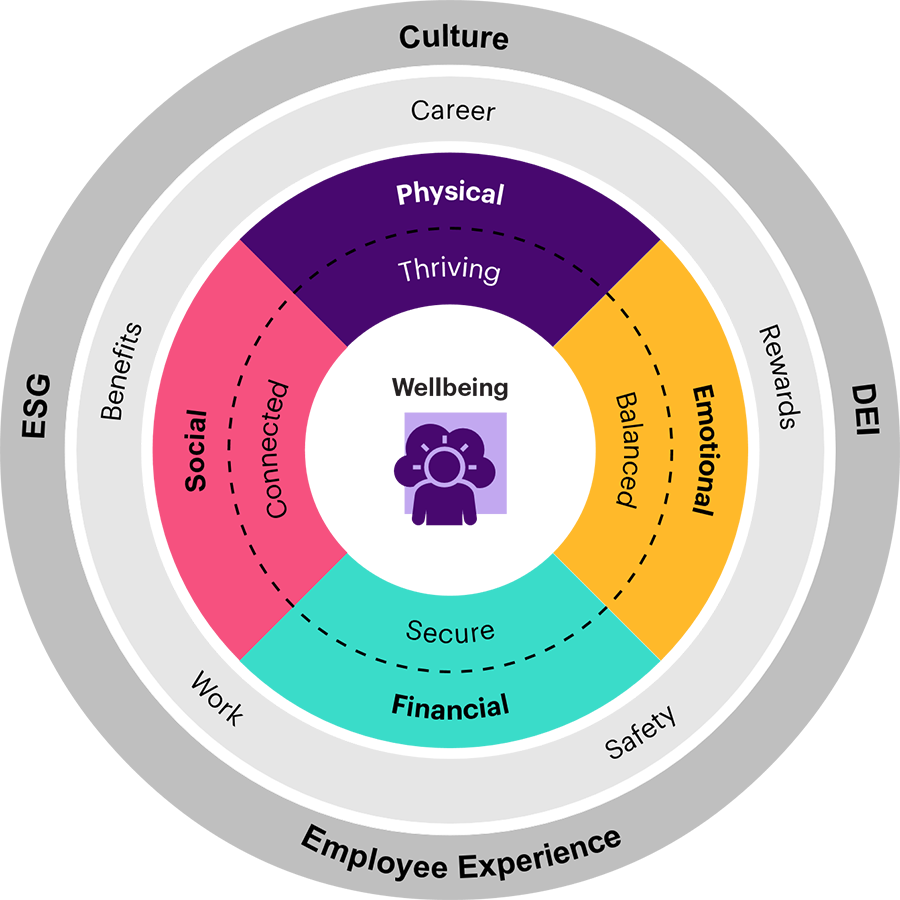
During the pandemic, employers emphasized supporting emotional and social wellbeing. They also recognized the value of taking an integrated approach to physical, financial, emotional, and social wellbeing and focused on diversity, equity, and inclusion (DEI) as data supports that employee struggles often intersect multiple dimensions.
As the demand for talent continues amid a tight labor market, the dynamics of work will continue to evolve. For example, employers expect 55% of employees will work hybrid or fully remote over the next three years, according to our 2023 Dynamics of Work Survey. Meanwhile, 75% of organizations report they are on a three-year journey to differentiate and customize their employee wellbeing programs from competitors to better attract talent.
While motivation varies, we typically see three key drivers of change and investment in employee wellbeing:
- Helping employees engage in wellbeing to increase engagement, productivity, and collaboration.
- Reducing costs related to stress, burnout, healthcare, and absenteeism.
- Building organizational resilience in alignment with environmental, social and governance (ESG) and DEI priorities, total rewards, work policies and health and safety objectives.
How utilities are updating employee wellbeing programs
What can other companies with essential workers learn from leading utility organizations about updating employee wellbeing programs?
- Utilities and other industries with essential workers and manual labor have struggled to compete with industries that can offer greater flexibility in how and when work is performed. For organizations with essential workers, reevaluating time off, caregiving and other leave programs are vital to compete for talent.
- Employee wellbeing programs need to be flexible in recognition of a diverse workforce and to help attract/retain new types of talent. Segmenting programs can help better meet the wellbeing needs of employees and their families and drive engagement.
- Digital solutions are great, but without continued investment, employee engagement will drop. Program designs and associated communications need to be reevaluated and modernized regularly. Employee listening is an effective tool to prioritize investments and improve outreach.
- Often, managers are the first point of contact for essential workers. Your leaders and managers need to be empowered and trained to have meaningful conversations related to employee wellbeing beyond being aware of existing programs.
- Employee wellbeing programs should be tailored to engage the entire workforce. As work populations vary, and some workplace settings are unique, employee wellbeing programs should be designed to accommodate and engage employees regardless of where they work.
Utilities offer a great example of balancing a split workforce that requires continual updates to employee wellbeing program design and services in order to better support and engage employees regardless of where they perform their work.