
ESG strategy helps deliver results
Three-quarters of board members participating in our Fostering Corporate Governance and Enhancing Board Effectiveness Survey agree that a coherent environmental, social and governance (ESG) strategy with clear priorities helps create sustainable organizational value and stronger financial outcomes. Consequently, having a well-established ESG strategy can help support an organization’s global stewardship efforts. Achieving alignment with business strategy (85%) and regulatory pressure (71%) were key factors in motivating board members to prioritize ESG.
Board members anticipate that human capital and governance will continue to be the top ESG priorities over the next three years.
Figure 1: ESG priorities now and in three years
Figure 1: ESG priorities now and in three years| Current | In 3 years | |
|---|---|---|
| Top 3 | Top 3 | |
| Social – human capital (e.g., employee health and safety, diversity, equity and inclusion) | 82% | 79% |
| Governance (e.g., ethics, reporting, and risks) | 70% | 68% |
| Environmental – climate | 52% | 56% |
| Social – other areas (e.g., customer, community) | 60% | 60% |
| Environmental – other areas | 28% | 28% |
Board members in Europe and Asia Pacific are much more likely to rank climate as a top ESG priority for their boards than board members in other markets; by contrast, board members in North America and the Middle East and Africa region are much more focused on human capital and governance.
There is an expectation among approximately six in 10 board members globally (59%), in particular those in Europe (76%) and the Middle East and Africa region (89%), that their organizations consider ESG developments and trends in every country and market where they have significant operations.
ESG oversight will continue to be a matter for the full board
Most respondents agree that ESG oversight is primarily the responsibility of the full board, with some specific discussions delegated to the committees. Over the next three years, it is expected that this will remain true but that an increasing number of organizations will establish committees to engage in more robust discussions about ESG strategy and priorities.
Respondents that use a combination of full board and other committees expect that three in five organizations (60%) will have a stand-alone ESG, corporate social responsibility (CSR) or sustainability committee in three years, up from 45% today.
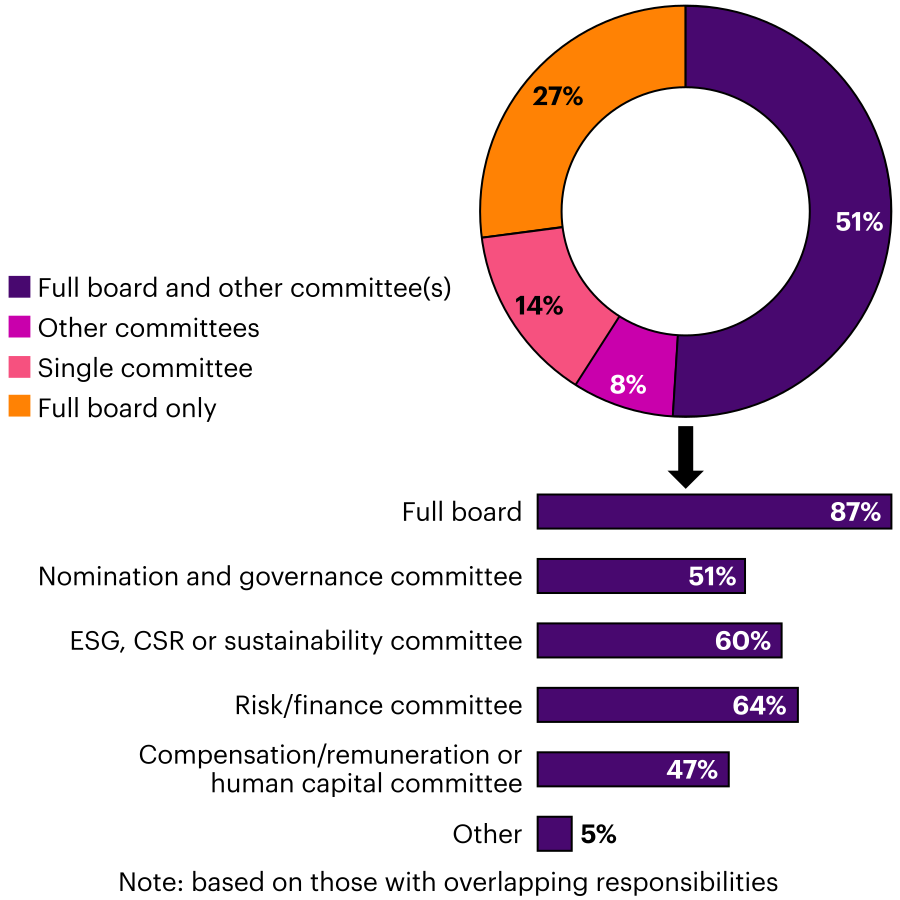
Figure 2: ESG oversight in three years
Climate skills present as education and learning opportunities
Roughly half of respondents (48%) report that their boards currently have limited skills and expertise to provide effective oversight of the climate risks and opportunitiesto which they are exposed. While it is expected this will improve over the next three years, gaps will likely persist.
Figure 3: Gaps in addressing environmental issues to persist
| % who lack skills | |||
|---|---|---|---|
| Currently | Expected in 3 years | Increase of “have skills” | |
| Social – human capital (e.g., employee health and safety, diversity, equity and inclusion) | 15% | 4% | +11% |
| Governance (e.g., ethics, reporting, and risks) | 15% | 3% | +12% |
| Environmental – climate | 48% | 18% | +30% |
| Social – other areas (e.g., customer, community) | 26% | 8% | +18% |
| Environmental – other areas | 46% | 23% | +23% |
Governance risks are increasingly complex
Some board members feel more time and resources are needed in this area
Our findings highlight the need for a stronger focus on governance risks. Only approximately three in five respondents (62%) think their board has dedicated sufficient time and resources to this area.
The lack of sufficient time and resources in governance can potentially expose organizations to a range of risks. Cybersecurity and data privacy along with management succession planning are the most commonly cited governance risks. Other top risks include board effectiveness, board composition and diversity, and compliance and disclosure.
Boards are open to third-party assessments and support to improve board effectiveness
Approximately three-quarters of board members (74%) say their current board evaluation process is effective. The most commonly cited criteria for evaluating board effectiveness is the assessment of board composition, skills and diversity.

Related content
While only roughly 10% of boards use facilitated board workshops and third-party assessments of board dynamics and culture to evaluate board effectiveness today, respondents expect the use of these assessment techniques to triple in the next three years.
Key board composition considerations
Most board members view professional background and gender representation as the most important criteria when considering board composition. In addition, roughly three in five (58%) cite cultural fit as a priority. Racial/ethnic representation in board composition (50%) is more top-of-mind for boards in North America (67%) than in other markets (26%), largely due to demographic differences. Board members also cited “overboarding” as a potential concern when considering board selection.
Boards regard management succession planning as a key board responsibility. Most respondents (55%) shared that their boards review the succession plan of their organizations for their entire executive leadership team, with a third (35%) reviewing the plan for the executive leadership team only and a fifth (20%) also reviewing the plan for the next level of leaders.
The Nasdaq Center for Board Excellence (the “Center”) and WTW joined forces to provide insights into modern boardroom dynamics to help boards find new ways of assessing and improving effectiveness. The Center promotes a culture of innovation, curiosity and long-term value creation for like-minded leaders to drive positive and meaningful impact. Through resources and experiences, the Center seeks to advance the overall quality of corporate governance across the expanded governance community.
A total of 349 board members from 44 countries across six continents participated in the Fostering Corporate Governance and Enhancing Board Effectiveness Survey, conducted between February 15 and April 7, 2023.
Download
| Title | File Type | File Size |
|---|---|---|
| Board members see improvement opportunities in climate skills and governance within sustainability strategiesPDF | .6MB |
Use of workshops and third-party assessments to evaluate board effectiveness expected to triple.