


Executive summary
Organizations spend considerable time preparing for unexpected disruption, yet the greater challenge may lie in preparing for the changes they can already see:
- Workforce mobility has slowed and employees are delaying retirement
- Healthcare costs are rising at record levels, while economic volatility and inflation risks persist
- Employees need support in building financial security, health and career resilience
- AI is reshaping work but requires substantial investment before productivity gains are realized
None of these trends are surprising on their own, but together they are reshaping the economics of total rewards. There’s a risk in treating these developments as isolated issues when in practice they reinforce one another. Structural workforce costs are rising while the returns from AI transformation will take time to emerge.
This changes the decisions leaders need to make today. The organizations best positioned for what’s next will be those that recognize these signals early, understand how they interact and take action today.
The illusion of workforce stability
At first glance, many organizations appear to have stability within their workforce. Voluntary turnover has moderated in many markets, and employers that struggled with widespread resignations only a few years ago are now seeing stronger retention and more predictable staffing levels.
It is tempting to read lower turnover as a sign of stronger engagement, but the picture is more complex. WTW’s recent employee sentiment research shows that nearly one in five employees (18%) say they feel “stuck” in their current job, meaning they are not actively looking for another role but would leave if they could. Economic headwinds, affordability concerns and fewer external opportunities are contributing to this kind of “job hugging.”
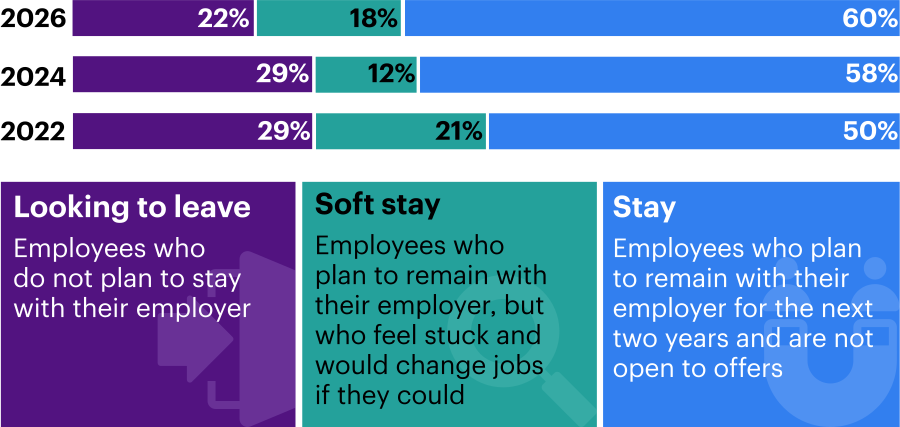
Employee intentions to stay, soft stay or leave their employer, 2022-2026
Global employee sentiment shows a growing proportion of employees planning to remain with their current employer. While the percentage of employees intending to leave has declined since 2022, the proportion of employees who feel "stuck" in their role and would leave if they could has increased since 2024, highlighting a potential risk of hidden disengagement within an otherwise stable workforce.
Three categories are displayed: "Looking to leave" (employees who do not plan to stay with their employer), "Soft stay" (employees who plan to remain with their employer but feel stuck and would change jobs if able), and "Stay" (employees who plan to remain with their employer for the next two years and are not open to offers). Results show: 2022 - 29% looking to leave, 21% soft stay, 50% stay; 2024 - 29% looking to leave, 12% soft stay, 58% stay; 2026 - 22% looking to leave, 18% soft stay, 60% stay. Source: 2026 Global Benefits Attitudes Survey (Global).
(Source: 2026 Global Benefits Attitudes Survey, Global)
Retirement patterns are shifting too, as longer life expectancy, concerns about retirement readiness and ongoing financial uncertainty lead more employees to delay retirement.
Employee concerns regarding retirement
73%
Concerned about having sufficient income to cover expenses throughout retirement*
59%
Expect to be worse off in retirement than their parents’ generation
*Aged 50 or more
(Source: 2026 Global Benefits Attitudes Survey, Global)
Because longer tenure tends to concentrate employees toward the upper end of salary ranges, reduce opportunities for advancement and slow talent movement across the organization, these shifts put pressure on compensation and healthcare costs, retirement obligations, succession planning, career progression and skills development.
Employers face these mounting fixed workforce costs at a time when organizations also need to increase their investment in reskilling, workforce transition and the capabilities required for future growth. What looks like stability today may in fact be the early warning signs of tomorrow’s cost structure.
When cost pressures become structural
Many organizations budget on the assumption that today’s elevated cost environment will ease over time, but the evidence suggests otherwise. Demographic changes, advances in medical treatment, prolonged economic uncertainty and shifting employee expectations mean that the forces driving total rewards costs are now structural rather than cyclical.
Healthcare illustrates the shift. Medical trends remain persistently high, driven by short-term price inflation and longer-term factors such as aging populations, chronic disease, rising behavioral health utilization and continued growth in specialty pharmaceuticals. In APAC, medical costs are projected to rise at double-digit rates in 2027, averaging 13.9%. In the U.S., specialty drugs, including GLP-1s and cell and gene therapies, are pushing pharmacy spend toward 50% of total healthcare costs and trend rates to 11%.
The same pressures extend across the broader rewards portfolio. Productivity growth, often a key element of sustainable real wage growth, has weakened significantly across developed economies, and medium-term growth forecasts remain below pre-pandemic levels.
The result is a more challenging environment for workforce investment. Employee expectations for pay continue to rise, but slower economic and productivity growth are limiting organizations' ability to keep pace.
When employee expectations change, investment priorities change
These economic pressures are also changing how employees evaluate rewards. Over half of employees globally say they are not financially secure, even as their physical, emotional and social wellbeing has improved.
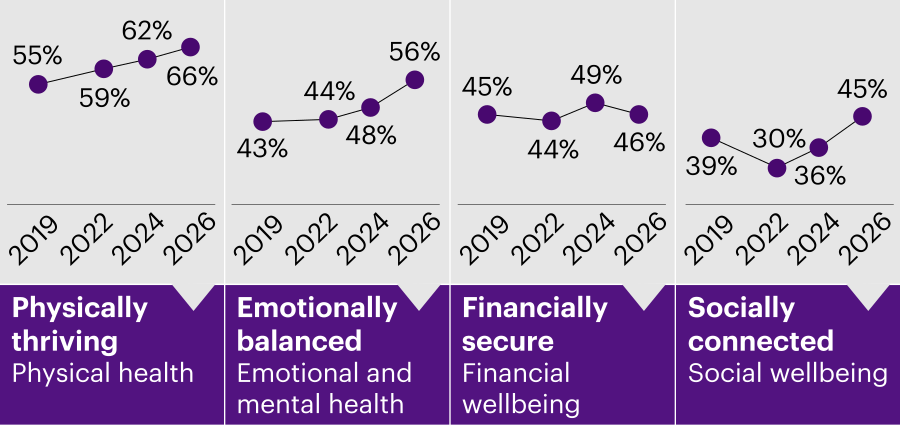
Employee wellbeing trends, 2019-2026
Employee wellbeing has improved across several dimensions since 2019, particularly physical health and emotional wellbeing. Financial security remains the lowest-rated wellbeing measure, with fewer than half of employees reporting they are financially secure in 2026.
Physical health increased from 55% in 2019 to 66% in 2026. Emotional and mental health increased from 43% to 56%. Financial security changed from 45% in 2019 to 46% in 2026. Social wellbeing increased from 39% to 45% over the same period. Source: 2026 Global Benefits Attitudes Survey (Global).
(Source: 2026 Global Benefits Attitudes Survey, Global)
Employees look to their employers for answers and help. In our latest global employee sentiment research, when looking to join a new organization, employees prioritize pay, job security, flexible work and core company benefits – all of which are connected to broader financial security and resilience.
Employee priorities reflect a focus on financial security
| Global | Asia | CEEMEA | Latin America | North America | Western Europe |
|---|---|---|---|---|---|
| Pay | Pay | Pay | Pay | Pay | Pay |
| Job security | Job security | Job security | Core company benefits | Job security | Job security |
| Flexible work arrangements | Core company benefits | Career opportunities | Career opportunities | Flexible work arrangements | Flexible work arrangements |
| Core company benefits | Working environment | Core company benefits | Bonus opportunity | PTO and leave policies | Interesting work |
| Bonus opportunity | Bonus opportunity | Bonus opportunity | Job security | Core company benefits | Working environment |
| Working environment | Flexible work arrangements | Working environment | Flexible work arrangements | Bonus opportunity | Bonus opportunity |
(Source: 2026 Global Benefits Attitudes Survey, Global)
Employers, meanwhile, must weigh these preferences against constrained budgets and long-term business objectives, and often favor mechanisms that preserve future flexibility and allow targeted investment. As a result, the rewards employees value may not always be the ones employers prioritize.
That tension should prompt organizations to consider which commitments they would not introduce if they were designing the rewards portfolio from scratch today, and what should be stopped, simplified or redesigned to fund future-critical priorities. Otherwise, organizations risk accumulating “rewards debt”: layers of cost and complexity that become harder to unwind each year.
AI changes the economics before it changes the outcomes
AI shows long-term potential to create new sources of value for businesses. However, before organizations can realize those gains at scale, they must invest in technology, organize and clean data, implement governance processes, redesign the workforce and build new skills. All of these activities require investment and compete for the same capital as other strategic priorities.
Early evidence suggests that AI implementation also comes with hidden workforce costs. Seventy-seven percent of employees report increased workload and stress since AI was introduced, and two-thirds say AI is contributing to burnout rather than reducing it.
While organizations expect AI to improve productivity, there is significant uncertainty about when these benefits will materialize and how large they will be. If meaningful gains are slow to emerge, employers may find themselves squeezed in the short term, with labor and benefits costs continuing to rise well before productivity improves enough to offset them.
The cost of waiting is therefore not neutral. Delaying decisions about work redesign, skills and rewards can lock in legacy costs while postponing the productivity gains needed to fund transformation, making today’s difficult choices materially more expensive in the coming years.
Acting before tomorrow becomes more expensive
Healthcare inflation, low turnover, delayed retirements, critical skills shortages, evolving employee expectations and AI investment are converging to create an environment in which workforce costs are becoming structural. Because these pressures are connected, they are best managed together rather than as a series of separate challenges.
To prepare now, organizations should update workforce assumptions, revisit long-term budgets and forecasts, strengthen governance and pressure-test total rewards decisions against the following criteria:
- Does the decision create a one-time expense or a compounding fixed-cost commitment?
- Do we sufficiently understand employee preferences, and have we identified where trade-offs could be made within the rewards portfolio? Are there programs that should no longer be prioritized in light of our cost trajectory and of our changing workforce?
- Which employee or business outcome is expected to improve, and how will it be measured?
- Should the investment be broad-based or concentrated on critical skills, performance, market gaps or financial vulnerability?
- What deferred retention, capability, productivity or equity cost arises if the organization does nothing?
- Are there opportunities to improve employee appreciation through better awareness and utilization of a program in lieu of a program enhancement?
Organizations that balance competitiveness, affordability, capability, fairness and effective delivery of pay, benefits, wellbeing, and career programs will be better positioned to sustain performance and maintain employee trust.
Success will depend less on predicting the future accurately than on preparing for what is already in view.
Questions for leadership teams
- Which workforce assumptions underpinning our rewards strategy are no longer true?
- Where are structural cost pressures likely to emerge over the next three to five years?
- How should our pay, benefits, career and wellbeing strategies evolve as our workforce becomes more AI-fluent?
- Which rewards investments create the greatest value for employees and the business?
- Do we have the governance needed to anticipate change rather than respond to it?
- Which rewards commitments would we not introduce if we were designing the portfolio from scratch today?
- Where is the organization accumulating “rewards debt” by delaying difficult decisions or maintaining programs that no longer support its workforce strategy?
WTW works with organizations around the world to translate these emerging challenges into practical strategies that optimize total rewards, improve employee outcomes and create lasting business value.
Authors


Related services
Related solutions

Total Rewards
Build a dynamic, data-driven total rewards strategy that aligns pay, benefits, wellbeing and careers to manage disruption, strengthen workforce resilience and deliver measurable business and employee outcomes.
AI Workforce Transformation
Turn AI ambition into workforce redesign for real business value.
Compensation Strategy and Design
Effective compensation design, which directs all aspects of your rewards programs, is based on a solid, well-informed philosophy.
Executive Compensation and Board Advisory
WTW provides strategic, research-driven executive compensation and board advisory consulting to help boards and management balance talent and governance risks while driving business performance.
Work Transformation
Discover the future of work and how work transformation can help your organization adapt and thrive.
Pay Equity and Pay Transparency
We help you become confident on pay equity and ready for greater pay transparency.
Health and Benefits
We partner with you to build an effective employee benefits program that sustains a healthy, high-performing workforce.