
Most real estate investors remain focused on the four traditional sectors: office, retail, industrial, and apartments. While these sectors continue to dominate institutional portfolios, they can overlook a growing opportunity set within “alternative” real estate.
We believe these alternative sectors can be attractive not only because they are typically underinvested and more fragmented, but also because they are supported by long-term, demographic-driven demand. In many cases, these structural tailwinds create more resilient and less cyclical income streams.
It was within this context that we began exploring the alternative real estate universe more deeply in the early 2010s, leading to our partnership with a specialist investment manager focused on alternative real estate, such as education, healthcare, and storage. This manager has been a pioneer in these demographic and needs-based sectors, with a long track record of investing in assets supported by essential demand. The investment case was compelling at the time:
- Demographic tailwinds: Aging populations support demand for senior housing; increasing participation in higher education underpins student accommodation; and rising healthcare utilization drives demand for medical office assets.
- Market growth and liquidity: These sectors were experiencing strong growth, creating a deep opportunity set for institutional capital alongside improving exit liquidity.
- Fragmented market: Ownership across these sectors remains highly fragmented, providing opportunities for scaling platforms through aggregation.
- Operator expertise: Operational capability is critical in these sectors. The investment manager has built an extensive network of operating partners over time, providing a competitive advantage in sourcing and managing assets.
- Defensive attributes: Many of these assets benefit from “sticky” demand. For example, residents in senior housing are less likely to relocate unless driven by health-related needs.
Continuum of needs
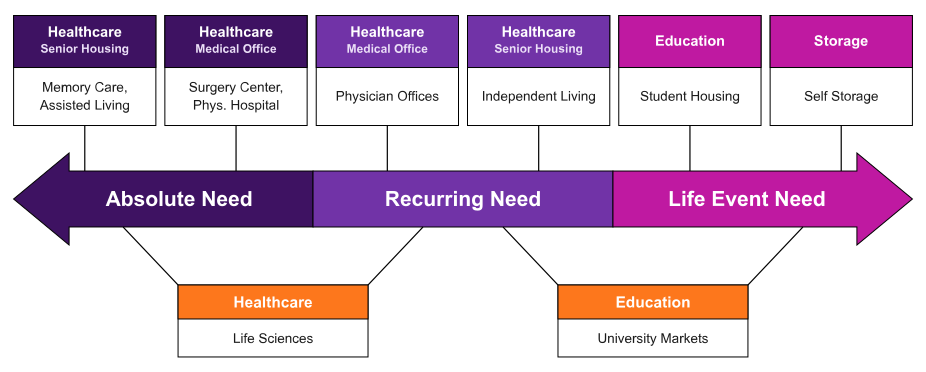
Alternative real estate sectors can benefit from long-term demographic trends and resilient demand drivers.
Designing and launching differentiated investment strategies through a decades-long partnership
WTW's relationship with this alternative real estate manager dates back to the mid-2000s and originated through local network connections within the investment industry. What started as a connection within the real assets investment community evolved into a long-standing partnership, with WTW providing early insight and guidance on a strategy that was, at the time, both niche and operationally complex. Our relationship deepened in 2012 as we grew our U.S. real estate research business, as part of a broader effort to expand client portfolios into alternative real estate sectors. Following detailed due diligence, we implemented the U.S. strategy across client portfolios and within our real assets discretionary solutions. Building on this foundation, we collaborated with the investment manager on additional product design and new strategy launches.
Looking beyond mainstream real estate sectors can support more resilient portfolios
For many investors, real estate allocations remain anchored to traditional sectors that can be more exposed to cyclical economic drivers.
Introducing alternative sectors alongside traditional real estate exposures can improve diversification and provide more resilient income profiles, particularly during periods of market stress. Additionally, these strategies offer exposure to long-term structural “mega-trends” (i.e. aging population and urbanization) which we believe are important contributors to sustainable performance over time. The resilience of these strategies has been evident in recent periods. For example, while real estate valuations broadly have struggled following interest rate hikes, the manager’s U.S. strategy outperformed the open-ended U.S. real estate index by 590 bps p.a. net of fees during the three-year period following interest rate hikes in 2022, with income representing a large portion of the total returns.[1] This demonstrates the diversification potential of alternative sectors, the added stability of income-driven returns, and the potential for consistent returns across market cycles.
Leveraging sector-specific expertise to access overlooked opportunities
Our partnership with this alternative real estate manager helps us capture what we seek in a “hidden gem”: specialist expertise in underappreciated sectors, backed by prevailing, long-term demand drivers. While many investors remain anchored to traditional real estate, alternative real estate offers access to more resilient income and structural growth opportunities. Combined with our early partnership and access, this is a differentiated and often overlooked way to enhance real estate portfolios.
While alternative real estate sectors may offer attractive diversification and income characteristics, investors should also consider the associated risks. These investments may be subject to leverage risk, liquidity constraints, changing economic and market conditions, interest-rate sensitivity, operational execution risk, and sector-specific risks that could adversely affect property values and investment returns.
Footnotes
- Index refers to NCREIF-ODCE (Open-End Diversified Core Equity) Equal Weighted which measures the investment performance of open-end commingled private real estate funds pursuing a core strategy. The three-year performance period reflects April 1, 2022, through March 31, 2025. The performance quoted represents past performance. Past performance is not a reliable indicator of future returns.Return to article
Disclaimer
This document was prepared for general information purposes only and does not take into consideration individual circumstances. The information contained herein should not be considered a substitute for specific professional advice. In particular, its contents are not intended by Towers Watson Investment Services, Inc., and its parent, affiliates, and their respective directors, officers, and employees (“WTW”) to be construed as the provision of investment, legal, accounting, tax or other professional advice or recommendations of any kind, or to form the basis of any decision to do or to refrain from doing anything. The information included in this presentation is not based on the particular investment situation or requirements of any specific trust, plan, fiduciary, plan participant or beneficiary, endowment, or any other fund; any examples or illustrations used in this presentation are hypothetical. As such, this document should not be relied upon for investment or other financial decisions and no such decisions should be taken on the basis of its contents without seeking specific advice. WTW does not intend for anything in this document to constitute “investment advice” within the meaning of 29 C.F.R. § 2510.3-21 to any employee benefit plan subject to the Employee Retirement Income Security Act and/or section 4975 of the Internal Revenue Code.
This document is based on information available to WTW at the date of issue and takes no account of subsequent developments. In addition, past performance is not indicative of future results. In producing this document WTW has relied upon the accuracy and completeness of certain data and information obtained from third parties. This document may not be reproduced or distributed to any other party, whether in whole or in part, without WTW’s prior written permission, except as may be required by law.
Views expressed by other WTW consultants or affiliates may differ from the information presented herein. Actual recommendations, investments or investment decisions made by WTW, whether for its own account or on behalf of others, may differ from those expressed herein.
Author
Contacts