
Key takeaways:
- Redesign work around the opportunities created by AI.
- Focus investment where AI can deliver measurable value.
- Equip managers to lead adoption of AI workflows and redirect capacity.
- Align skills, performance and reward with changing work.
Few functions are more exposed to AI than HR. HR shapes the relationship between the organisation, its people and the work itself and all three are changing at a new pace. That was clear across this year's HR conference season. In speaker sessions and in our conversations, HR leaders focused less on whether AI will change work and more on what it means for jobs, skills, workforce requirements and organisational performance
In times of significant change, it is natural to worry about what lies on the other side. Much of the debate around AI has been shaped by that instinct, with predictions ranging from mass job displacement to the end of work as we know it. Yet the mood this year felt markedly different. Concern has not disappeared, but it is no longer the dominant theme. In its place is a growing recognition that AI is already changing how work gets done and a genuine sense of excitement about the opportunities that creates.
As a result, attention has turned to practical questions: how roles should be redesigned as AI takes on some tasks and augments others; how organisations can reskill employees and redeploy talent into higher-value work; how workforce planning should evolve as skill requirements change; and how reward should recognise new forms of contribution. These are now questions of business strategy, not HR alone.
Four priorities repeatedly came to the fore. Together, they cover what changes in the work, where to invest first, who makes adoption happen and how contribution is recognised and rewarded. In each, HR can and should take a lead role.
01
Redesign work around the opportunities created by AI
While much of the discussion this year has centred on ‘role compression’, our experience suggests a different story is emerging. Organisations are not simply looking at how to do the same work with fewer people. They are rethinking how work is structured, redesigning roles around new capabilities and creating potential opportunities for employees to move into higher-value activities as AI takes on routine tasks.
AI will reshape work, but the outcome is unlikely to be a simple story of workforce reduction. Gartner’s Hype Cycle for the Future of Work 2026 predicts that by 2029, 30% of employees laid off due to AI replacement will need to be rehired, potentially at significantly higher cost. The more valuable question is how AI can augment human capability and open new sources of value. That starts with a clear view of the work itself: the tasks within each role, which of them AI can take on or support, and where human judgement remains essential. Not every future role can be predicted, but HR is best placed to lead that redesign rather than react to it.02
Focus investment where AI can deliver measurable value
The range of possible AI use cases can be overwhelming. HR can bring focus by working with leadership teams to identify where AI is likely to have the greatest impact on the work and the workforce and starting there. Define what success looks like before launch, not only in productivity terms but in workforce terms: how much capacity is released, where it is redirected and which skills are needed as a result. Communicate clearly what is changing and why. Early, measurable results build the case for the next investment and make it easier to scale.
03
Equip managers to lead adoption of AI workflows and redirect capacity
Managers are where AI strategy meets day-to-day work. They decide how tasks are reallocated, see where AI is and isn't being used, and shape how their teams experience the change. That makes equipping them one of HR's most important levers.
One of the most practical roles managers play is deciding what happens to the time AI frees up. Without clear direction, that capacity risks being absorbed into existing workloads. With it, managers can redirect time towards work that creates greater business impact. HR can provide the framework, guidance and support; managers make it happen in practice.04
Align skills, performance and reward with changing work
In any period of significant change, organisations are forced to reconsider what creates business value and how that value should be recognised and rewarded. As AI becomes more deeply embedded in work, technical proficiency will matter, but so too will broader competencies such as judgement, critical thinking, creativity, collaboration and the ability to apply AI effectively to solve business problems. Recognising those capabilities depends on a current view of the skills the organisation needs and the skills it already has, both of which will keep changing.
This raises important questions for HR leaders. How should compensation philosophies evolve as AI changes the nature of work and contribution, and as traditional processes are automated? Which skills, behaviours and outcomes should be reinforced through reward? Do traditional approaches to job design, market pricing, performance management and incentives still reflect how value is created? And as AI drives productivity gains, how should the benefits be shared?
As roles continue to evolve with AI, reward frameworks will need to provide clear answers to what the organisation values, how contribution is measured and where it chooses to invest for future success.
From discussion to action: Where HR leads next
The shift from theoretical discussion in 2025 to practical action in 2026 gives HR a clear mandate. The function can connect AI investment with work redesign, workforce planning, capability development, management practice and reward. HR's active involvement will help organisations build trust, manage adoption and turn technological potential into workforce and business value.
Where to start depends on where your organisation is today. The AI transformation journey below sets out the path from AI explorer to enterprise reinventor. Use it to identify your starting point and the workforce decisions needed to move forward.
HR leaders have an opportunity to shape how work changes, where human judgement matters most and how people are equipped and rewarded for new forms of contribution. The priority is not to introduce AI everywhere, but to identify the next opportunities to create value, redesign work around them and build the conditions for successful adoption.
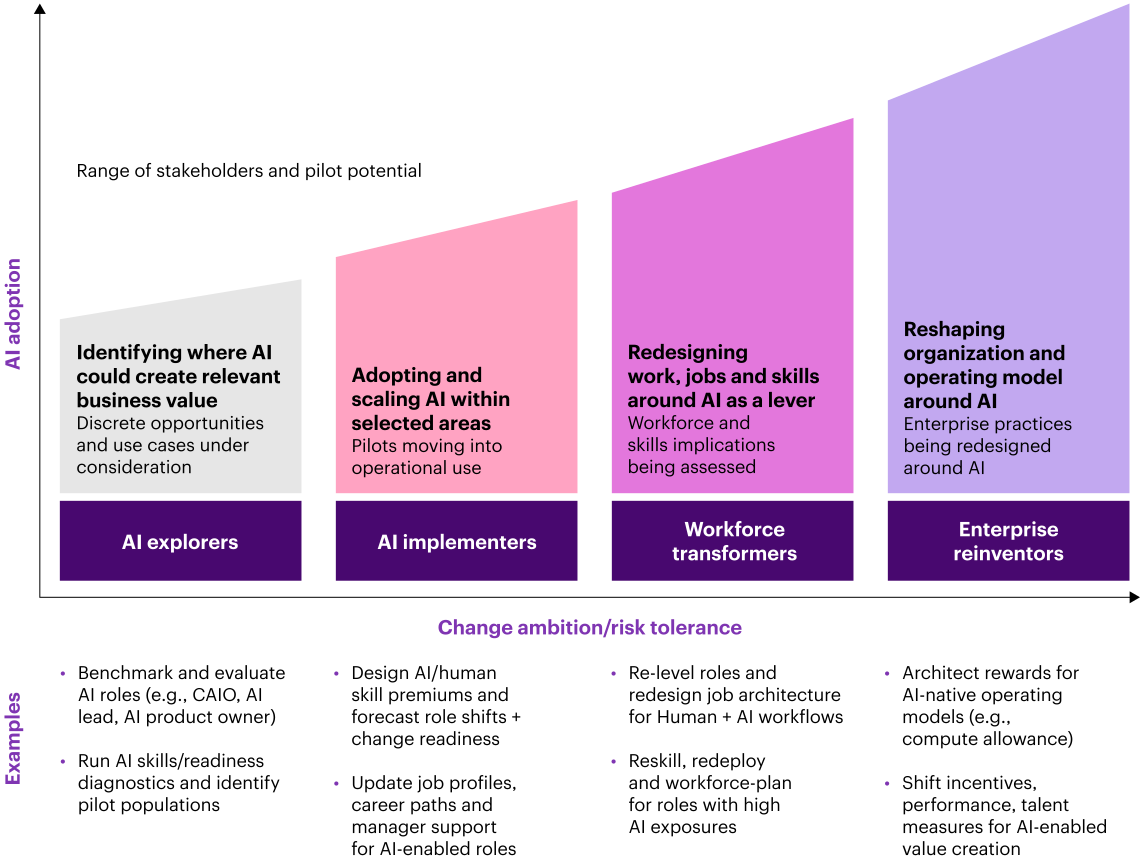
Where does your organization sit on the transformation journey?
Wherever you are on that journey, the priority is not to introduce AI everywhere. It is to identify the next opportunities to create value, redesign work around them and build the conditions for successful adoption. That is where HR leaders can shape how work changes, where human judgement matters most and how people are equipped and rewarded for new forms of contribution.
WTW works with HR and business leaders to move from AI experimentation to measurable workforce value. We combine advisory expertise across work design, skills, talent and reward with data and technology that help organisations understand how work is changing and act on it.
Explore how WTW is helping organisations move from AI experimentation to measurable workforce value. Explore AI Workforce Transformation.
Related solutions

Career Analysis and Design
In today’s competitive business environment, a meaningful career framework is crucial for your employees to thrive.
Talent Intelligence
Talent Intelligence provides data-driven insights that empower informed decisions on the factors that shape your workforce, enabling your organization to leverage talent to its fullest potential.
Work Transformation
Discover the future of work and how work transformation can help your organization adapt and thrive.