AI’s build-out is reshaping commodity markets and creating new sources of return
Artificial intelligence is becoming one of the most powerful investment themes shaping markets. Yet AI is not built on software alone — it relies on physical resources. As demonstrated below, the expansion of data centers, electricity networks, and energy infrastructure is increasing demand for commodities such as copper, aluminum, natural gas, and uranium, creating a direct link between the digital economy and the real economy.
Figure 1. Projected global supply-demand balance for select minerals (2035e)*
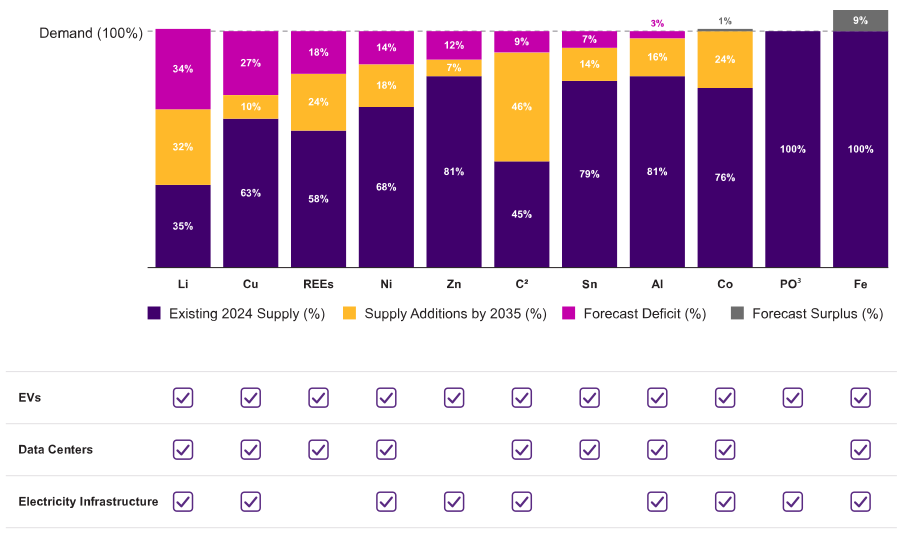
Several critical minerals face projected supply deficits by 2035, increasing reliance on new projects.
Source: Notes: Balances are indicative and synthesized from multiple sources based on available information; figures may vary by source and assumptions (e.g. demand trajectories, project start-up/ramp, recycling rates). * Percentage shortfall/surplus = (forecast refined supply – forecast refined demand) ÷ forecast demand (2035e). ² C: Graphite ³ PO: Phosphates.
Chart source: World Economic Forum, From Minerals to Megawatts: Building Resilience for EVs, Data Centers, and Power Grids. Data sourced from IEA, Shanghai Metals Market, CRU Commodities Research Unit, Association for Iron & Steel Technology, International Lead and Zinc Study Group, USGS, Silver Institute, Research and Markets, International Tin Association, International Aluminum Institute, S&P Global, Wood Mackenzie, and Kearney analysis.
At the same time, inflation remains more persistent than many expected, while years of underinvestment and geopolitical fragmentation have constrained supply across key commodity markets. Together, these forces are creating an attractive backdrop for commodities.
Importantly, the opportunity is not uniform. Energy, industrial metals, precious metals and agricultural markets are responding differently to changing economic, political, and supply dynamics, creating opportunities that extend beyond broad commodity market exposure.
For investors, the challenge is not identifying the theme but accessing it efficiently.
Many commodity investment strategies gain exposure through futures contracts rather than direct physical ownership. Commodity futures can be highly volatile and may involve leverage, margin requirements, liquidity constraints, counterparty exposure, and sensitivity to geopolitical and regulatory developments, all of which can affect returns.
At the same time, commodity markets have become increasingly unpredictable. According to the World Bank, commodity-price volatility has been higher than in any decade since at least the 1970s[2]. Investors must also navigate decisions around futures structures, implementation vehicles and exposure selection, each of which can also materially influence investor outcomes.
Against this backdrop, implementation matters. We believe a combination of complementary specialist strategies offers a more effective way to participate in this evolving opportunity set.
Accessing the opportunity with a multi-manager strategy
Commodity markets are increasingly shaped by distinct demand, supply, and geopolitical drivers, making a selective approach particularly important. Combining managers with distinct investment disciplines can reduce concentration risk, broaden opportunity capture, and improve portfolio resiliency across changing market environments.
Rather than relying on a single forecast, investment style, or commodity sector, a multi-manager structure seeks to generate more consistent outcomes by accessing multiple sources of return potential and risk management simultaneously. Macro managers can express thematic views across markets, specialist commodity managers can exploit market inefficiencies, and systematic strategies can capture persistent trends.
Together, these approaches provide diversified exposure to commodity opportunities, which may include:
Accessing the Broader Commodities Opportunity Set
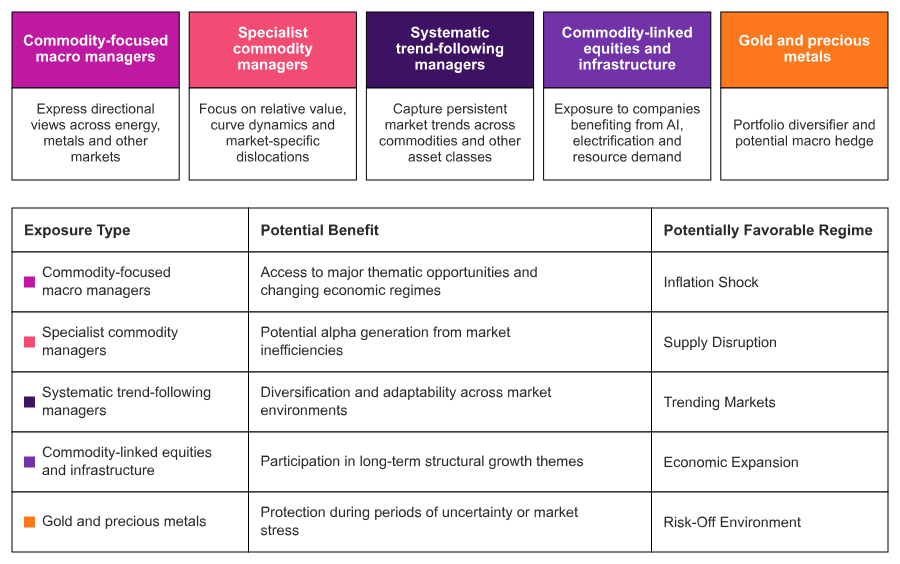
WTW employs a multi-manager approach to seek commodity opportunities across sectors, themes, and market regimes, while leveraging specialist managers to help expand access to a broader set of commodities return drivers and opportunities.
WTW's global manager research platform, covering more than 9,800 managers and 38,000 investment products globally[3], combined with our capital markets expertise and industry relationships, helps investors identify and access high-conviction discretionary, systematic and specialist commodity managers, while our scale can enhance implementation efficiency.
Conclusion
AI is accelerating investment in the infrastructure that powers the digital economy, increasing demand for a range of physical resources. Combined with ongoing supply constraints, this is creating a compelling opportunity set across commodity markets.
Rather than relying solely on direct commodity exposure, investors can access these opportunities through a blend of complementary strategies designed to capture different return drivers and navigate an increasingly differentiated market.
AI may be transforming the digital economy, but its foundations remain physical. Commodities provide a practical way to participate in that transformation while broadening sources of portfolio return potential.
Footnotes
- Bloomberg Commodity Index (BCOM) historical return data, as reported by eVestment. Trailing one-year volatility and maximum drawdown statistics calculated from the index return series as of August 2026. Return to article
- World Bank Group, Commodity Markets Outlook (April 2025), World Bank Open Knowledge Repository. [Dataset containing historical prices and forecasts for gold, silver, platinum, and related precious metals markets] Return to article
- WTW as of December 31, 2025. Return to article
Disclaimer
Futures and options trading involves substantial risk of loss. The highly leveraged nature of commodity interest trading can quickly lead to large losses as well as gains. Past performance is not a reliable indicator of future returns.
This document was prepared for general information purposes only and does not take into consideration individual circumstances. The information contained herein should not be considered a substitute for specific professional advice. In particular, its contents are not intended by Towers Watson Investment Services, Inc., and its parent, affiliates, and their respective directors, officers, and employees (“WTW”) to be construed as the provision of investment, legal, accounting, tax or other professional advice or recommendations of any kind, or to form the basis of any decision to do or to refrain from doing anything. The information included in this presentation is not based on the particular investment situation or requirements of any specific trust, plan, fiduciary, plan participant or beneficiary, endowment, or any other fund; any examples or illustrations used in this presentation are hypothetical. As such, this document should not be relied upon for investment or other financial decisions and no such decisions should be taken on the basis of its contents without seeking specific advice. WTW does not intend for anything in this document to constitute “investment advice” within the meaning of 29 C.F.R. § 2510.3-21 to any employee benefit plan subject to the Employee Retirement Income Security Act and/or section 4975 of the Internal Revenue Code.
This document is based on information available to WTW at the date of issue and takes no account of subsequent developments. In addition, past performance is not indicative of future results. In producing this document WTW has relied upon the accuracy and completeness of certain data and information obtained from third parties. This document may not be reproduced or distributed to any other party, whether in whole or in part, without WTW’s prior written permission, except as may be required by law.
Views expressed by other WTW consultants or affiliates may differ from the information presented herein. Actual recommendations, investments or investment decisions made by WTW, whether for its own account or on behalf of others, may differ from those expressed herein.
Authors
Contacts