


Most organizations don’t set out to build an ‘average’ retirement plan. And with most employees relying heavily on their workplace retirement program, employers want a plan that will engage employees and help them achieve better long-term financial outcomes.
But reality has a way of complicating things. HR teams are stretched thin with plan management activities, employee needs are wildly diverse and the pace of change, from new legislation to investment innovation, just keeps accelerating. Employers are juggling more complexity than ever and often with limited internal resources.
So, how can organizations move from day-to-day plan management to creating a next-generation 401(k) plan?
4 emerging trends in market-leading DC plans
There’s a lot that goes into running a defined contribution (DC) plan, but four key, emerging areas are important to developing a market-leading 401(k).
Pooled Employer Plans (PEPs) as a vehicle for innovation
Multiple employer plans are not new, but new legislation has made this structure significantly more accessible to employers in recent years.
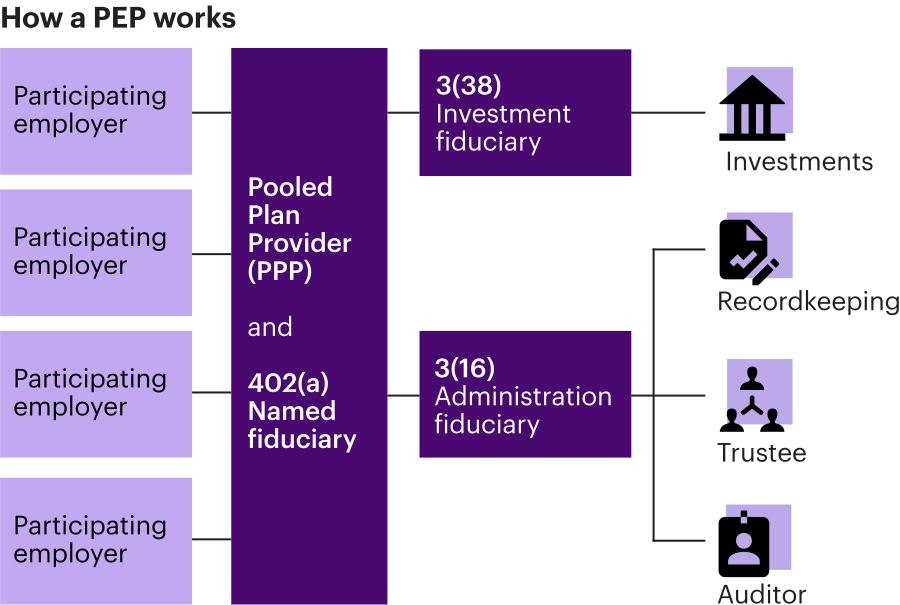
How a PEP works
PEPs allow multiple, unrelated employers to participate in a single, professionally-managed retirement plan.
Born out of the SECURE Act, PEPs allow multiple, unrelated employers to participate in a single, professionally-managed retirement plan. Think of a PEP as a fully outsourced 401(k) that shifts much of the administrative, fiduciary and operational heavy lifting to an organization that has built their business around retirement plans.
Employers still control their core plan design but gain access to expertise, scale and efficiency that would be difficult to achieve on their own.
Why the buzz?
PEPs are gaining real traction. Assets in PEPs have surged to over $30 billion within five years, with continued acceleration expected [1]. That growth reflects a powerful value proposition:
- Reduced effort: Employers can cut time spent on plan management by as much as 75%, freeing teams to focus on strategic priorities [2]
- Lower costs: On average, fees are about 30% lower compared to traditional approaches [3]
- Risk mitigation: Fiduciary responsibilities shift largely to the PEP provider, reducing employer exposure in a world of rising litigation
- Better outcomes: Scale can unlock stronger investments, improved tools and more effective participant engagement
In short, the PEP adoption rate is accelerating as organizations recognize the value of professional management.
PEP myths and misperceptions
Although familiarity with PEPs is growing, some misconceptions still linger.
“PEPs are only for small employers.” Early adopters were largely on the small end of the market, but each year sees larger employers make the move to a PEP. The value proposition of a PEP can appeal to organizations of all sizes.
“Employers lose all control in a PEP structure.” While there are PEPs that limit flexibility, many allow the employers to retain control over plan design while offloading operational complexity.
“PEPs are hard to implement.” With the right provider, implementation can be significantly easier than changing a recordkeeper.
“PEPs are difficult to exit.” Transitioning out of a PEP is generally straightforward if your needs change.
The bottom line is: Not all PEPs are created equal. An important part of assessing if a PEP structure is right for an organization is finding the right partner.
From administration to transformation
By freeing up the time and effort it takes to run a DC plan, PEPs allow organizations to focus on what matters most — helping employees make smarter financial decisions and achieve stronger retirement outcomes.
With built-in analytics, personalized engagement and innovative investment solutions, PEPs can act as a catalyst for actionable intelligence, personalization, flexibility, and investment and income innovation.
Ready to explore what’s possible?
For a deeper dive on PEPs and other key trends impacting today’s mid-market employers, be sure to check out our Today’s 30 webinar series.
And if you’re curious how a Pooled Employer Plan could fit into your retirement strategy, WTW’s LifeSight PEP offers a powerful combination of professional management, advanced analytics and personalized participant experiences. Connect with us to see how you could reduce complexity while improving outcomes.
Footnotes
- Based on publicly available 5500 filings. Estimated 2025 assets reflect growth approximately on pace with growth of $10B seen in 2024. Return to article
- Based on roles and responsibilities and estimated time commitments of a single employer plan versus LifeSight PEP. Actual time savings may vary based on individual circumstances Return to article
- Across over 250 pricing reviews comparing WTW’s LifeSight PEP total plan costs vs. the existing approach we’ve seen approximately 30% average savings as of April 2026 Return to article
Disclaimer
This document was prepared for general information purposes only and does not take into consideration individual circumstances. The information contained herein should not be considered a substitute for specific professional advice. In particular, its contents are not intended by Towers Watson Investment Services, Inc., and its parent, affiliates, and their respective directors, officers and employees (WTW) to be construed as the provision of investment, legal, accounting, tax or other professional advice or recommendations of any kind, or to form the basis of any decision to do or to refrain from doing anything. The information included in this presentation is not based on the particular investment situation or requirements of any specific trust, plan, fiduciary, plan participant or beneficiary, endowment, or any other fund; any examples or illustrations used in this presentation are hypothetical. As such, this document should not be relied upon for investment or other financial decisions and no such decisions should be taken on the basis of its contents without seeking specific advice. WTW does not intend for anything in this document to constitute “investment advice” within the meaning of 29 C.F.R.§ 2510.3-21 to any employee benefit plan subject to the Employee Retirement Income Security Act and/or section 4975 of the Internal Revenue Code.
This document is based on information available to WTW at the date of issue and takes no account of subsequent developments. In addition, past performance is not indicative of future results. In producing this document WTW has relied upon the accuracy and completeness of certain data and information obtained from third parties. This document may not be reproduced or distributed to any other party, whether in whole or in part, without WTW’s prior written permission, except as may be required by law. Views expressed by other WTW consultants or affiliates may differ from the information presented herein. Actual recommendations, investments or investment decisions made by WTW, whether for its own account or on behalf of others, may differ from those expressed herein.
Authors


Today’s 30
A webinar series spotlighting key topics for mid-sized companies