Alpha opportunities are hiding beneath a concentrated surface
Equity markets are increasingly polarized. At the index level, returns are dominated by a small group of mega cap stocks. Beneath that surface, dispersion across sectors, regions and business models remains deep, but is routinely masked by fast‑moving, macro‑driven narratives. For equity long/short investors, this disconnect matters. Alpha today is not scarce—but it is unevenly distributed and increasingly difficult to capture through broad market exposure alone.
For example, for the one-year period ending May 2026, the cap-weighted S&P 500 index outperformed its equal-weighted counterpart by roughly 9 percentage points. Over the past three years, however, this cumulative outperformance is nearly 30%, a stark illustration of how much benchmark returns have depended on a narrow group of winners.
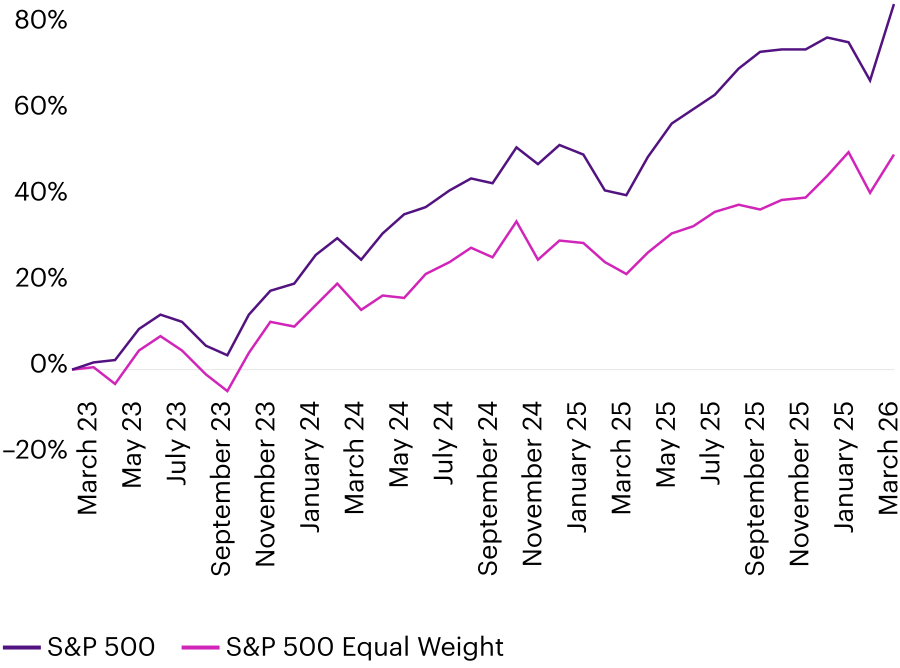
Figure 1: Cumulative Returns: S&P 500 vs S&P 500 Equal Weight
Source: eVestment as of May 2026
Today’s market requires specialist managers
The defining challenge for equity long/short investors today is not a lack of opportunity, but how unevenly opportunity is distributed. Concentration at the top of equity indices limits the value of broad market exposure, while frequent narrative swings around AI, rates or geopolitics create noise that can overwhelm fundamentals.
In this environment, stock‑specific insight and disciplined long-short construction matter more than ever. For example, momentum factor has been flying, justified by a surge in earnings, and has created opportunities on both the long and short side which sector specialists can monetize skillfully (e.g., long semiconductors and tech hardware vs short software and services). The key insight is that narrow breadth plus high index concentration plus strong momentum often produce high dispersion beneath the index surface. And high dispersion is one of the most important conditions for alpha generation.
These dynamics have important implications for manager selection. While global, multi‑sector equity long/short managers offer breadth, it has become increasingly difficult for one team to maintain a best‑in‑class edge across multiple sectors and regions simultaneously—particularly when return drivers are technical, local or structurally complex.
This opportunity set should be considered alongside the inherent risks of equity long/short investing, including manager dispersion, liquidity considerations and the reliance on effective risk management and implementation.
As shown below, dispersion is not only occurring across sectors, but within them. While sector return spreads have widened materially, stock-level outcomes within sectors are also diverging sharply.
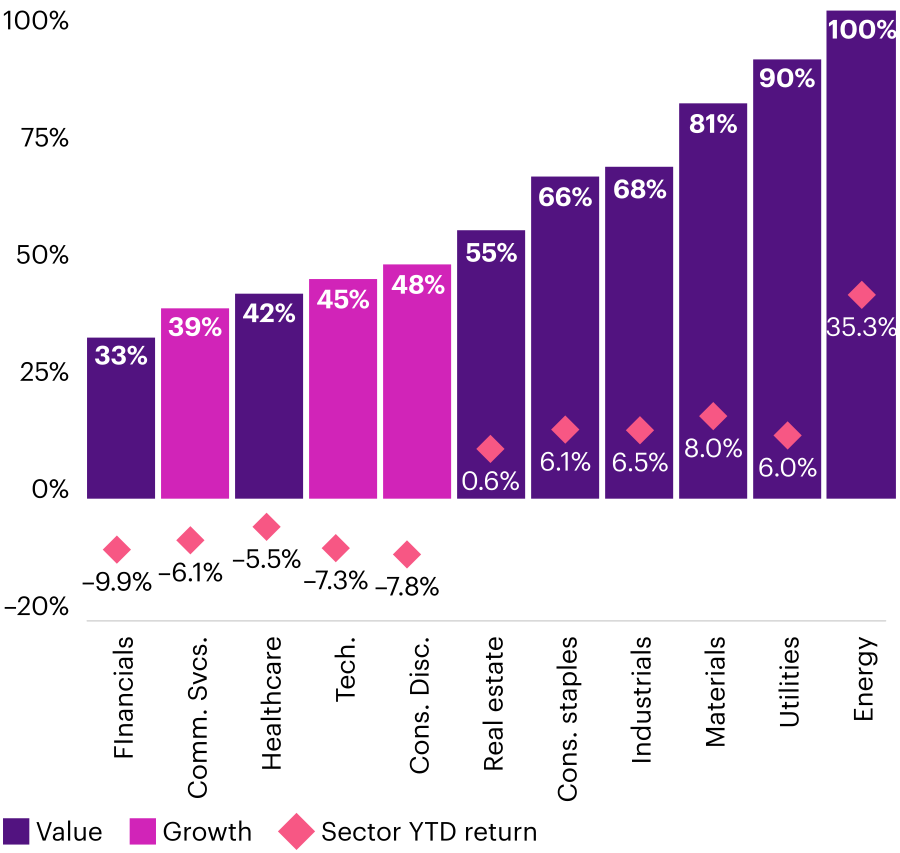
Figure 2. Percent of companies outperforming the S&P 500 by sector (YTD 2026, price return)
Source: Factset, S&P 500, J.P. Morgan Asset Management
Data are as of March 25, 2026.
Past performance is not a reliable indicator of future returns.
Equity long/short returns are driven primarily by stock selection, not market direction. This is where high-conviction specialist managers tend to have an edge. Operating within a narrower universe allows deeper understanding of industry structures, regulatory regimes, cost dynamics and competitive positioning. Specialization also enables more precise risk management, with hedges and position sizing tailored to sector‑specific risk drivers rather than broad market proxies and higher conviction through narrative-driven swings.
In today’s market, specialization is not a constraint – it is a source of diversification. Within our liquid diversifier solutions, specialization is evident through clearly differentiated mandates, research universes and risk frameworks. Exposure is allocated across managers with distinct thematic, regional and implementation focuses who express their edges in different ways, including:
- Deep structural knowledge of capital-intensive sectors such as energy or commodities;
- Expertise in innovation-driven areas such as diagnostics or biotechnology; and
- Deep understanding of the global technology supply-chain or through regionally focused approaches where local market structure and policy dynamics are critical, such as in Asian markets.
Taken together, these differentiated specializations create complementary return profiles. When combined thoughtfully, they result in limited position overlap, modest correlations and a broad, resilient set of return drivers.
Diversification through specialization
The objective for investors is clear: resilient, repeatable alpha that does not rely on market direction. At WTW, we believe the most robust way to harness equity long/short alpha is by constructing diversified portfolios of high conviction specialist managers rather than relying on global generalists. Our equity long/short portfolios are deliberately built across complementary sectoral, thematic and regional specializations, with each manager playing a clearly defined role within the whole.
This approach reflects our broader liquid diversifier philosophy[1]: resilience comes from differentiated sources of return and explicit portfolio design, not breadth for its own sake.
By engaging with WTW’s liquid diversifiers specialists, investors can identify attractive specialists with repeatable edges, clear risk frameworks and complementary exposures, combining them deliberately in diversified portfolios designed to perform across market regimes. Leveraging our scale and long-term manager relationships, we can negotiate favorable fee structures, helping ensure that more of the alpha we identify is retained by our clients.
Footnote
- WTW – 2024 Liquid Diversifier Strategies – A Portfolio Playbook. Return to article
Disclaimer
This document was prepared for general information purposes only and does not take into consideration individual circumstances. The information contained herein should not be considered a substitute for specific professional advice. In particular, its contents are not intended by Towers Watson Investment Services, Inc., and its parent, affiliates, and their respective directors, officers, and employees (“WTW”) to be construed as the provision of investment, legal, accounting, tax or other professional advice or recommendations of any kind, or to form the basis of any decision to do or to refrain from doing anything. The information included in this presentation is not based on the particular investment situation or requirements of any specific trust, plan, fiduciary, plan participant or beneficiary, endowment, or any other fund; any examples or illustrations used in this presentation are hypothetical. As such, this document should not be relied upon for investment or other financial decisions and no such decisions should be taken on the basis of its contents without seeking specific advice. WTW does not intend for anything in this document to constitute “investment advice” within the meaning of 29 C.F.R. § 2510.3-21 to any employee benefit plan subject to the Employee Retirement Income Security Act and/or section 4975 of the Internal Revenue Code.
This document is based on information available to WTW at the date of issue and takes no account of subsequent developments. In addition, past performance is not indicative of future results. In producing this document WTW has relied upon the accuracy and completeness of certain data and information obtained from third parties. This document may not be reproduced or distributed to any other party, whether in whole or in part, without WTW’s prior written permission, except as may be required by law.
Views expressed by other WTW consultants or affiliates may differ from the information presented herein. Actual recommendations, investments or investment decisions made by WTW, whether for its own account or on behalf of others, may differ from those expressed herein.
Authors
Contacts