


Institutional investors are facing an increasingly complex landscape. The year 2025 was marked by significant developments that continue to shape the investment environment. Geopolitical tensions, including shifting trade alliances and Middle East instability, remained a concern. Meanwhile, sweeping legislative changes, such as the 2025 U.S. Budget Bill, permanently altered the tax landscape, incentivizing industrial development and reshaping investment opportunities.
Regulatory reform also played a crucial role. U.S. regulatory agencies are providing clearer guidance on digital assets, opening new doors for innovation. Recent and pending legislation is also laying the groundwork for asset tokenization, while executive orders promoting private assets drew renewed attention to defined contribution (DC) plans. Despite these changes, capital markets have remained resilient as inflation stabilized, the Federal Reserve began to lower rates and questions about economic growth came to the fore.
What are the opportunities ahead for investors?
The changing environment has created new investment opportunities as we look ahead to 2026. Institutional investors face a landscape that demands agility, specialization and a holistic view of portfolio construction. With that in mind, it is important for investors to:
- Re-visit investments to ensure they are aligned with long-term goals and objectives
- Build portfolios that are resilient across market regimes
- Understand the landscape changes and how to capitalize on new investment opportunities
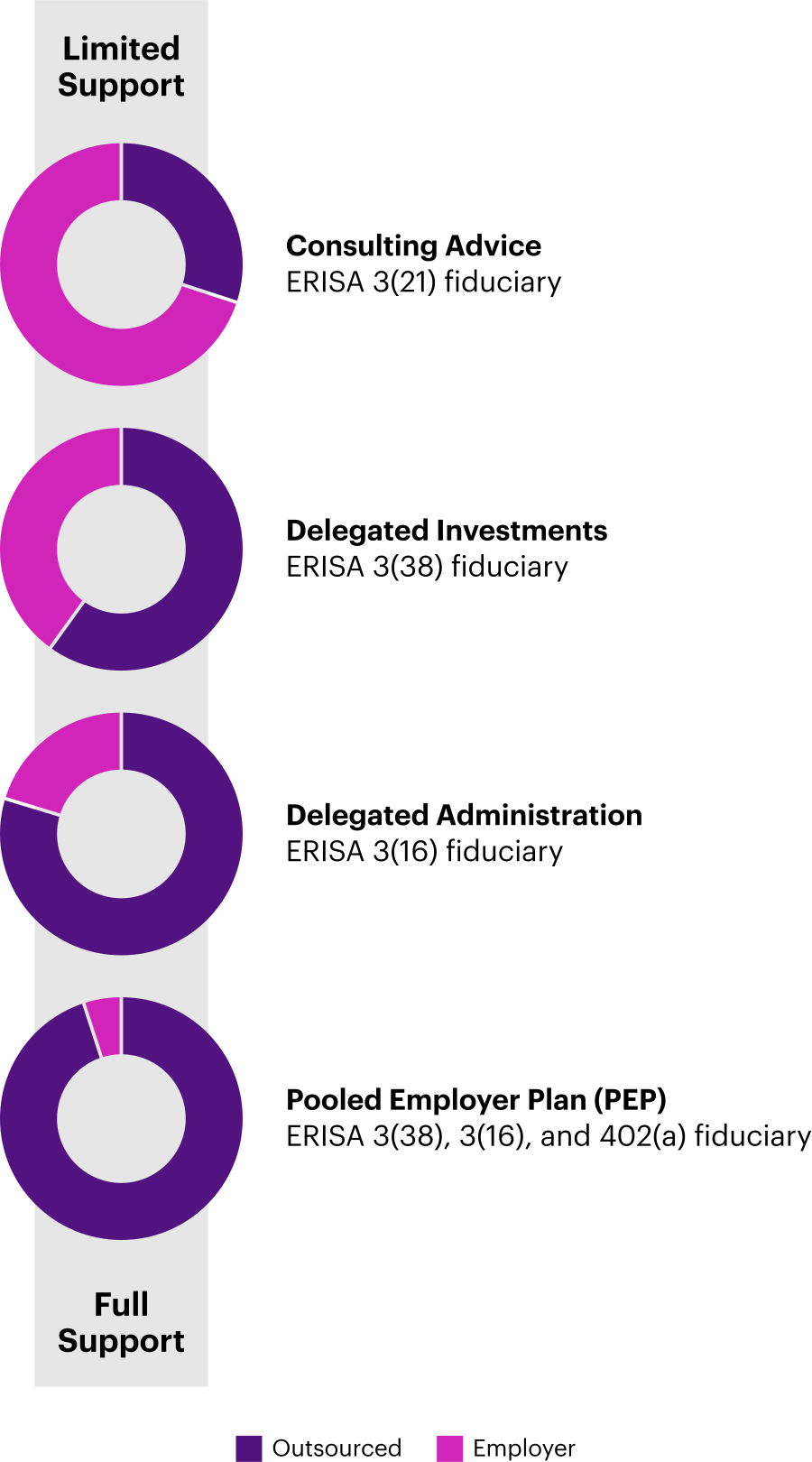
Spectrum of Defined Contribution Plan Support
Source: Georgetown, “Are PEPs Reshaping the Retirement Plan Market?”
It features four donut charts:
Disclaimer
This document was prepared for general information purposes only and does not take into consideration individual circumstances. The information contained herein should not be considered a substitute for specific professional advice. In particular, its contents are not intended by Towers Watson Investment Services, Inc., and its parent, affiliates, and their respective directors, officers, and employees (“Willis Towers Watson”) to be construed as the provision of investment, legal, accounting, tax or other professional advice or recommendations of any kind, or to form the basis of any decision to do or to refrain from doing anything. The information included in this presentation is not based on the particular investment situation or requirements of any specific trust, plan, fiduciary, plan participant or beneficiary, endowment, or any other fund; any examples or illustrations used in this presentation are hypothetical. As such, this document should not be relied upon for investment or other financial decisions and no such decisions should be taken on the basis of its contents without seeking specific advice. Willis Towers Watson does not intend for anything in this document to constitute “investment advice” within the meaning of 29 C.F.R. § 2510.3-21 to any employee benefit plan subject to the Employee Retirement Income Security Act and/or section 4975 of the Internal Revenue Code.
This document is based on information available to Willis Towers Watson at the date of issue and takes no account of subsequent developments. In addition, past performance is not indicative of future results. In producing this document Willis Towers Watson has relied upon the accuracy and completeness of certain data and information obtained from third parties. This document may not be reproduced or distributed to any other party, whether in whole or in part, without Willis Towers Watson’s prior written permission, except as may be required by law.
Views expressed by other Willis Towers Watson consultants or affiliates may differ from the information presented herein. Actual recommendations, investments or investment decisions made by Willis Towers Watson, whether for its own account or on behalf of others, may differ from those expressed herein.