Choose your location
Select the location and the language that you prefer


main content, press tab to continue
As public- and private-sector leaders increasingly integrate economic inclusion and climate change into their policy and growth strategies, investors need to consider the financial benefits and risks which come from the combination effects of this social, environmental, and economic investment.
This is occurring at a time when financial markets are at a pivotal point in the capital cycle. In advanced economies the major central banks are beginning to tighten monetary policy and governments are slowing their pace of spending in response to high growth rates and high inflation.
WTW tracks hundreds of specific geographical and sectoral changes driven by changes in policy, supply and demand, investment, and purpose. This type of probabilistic real-world risk assessment enables us to determine which specific components or uncertainties with respect to prosperity and economic policy, inclusive growth, and climate transitions pose the greatest risk and opportunity to financial investors and countries. With that we can develop investment strategies that manage that risk, reduce the uncertainty, add financial value, and perhaps create positive social or environmental impact.
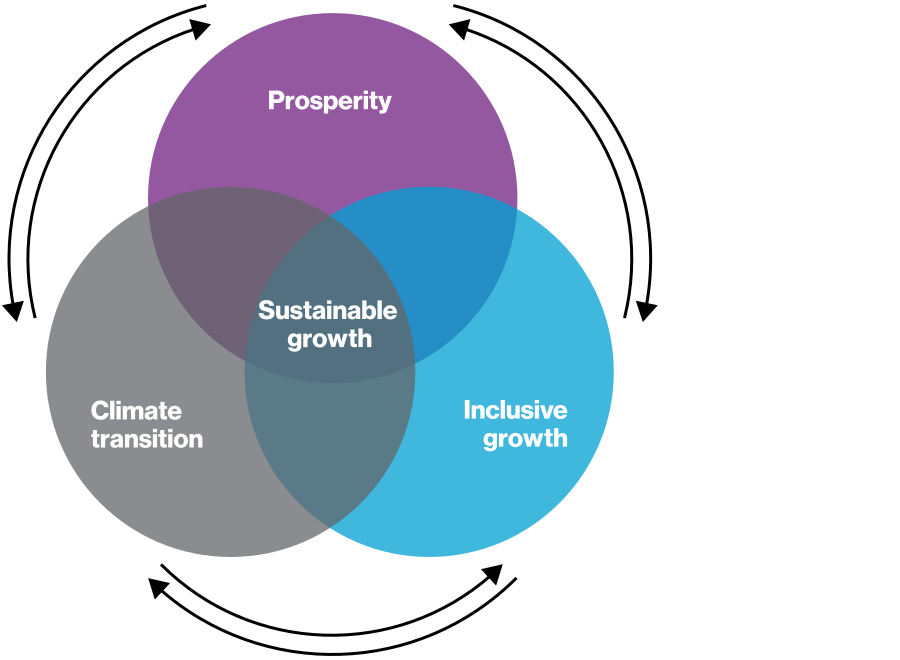
Investors need to consider the multiple interactions between prosperity and growth, inclusion, and climate transition; these can be either self-reinforcing or trade-offs
Prosperity
Our prosperity dashboard aims to help investors track the key features of macro policy and the economy and understand the future risk and return environment. It focuses on the following four categories:
- Economic policy
- Inflationary pressures
- The capital cycle, and
- Asset prices.
For example, demand and supply responses should help manage inflationary pressures. It is useful to track the major pinch points of demand and supply imbalances across the global economy to help understand the likely pressures on future prices. Tightness of capacity persists in certain areas, e.g., selective housing and labour markets. However, the supply-side responses in other areas, e.g., shipping, provides a fact-base that supply will most likely adjust to spending, easing inflationary pressures.
Inclusive growth
Unequal access to economic opportunities and economic inequality can negatively impact growth and prosperity. An active investor will need to track each of the effects from policy changes designed to address disparities in economic inclusion, including the risk of policy failure, and take a position on each. We are developing tools that will help investors manage inherent risk and opportunity – across financial inclusion, health, education, and community sectors – and/or provide finance to create positive social impact.
Transition to a low carbon economy
In order to minimise the potentially devasting physical impacts of climate change, long-term structural changes are required that will influence the value of physical and financial assets, revenues, royalties, tax flows and jobs. The risk of value reductions brought about by the transformation to a low carbon economy is often referred to as “climate transition risk”. We show how to use company, commodity specific, and financial analytics to price these risks, value the assets you own and identify risk management solutions.
For example, robust quantification must address several issues central to climate transition risk.
Risks materialise at the micro level driven by macro forces
- Measuring transition risk requires a hybrid approach to understand how macro changes will affect the value of individual assets
Risks are often driven by non-linear, structural change
Risks depend on the timing and path of the transition
- Incorporate multiple scenarios to evaluate the largest structural changes and the likely path of the impact on financial assets and businesses; the most likely transition paths are disorganised.
Risk transfer between stakeholders
- Valuation needs to map how risk flows at a national level, including impact on sovereign balance sheets, financial system stability, consumers, taxpayers, and workers
We explore this in more depth, with supporting data, on the following three pages: Prosperity, Inclusive growth and Climate transition.
Disclaimer
This document was prepared for general information purposes only and should not be considered a substitute for specific professional advice. In particular, its contents are not intended by Willis Towers Watson to be construed as the provision of investment, legal, accounting, tax or other professional advice or recommendations of any kind, or to form the basis of any decision to do or to refrain from doing anything. The information included in this presentation is not based on the particular investment situation or requirements of any specific trust, plan, fiduciary, plan participant or beneficiary, endowment, or any other fund; any examples or illustrations used in this presentation are hypothetical. As such, this document should not be relied upon for investment or other financial decisions and no such decisions should be taken on the basis of its contents without seeking specific advice.
Table of Contents
Podcast
PODfolio: Season 2
Episode 3: Heart vs Head: investment outlook for 2022