Today, employees stand on unsteady ground. The global economy has slowed, trade tensions have escalated and geopolitical risk is elevated. Many employees are still absorbing the cumulative effect of several years of high prices and moderate wage growth, which has left living standards squeezed. Added to this is a newer and less familiar risk: that AI reshapes what their job involves, or replaces it altogether. As a result, employee confidence in their future prospects has been shaken — leaving employees seeking stability while remaining cautious about what lies ahead.
Employers face a different set of pressures, from rising benefit costs to their own AI-driven shifts. The tension is clear: employees are seeking security and stability at precisely the moment employers need cost discipline and flexibility.
As a result, the 2026/2027 Global Benefits Attitudes Survey comes at a crucial time for employers to understand their employees' views on their benefits, wellbeing and the wider labor market –so as to shape the benefits programs of the future.
The forces influencing today's workforce – what employees are telling us
- Health and financial wellbeing. Since 2019, employee wellbeing has improved on most measures. The share of employees who are physically thriving has risen from 55% to 66%. Broadly, emotional and mental wellbeing has improved as well. Financial wellbeing is the exception, which has deteriorated in the past two years in the face on ongoing cost of living pressures (Figure 1).
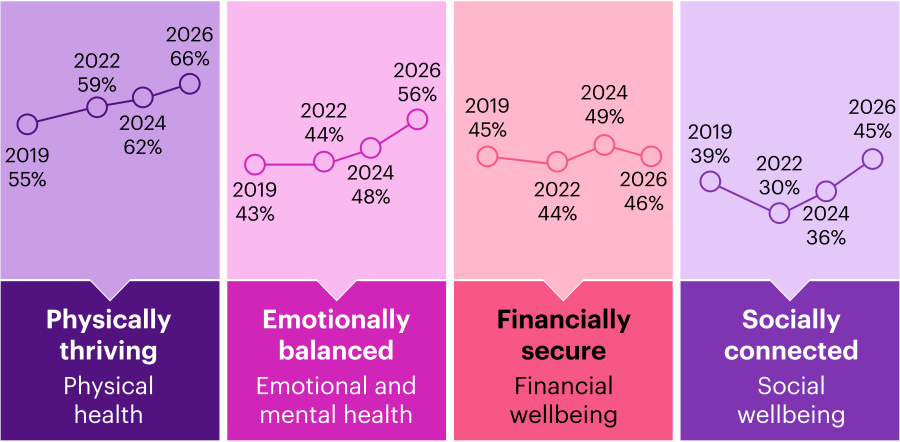
Figure 1. Improvements in physical, emotional and social wellbeing are offset by ongoing financial strain
- Labor market uncertainty. Job security is under pressure in both the short term (a weaker global economy, unresolved trade tensions and heightened geopolitical risk) and the long term, where AI is raising concerns on the future of jobs. Almost two in five (38%) of employees are worried that AI could have a major negative impact on their job security. And employees concerned about AI are three times as likely to be a “soft stay” – planning to remain with their employer but feeling stuck and ready to move if a better opportunity appeared.
Employees concerned about AI are three times as likely to be a “soft stay”.
Faced with these risks, employees are responding in predictable ways: they are prioritizing stability and security – job security now ranks second only to pay as a driver of attraction and retention decisions. “Job hugging” is increasing, with employees holding on to roles they would maybe leave in a stronger job market.
Benefits: rising to the challenge
Over the last decade, employee benefits have been a success story. Employers have expanded choice, invested in digital access, improved communication and broadened their support beyond the traditional core. And employees have noticed. Since 2017, the share of employees who say they have a very good understanding of their benefits package rose from 56% to 74%, the share reporting a high degree of choice from 54% in 2019 to 67%. This has translated into greater appreciation of benefits: seven in 10 now say their benefits package meets their needs, up from around half in 2017.
70%
70% of employees now say their benefits package meets their needs, up from around half in 2017.
Greater appreciation has brought greater trust. Employers have the brand permission to play a more active role in their employees’ lives, and workers want them to use it (Figure 2).
This is partly driven by generational changes. Younger employees, and Gen Z in particular, look for more help and support than previous cohorts. But their needs are also different: student debt, rising mental health issues and the difficulty of buying a home loom larger for these workers. Alongside these generational changes, we see lower wage cohorts and the more vulnerable becoming more exposed and needing more help.
Alongside growing demand, how benefits are managed, communicated and delivered is likely to change fundamentally as a result of AI. It offers the prospect of genuine personalization, tailored to individual circumstances, at a scale and cost that has not been available before. The pace of change in benefits will undoubtedly accelerate.
The question, then, is not whether change is coming to employers, but how they will respond to a rapidly changing environment. Enhancing value will mean building on the trust already earned, delivering a wider range of support tailored closely to the needs of the workforce, and using technology to achieve better outcomes at a sustainable cost.
About the survey
2026/2027 Global Benefits Attitudes Survey
WTW first started surveying employees about their retirement, health benefits and overall wellbeing over two decades ago. This is our seventh biennial global survey.
The 2026/2027 survey spans 31 markets, including 41,000 employees. The questions covered:
- What employees want from benefits programs; what influences attraction, retention and turnover decisions
- What drives benefits appreciation and what help employees want from their employer
- Which factors are shaping employee wellbeing, and where employers can make the biggest impact.
Organizations can purchase detailed data cuts across priority topics including attraction and retention, benefits preferences, work flexibility, retirement expectations and attitudes to AI. Custom analysis is also available by market, demographic, occupation and sector, including employer-specific modelling to show what your own workforce may value and expect.
For early access to the report, complete the form
Go deeper with data. Get early access to the report, which includes more insights from the survey and eight steps employers can take to deliver competitive advantage, by filling out the form below.
Related capabilities

Health and Benefits
We partner with you to build an effective employee benefits program that sustains a healthy, high-performing workforce.
Employee Wellbeing
We unlock the business value of employee wellbeing, boosting the effectiveness of total rewards, increasing employee engagement, and improving work-life balance, performance and productivity.
Retirement
We optimize retirement programs, delivering strong financial outcomes for employees and organizations while navigating a dynamic talent and economic environment.
Employee Experience
We help organizations improve business performance with High Impact Employee Experiences focused on the conditions that deliver productivity, performance and sustainable growth.