


Building portfolios to seize the AI upside while managing the downside
The rapid rise of generative AI is dramatically reshaping equity markets, driving outsize gains in a handful of U.S. mega-cap technology stocks and confronting investors with a new concentration risk. The acceleration of AI adoption has powered a tech rally that’s captured global attention, but its flipside is a market increasingly dominated by a few winners—a dynamic that presents both lucrative opportunities and potential pitfalls for equity portfolios.
WTW’s answer is a multi-manager, multi-style equity structure that blends passive, fundamental, and systematic strategies plus risk analytics and scenario testing to keep AI exposure intentional, not accidental. This approach can help investors participate in innovation-driven growth without relying on a handful of market leaders—helping build a more resilient equity portfolio.
The AI-fueled equity market surge—and its downside risk
Over the past year, artificial intelligence has matured from a futuristic concept to a primary engine of equity market performance. Companies at the forefront of AI—especially the U.S. “Magnificent Seven” tech giants —have seen their stock prices soar, profoundly influencing index returns.
By late 2024 the top seven U.S. stocks made up roughly one-third of U.S. equity market value[1], and some individual companies (Apple, Microsoft, Nvidia) grew so large that each had a market cap exceeding the entire equity markets of most countries[1] .
The media buzz and investor enthusiasm around AI breakthroughs have been relentless, but the hidden story is how these AI-driven gains are transforming market structure. Why should investors care? Because this extreme leadership by a few AI winners has skewed risk/return profiles. Broad equity indices are now more top-heavy than at any time since the tech bubble[2], implying higher volatility and vulnerability should those leaders falter.
As shown below, index “height” has increased, but the foundation has narrowed—creating a less forgiving risk/return profile if today’s leaders disappoint.
The market has become a tower, not a pyramid
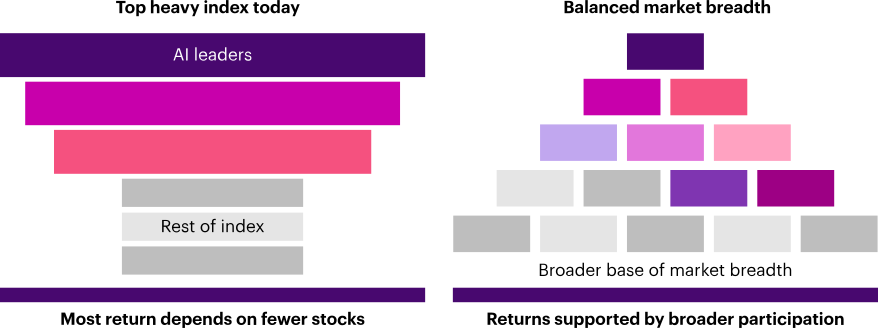
Index “height” has increased, but the foundation has narrowed - creating a less forgiving risk/return profile if today’s leaders disappoint.
Conceptual illustration, not to scale
Indeed, these stocks sport premium valuations near late-1990s dot-com-era highs[2]—meaning if AI expectations prove even slightly too optimistic, we believe an unwinding could reverberate across many portfolios. At the same time, many fundamentally solid companies have been left behind by this wave. Traditional “quality” stocks, known for steady earnings and strong balance sheets, had one of their worst relative performances in decades as the AI craze overshadowed fundamentals[3].
Quality stocks: Underperformance deepens in 2025
The typical safety of quality was upended—software firms long considered high-quality were hit hard by AI’s emergence[3]. And although the AI theme remains powerful, as 2026 began we saw signs of rotation: in the first quarter of 2026, value-oriented equity indices rose about +2.7% while growth indices fell ~4.5%[4], as investors started to question sky-high valuations. In short, the AI revolution has delivered stunning returns but at the cost of unprecedented market concentration and strategy-challenging volatility.
Positioning for the long-term—harnessing AI without the hype
The investment challenge now is clear: how to participate in AI-driven equity growth without accepting undue risk. We feel investors should resist the temptation to chase the most overhyped winners exclusively.
History shows that maintaining balance is crucial; even transformational innovations eventually normalize, and early market darlings can stumble. For example, a year of rapidly rising interest rates in 2022 saw the Magnificent Seven stocks plunge about 50% on average[5]— a stark reminder that concentration can cut both ways.
Instead of a binary bet on a few AI titans, a wiser approach is diversified conviction.
This means ensuring exposure beyond the obvious names— including hidden beneficiaries of AI and overlooked sectors— as well as a plan for managing downside risk. Rebalancing toward an equal-weighted approach in equity (or adding more active stock selection) can mitigate concentration: notably, an equal-weight S&P 500 strategy has historically outperformed the standard capitalization-weighted index over the long run by capturing performance beyond just the mega-caps[5]. Similarly, adding global and mid-cap equity exposure can broaden the opportunity set and reduce a portfolio’s vulnerability to any single trend.
A balanced, AI-ready equity portfolio – here’s how WTW plays it
Achieving real resilience and upside in an AI-driven market calls for combining multiple strategies and risk disciplines. WTW has been proactively helping clients navigate the AI theme using a multi-pronged approach.
First, we blend fundamental, passive, and systematic equity strategies to ensure portfolios can capture AI-related gains without relying on market timing. In practice, this might involve complementing core passive index holdings (to maintain exposure to the big AI winners) with high-conviction active equity managers who can find underappreciated opportunities beyond those top seven stocks.
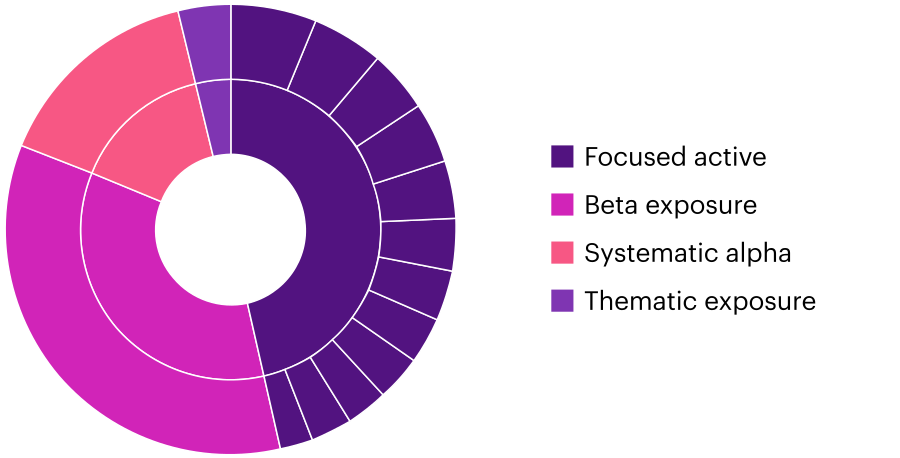
WTW combines beta, active, systematic and thematic strategies to build diversified equity portfolios for an AI-driven market.
Sample/illustrative best ideas client portfolio
We typically work with a roster of diverse, specialized active managers—for example, eight to twelve different equity managers each picking their best ideas—which collectively yields a diversified but focused portfolio, in line with our recommended approach[1]. This structure reduces reliance on any single company and introduces varied perspectives on where AI-driven value will emerge.
Second, we incorporate sophisticated risk analytics and scenario-testing, using advanced risk models to break down the total portfolio’s exposures by style, sector and region to ensure resilience across a range of market shocks. This rigorous oversight helps us identify and manage any unintended factor tilts or concentration risks, so that stock-specific opportunities remain the primary drivers of return potential.
Finally, we emphasize long-term objectives over short-term fads. The goal is to achieve concrete outcomes—such as improved risk-adjusted returns, greater diversification and durable growth exposure— rather than chasing momentum or hype. With robust governance and tailor-made solutions like WTW’s delegated equity portfolios, we help investors seek the upside of the AI revolution while managing its potential downsides. In essence, the key is to embrace innovation as a strategic opportunity—but to do so in a way that keeps portfolios balanced, diversified, and future proof. Here’s how we plan to play this pivotal shift: with eyes open to both the promise and the risks of AI, and a portfolio built to weather whatever comes next.
Footnotes
- Willis Towers Watson (WTW), “Top Investment Actions for Institutional Investors in 2025,” WTW Insights (published Dec 16, 2024). [WTW analysis citing FactSet data on equity market concentration and company market caps]. Return to article
- Morgan Stanley Wealth Management, “Mag 7 Stocks vs Other 493: Stock-Picking Key,” research note by Lisa Shalett et al., Morgan Stanley Insights (July 30, 2025). [Analysis of top-heavy U.S. stock indexes relative to historical norms and tech bubble era]. Return to article
- Pensions & Investments (via WTW/Mercer), Active Strategies Face Challenges as AI-Fueled Rally Narrows Markets, industry news coverage (April 2026). [Reported that “quality” factor stocks had their worst relative performance in ~30 years amid AI-driven market leadership]. Return to article
- Pensions & Investments (via Mercer interview), Active Equity Style Shifts in Early 2026, industry news coverage (April 2026). [Noted Q1 2026 rotation: U.S. growth stock indices -4.5% vs. value +2.7%, as investors questioned high tech valuations]. Return to article
- Avalan Wealth Management, “The Magnificent 7, AI, and Concentration Risk,” by Peter Madlem, CFA (Aug 13, 2025). [Highlights 2022 decline of ~50% in Mag7 stocks during rate hikes, and evidence of equal-weight S&P 500 index outperforming cap-weighted index over long periods]. Return to article
Disclaimer
This document was prepared for general information purposes only and does not take into consideration individual circumstances. The information contained herein should not be considered a substitute for specific professional advice. In particular, its contents are not intended by Towers Watson Investment Services, Inc., and its parent, affiliates, and their respective directors, officers, and employees (“WTW”) to be construed as the provision of investment, legal, accounting, tax or other professional advice or recommendations of any kind, or to form the basis of any decision to do or to refrain from doing anything. The information included in this presentation is not based on the particular investment situation or requirements of any specific trust, plan, fiduciary, plan participant or beneficiary, endowment, or any other fund; any examples or illustrations used in this presentation are hypothetical. As such, this document should not be relied upon for investment or other financial decisions and no such decisions should be taken on the basis of its contents without seeking specific advice. WTW does not intend for anything in this document to constitute “investment advice” within the meaning of 29 C.F.R. § 2510.3-21 to any employee benefit plan subject to the Employee Retirement Income Security Act and/or section 4975 of the Internal Revenue Code.
This document is based on information available to WTW at the date of issue and takes no account of subsequent developments. In addition, past performance is not indicative of future results. In producing this document WTW has relied upon the accuracy and completeness of certain data and information obtained from third parties. This document may not be reproduced or distributed to any other party, whether in whole or in part, without WTW’s prior written permission, except as may be required by law.
Views expressed by other WTW consultants or affiliates may differ from the information presented herein. Actual recommendations, investments or investment decisions made by WTW, whether for its own account or on behalf of others, may differ from those expressed herein.
Author
Contact