
Since January 2025, there have been major shifts in the United States regarding the diversity, equity, inclusion (DEI) regulatory landscape. Federal executive actions, renewed enforcement priorities at the Equal Employment Opportunity Commission (EEOC) and Department of Justice (DOJ), and changing securities disclosure expectations have collectively altered the risk profile for directors and officers (D&Os).
DEI in the workplace has been a top issue for the past several years. For several years, many businesses created DEI programs and publicized their initiatives to increase diversity within their organizations. In fact, our D&O survey results from 2025 indicated that DEI was one of the top seven concerns for directors and officers in Great Britain, North America and Africa. While DEI remains an important concern to businesses, there has been a shift over the past couple years in the United States in the regulation of DEI in the workplace.
After taking office, the President of the United States issued a multitude of executive orders aimed at ending DEI policies and practices at the federal level that were deemed to be illegal while also addressing the use of DEI policies in the private sector. Specifically, the executive orders bar federal agencies and federal contractors from considering race, color, sex, sexual preference, religion, or national origin in their employment practices. The orders require federal contractors to certify compliance that they are not engaging in illegal DEI. Additional executive orders rescind corporate policies that (1) impose equal opportunity and DEI requirements on the federal government; and (2) prohibit discrimination against federal employees because of their sexual orientation or gender identity. The executive orders also direct federal agencies to investigate whether DEI practices of private employers violate federal civil rights laws.
Guidance from executive agencies under the current U.S. administration has followed suit. The EEOC and DOJ issued a joint press release announcing two pieces of EEOC guidance for employers relating to DEI initiatives in the workplace. The EEOC guidance specifically highlights how employees can bring claims based on their employer’s DEI policies and procedures. The EEOC has stated a focus on discrimination against “majority” group plaintiffs, especially in light of DEI policies it found to be unlawful. In addition, the DOJ established the Civil Rights Fraud Initiative which will use the False Claims Act to investigate and pursue claims against federal contractors and recipients of federal funds who knowingly violate civil rights laws, giving enforcement power to the executive orders.
These changes in enforcement priorities create additional avenues for litigation by employees. In addition, the EEOC’s focus on DEI policies also poses an increased risk for directors and officers, as it could increase the likelihood of federal agency investigations, enforcement actions and private litigation.
Recently, the DOJ settled its first DEI related False Claims Act claim, brought through the Civil Rights Fraud Initiative, for $17 million. In addition to demonstrating the real threat of U.S. federal enforcement action, a settlement like this creates additional risk for directors and officers as it has the potential to lead to securities class action lawsuits or shareholder derivative claims.
The shareholder and derivative claims could allege failure to properly oversee and implement DEI decision making, which would expose directors and officers to additional risk. Such claims may arise from maintaining DEI initiatives that allegedly violate anti-discrimination laws or from dismantling programs without an adequate review of the potential risks or disclosure of legal and reputational consequences.
In light of recent shifts in the U.S. administration's stance on inclusion and diversity, how prepared do you believe your board is to respond to changes in related policy and stakeholder expectations?
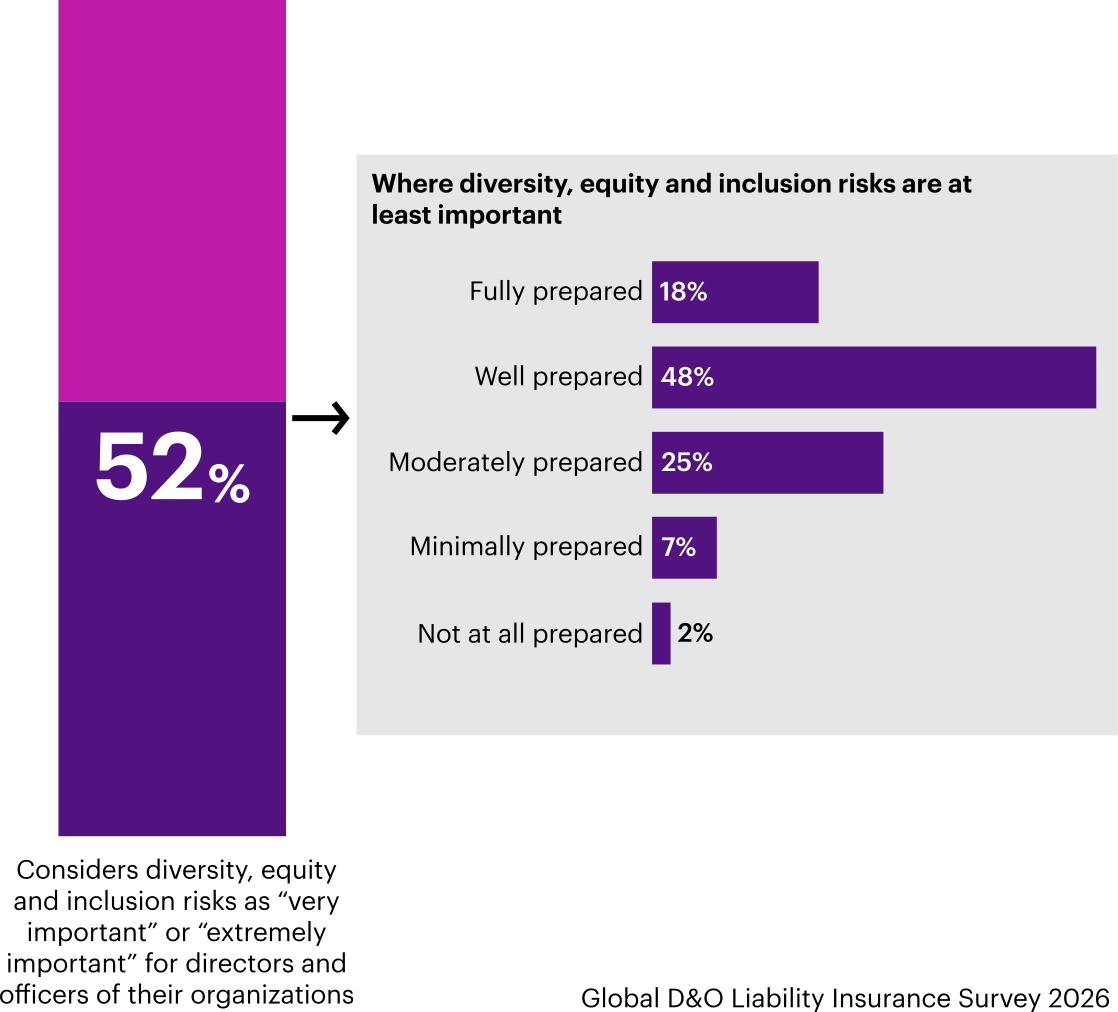
Board preparation for changes in diversity, equity & inclusion policies and stakeholder expectations
Graphic showing perceptions of diversity, equity, and inclusion (DEI) risk importance and organizational preparedness. On the left, a vertical bar highlights “52%,” indicating that 52% of directors and officers consider DEI risks to be “very important” or “extremely important.” An arrow points to a horizontal bar chart on the right titled “Where diversity, equity and inclusion risks are at least important.” The chart shows levels of preparedness: 48% say their organization is “well prepared,” 25% “moderately prepared,” 18% “fully prepared,” 7% “minimally prepared,” and 2% “not at all prepared.” The visual emphasizes that while over half view DEI risks as highly important, preparedness varies, with most organizations reporting being well or moderately prepared.
Given this heightened regulatory environment regarding DEI, one would assume that it would continue to be a top concern for directors and officers. However, the Global Directors’ and Officers’ Survey Report 2026 indicates that only 52% consider DEI risks as ‘very important’ or ‘extremely important’ for the directors and officers of their organization, down from 59% in 2025. Interestingly, based on the survey results, only 18% (out of respondents who considers DEI "very important" or "extremely important") believe their company’s board is “fully prepared” to respond to changes in DEI policies and stakeholder expectations. It is possible that, because the federal government is de-emphasizing DEI, organizations are less concerned. However, the de-emphasis on DEI does not mean that it is not being regulated. Quite the contrary, the federal government is very keen on regulating DEI in the workplace and has made that clear through the executive orders and changes in enforcement priorities. Indeed, the regulation of DEI in the workplace is even more prevalent now than it was just two years ago.
Authors


Contact