

Innovation is never far from the de-risking market
2023 was yet another year of de-risking industry firsts, with WTW leading the first ever superfund transaction between Clara-Pensions (“Clara”) and Sears Retail Pension Scheme. While the pension trade press, and many mainstream media outlets, lit up at the announcement evidencing the launch of another viable de-risking avenue for UK defined benefit pension schemes, it was of course the fruition of many years’ investment, development and hard work for those involved – particularly the team at Clara for whom this first deal must have felt a long time coming, having first launched over six years ago.
It is no coincidence that 2023 was the year that superfunds finally moved from being a “great idea” into “tangible reality”, as with a government backdrop of consolidation, productive finance and governance reform, Clara found itself ready to play very supportively to the tune of the political day. I have no doubt that over the coming years consolidation will remain a key focus and we will see Clara building its pipeline and scale, alongside the government’s intention to establish a public sector consolidator by 2026, which is aimed at schemes (likely the smallest) that are unattractive to commercial providers, such as Clara.
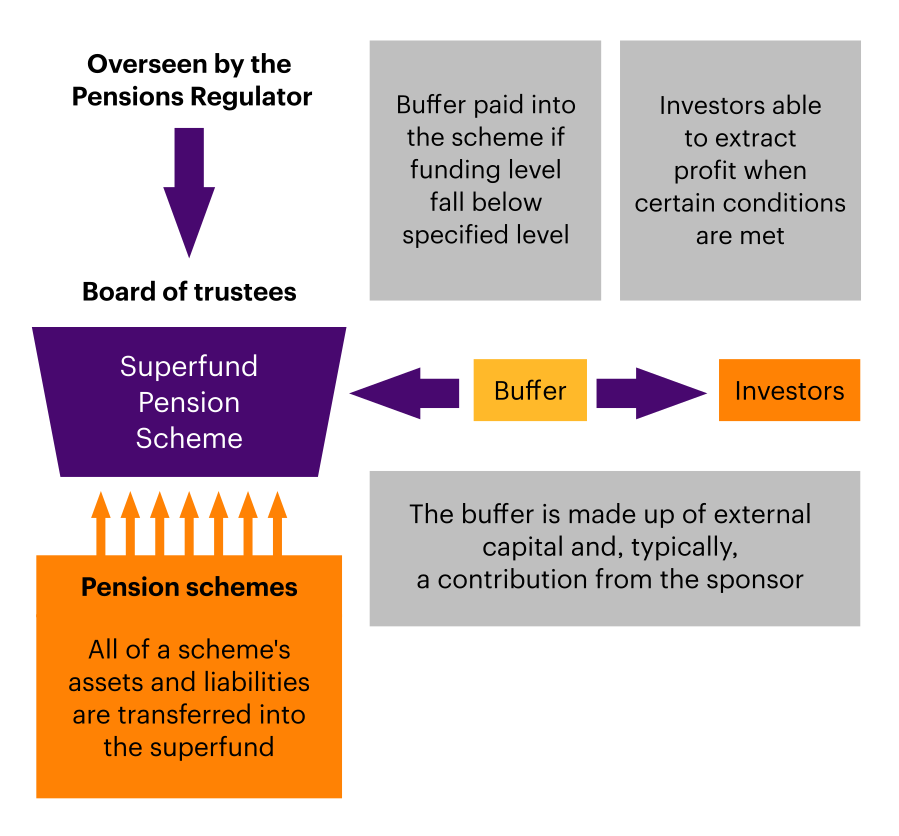
What is a superfund?
What was the Clara/Sears transaction?
The £590m transaction between Sears Retail Pension Scheme and Clara announced in November 2023 saw the c9,600 Sears members become the first ever to enter a UK pension superfund. Critically, as part of the transaction, Clara provided £30m of new capital. This injection of capital resulted in an overall increase in member benefit security, which was the key objective behind the Trustees electing to execute the transaction. This £30m (sourced from Clara’s investors) is ring fenced and was injected immediately upon completion of the transaction, meaning that from day 1 it was there to protect the Sears members and only the Sears members. This transaction was concluded with no additional funding being made available from the sponsor, and fully transferred the liabilities to Clara-Pensions meaning the now empty scheme can commence work to wind-up and no further call for funding will be placed on the sponsor.
What are the implications for trustees, sponsors and the insurance market?
The Sears transaction was a Trustee-led de-risking exercise. In considering the optimal outcome for members the Trustees assessed the full range of de-risking paths open to them, balancing up the different risks and risk mitigations of each path, including simply maintaining the “status-quo”. For this set of Trustees, it was clear a superfund was the most appropriate way to balance the remaining risks of the Scheme in a way that was clearly in members’ best interests.
While the Sears transaction was Trustee-led, the implications of this transaction carry across into the corporate arena as it is anticipated that future cases may be equally led and initiated by scheme sponsors looking to work to secure their pension promises. Superfunds, like insurer buyouts, allow companies to remove pension promises (and the associated cost and risks) from their balance sheets and streamline for broader corporate activities, such as corporate restructuring. However, the cost of a superfund transaction is generally expected to be materially less than the equivalent cost of an insurer buyout, making it an attractive option to consider in the right circumstances.
It will be interesting to see how bulk annuity insurance companies react in response as Clara, or other superfunds, start to build scale. For example, might bulk annuity insurers see 2024/25 as a final opportunity to squeeze out the new kids on the block, by offering improved price propositions to marginalise the likes of Clara, or will the level of activity in the bulk annuity market expected over 2024/25 mean these insurers pay little attention to another playing on their turf because there is more than enough business to go around? And of course, Clara is a “route to buyout” superfund so is expecting to ultimately provide new business to the insurers, although future superfunds may not always have this model which may change the insurers’ attitudes.
How can a scheme enter into a superfund?
Before any pension scheme can enter into a superfund, it must first satisfy the three gateway principles set out in the current Pension Regulator Guidance. These being:
- The scheme should not view buyout as accessible now
- It has no realistic prospect of buyout in the foreseeable future, given potential sponsor cash contributions and the insolvency risk of the sponsor
- It must improve the likelihood of members receiving full benefits
Given these gateway tests we consider that schemes that could consider a superfund would be:
- Funded between c90-95% on buyout with uncertain or no covenant; or
- Funded between c70-90% on buyout and a sponsor contribution can be made to facilitate superfund entry.
The Sears Scheme found itself in very much the “sweet spot” in terms of funding levels for a transfer to a superfund, reasonably well funded, but too far from buyout to say with any degree of certainty this would be achieved in the future. This, coupled with the fact that for more than two decades the Company had no trading businesses to support the Scheme, left the Scheme in a position where there was no doubt that all three gateway principles were comfortably met.
As well as leading the transactions advice and project management, WTW also led the liaison with the Pensions Regulator on behalf of the Trustees and Sponsor. This gave unique insights into the clearance process that trustees and sponsors of pension schemes need to go through. Our reflections on the clearance process itself suggest that our top tip is to engage early and often with the Regulator and to run an open and collaborative approach. WTW were also Scheme Actuary, covenant adviser and communications adviser to the transaction.
- Firstly, it is essential that the team advising has ready and deep access to live bulk annuity insurer pricing, this will allow you to easily fast track entry to superfund, without the need to circle round seeking quotes from insurers in the market risking losing a superfund deal that might be in your grasp.
- Secondly, select an adviser that has deep understanding of bulk annuity transactions, as the negotiated “Bulk Transfer Agreement” executed between the Sponsor, Trustees and Clara is similar to a buy-in contract with an insurer, so a detailed knowledge of the commercials negotiated on insurer transactions is key to good negotiation outcomes, as is knowing the art of the possible with both Clara and the Pensions Regulator.
- Finally, schemes should choose an adviser that has a track record of the oversight needed for such risk transfer deal execution.
Wider implications and what next?
Turning to the wider implications, here are my key reflections:
Contact

Complete the form below to download a PDF of the report.
De-risking report 2024 articles
Pensions Briefing
A monthly newsletter, relevant to HR professionals, pension trustees and corporate sponsors delivering a round-up of UK pensions news, insights and updates from the last month.