


As global mobility becomes increasingly complex, employers continue to support internationally mobile employees through international health, risk, wellbeing and travel programs. However, the focus is evolving beyond benefit provision toward stronger compliance, enhanced vendor oversight, cost management and better coordination across programs. Against a backdrop of geopolitical uncertainty, regional conflicts, regulatory change and heightened travel risks, multinational organizations are reassessing their duty of care strategies to ensure they remain compliant, resilient and responsive to the changing needs of internationally mobile employees and their families.
A significant majority of multinational employers continue to provide tailored benefits and related services to internationally mobile employees as part of a competitive and protective employment package. While some employers still rely on home or host country plans, global programs can offer more consistent coverage, stronger governance and improved support for employees and dependents navigating healthcare systems, travel risks and emergency events.
Key findings from the survey
Global mobility remains a strategic workforce priority.
Organizations continue to maintain globally mobile workforces across all regions, relying heavily on long-term expatriate assignments while also supporting broader populations of internationally mobile employees through health, risk and travel benefit programs.
Employers are increasingly balancing cost management with the need to maintain competitive and relevant benefits for a globally mobile workforce.
Top employer priorities in managing healthcare and risk benefits for international assignees and their families continue to center on cost management, benchmarking, and ensuring benefit relevance.
International health plans remain the foundation of IME benefits.
Health insurance is the most widely provided benefit for international assignees, with 97% of participants offering coverage.
Figure 1. Benefits provided to international assignees
| International plan | Home country plan | Host country plan | Other | |
|---|---|---|---|---|
| Health insurance (e.g., medical, dental, vision) | 85% | 20% | 17% | 3% |
| Life insurance (death-in-service) | 51% | 54% | 19% | 1% |
| Disability benefits | 52% | 53% | 18% | 1% |
| Accidental death and dismemberment (AD&D) | 43% | 56% | 22% | 3% |
International Health Plan vendors
The top three factors used to evaluate international health plan vendors have remained remarkably consistent across the 2021, 2023 and 2026 surveys. Compliance remains the leading consideration, followed by member service quality and pricing, reinforcing the importance employers place on delivering globally compliant coverage while maintaining a positive employee experience.
Core health coverage is comprehensive, while emerging benefits remain less consistent.
International health plans generally provide broad, comprehensive medical coverage. Medical, dental and vision benefits are widely offered, and many plans also include evacuation and assistance services, as well as global Employee Assistance Programs (EAPs).
Wellbeing is becoming an important component of the international employee value proposition.
Wellbeing support is increasingly embedded within international employee benefit programs. Among organizations offering Employee Assistance Programs (EAPs), nearly three-quarters provide these services through their international health plan, reinforcing the role of health programs as a broader platform for employee support. Many employers also provide dedicated wellbeing resources, including emotional wellbeing services, helplines and digital support tools.
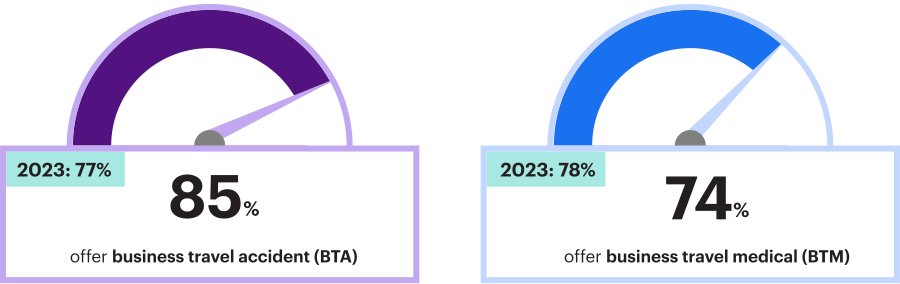
Business travel protection remains a core part of the mobility benefits ecosystem.
Business travel protection remains a core mobility benefit, with employers increasingly viewing coverage through a broader duty-of-care lens. Coverage eligibility is also expanding to support more diverse mobile populations.
Figure 4. Business travel insurance
Business travel insurance
Source: 2026 Internationally Mobile Employee Benefits Design Survey
The executive summary highlights findings from the 2026 Internationally Mobile Employee Benefits Design Survey, including:
- International health plan coverage and funding
- Top considerations when selecting a global international health plan vendor
- Medical, dental and vision coverage design
- Employee assistance programs and wellbeing benefits
- Risk benefits for international assignees
- Benefits for business travelers
- Evacuation and assistance services for internationally mobile employees
- Takeaways for global employers
Download the executive summary for insights into how organizations are evolving their health, risk, wellbeing and travel benefit strategies to support globally mobile employees, strengthen duty of care, manage compliance requirements and enhance the employee experience.
Contact us



Survey results