


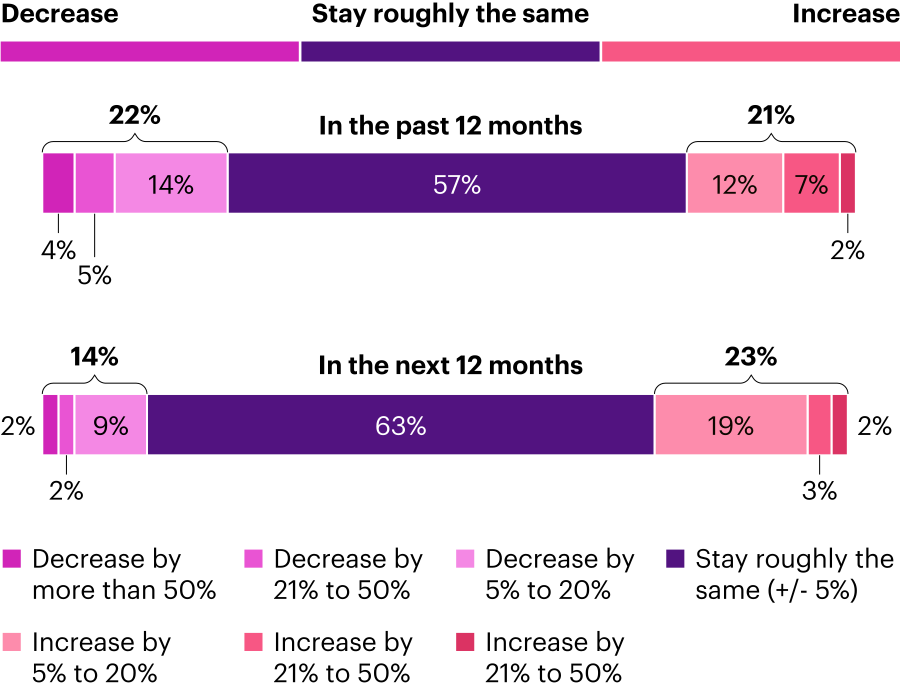
Global mobility continues to be a strategic lever for business growth, skills transfer, and talent development. The 2025 Global Mobility and Expatriate Benefits Survey reveals that over 80% of employers plan to maintain or increase international assignees in the next 12 months, despite rising costs and geopolitical uncertainty (Figure 1).
Figure 1. Over 80% of employers plan to maintain or increase international assignees over the next 12 months
To what degree has your international assignee (expatriate) population increased or decreased in the past 12 months? How do you expect it to change over the next 12 months?
However, there’s a growing tension between cost control and providing an optimal employee experience for international assignees. Increasing healthcare premiums have made cost management and benchmarking top priorities; but at the same time, physical wellness, mental health, and duty-of-care considerations rank high for international assignees, signaling that organizations must balance financial pressures with comprehensive support. Evolving geopolitical landscapes and minimum benefit standards further complicate planning, reinforcing the need for agile, risk-aware strategies.
Key findings
- Two in five (42%) of participants said that the current geopolitical landscape is largely impacting their strategic thinking around expatriate assignees (Figure 2).
- The vast majority (84%) of employers still rely on long-term (12+ months) assignments, though alternative arrangements such as short-term, commuter, and globally remote roles are gaining traction.
- Business expansion (cited by 65% of participants), skills transfer (61%), and talent development (60%) remain the top objectives for global mobility programs.
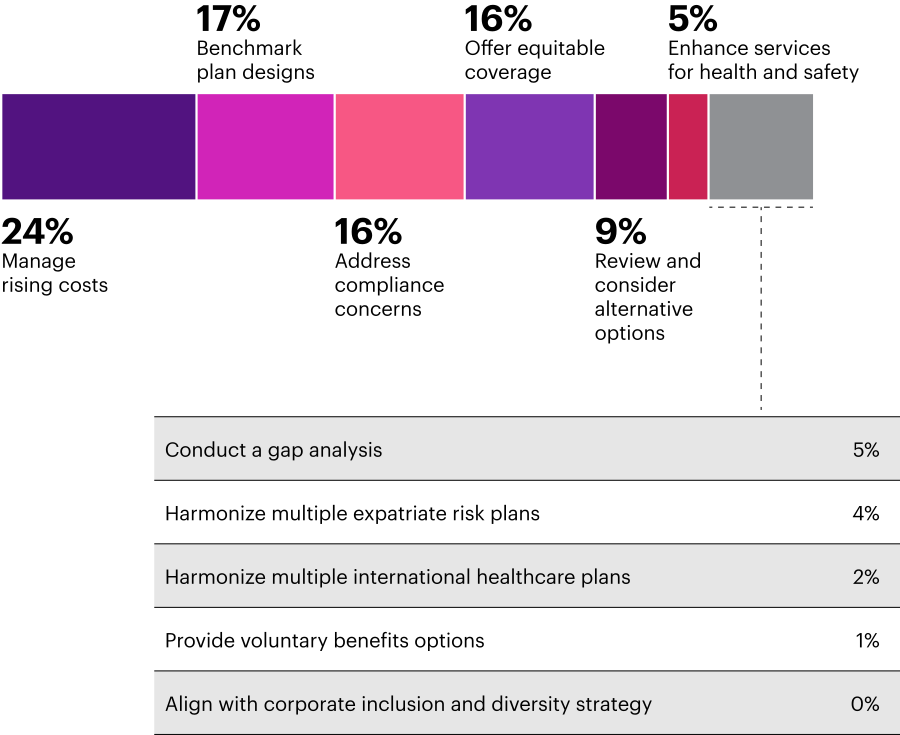
- Healthcare premiums increased for three-fifths of employers at renewal, making cost management and benchmarking the top priorities for mobility leaders (Figure 3).
Figure 3. Costs and benchmarking are top priorities in managing international healthcare and risk benefits
Please rank your top priorities. Rank 1 for those that are the highest priority, 2 for the next highest priority and so on.
(% of “Ranked #1”)
(% of “Ranked #1”)
- Most employers offer international health care benefits to international assignees – and 42% also offer them to localised expatriates who were previously on formal assignments abroad (Figure 4).
- Physical wellness ranks as the top consideration for employers, followed by mental health and medical evacuation and repatriation support. Employers are expanding duty-of-care measures to include security and crisis management (Figure 5).
A path to action
Multinational employers can act now to future-proof their global mobility programs by:
For more detailed findings, please download our full report using the form on the right.
Contact us


Survey results
2025 Global Mobility and Expatriate Benefits Survey
Complete the form to access our full report.