
Indian employers are entering a new phase of benefits strategy. After a decade of sustained investment, employee wellbeing is now a mainstream business priority. The next challenge is to make that investment more effective.
Rising healthcare costs, budget pressures and changing workforce expectations are forcing organisations to rethink how benefits create value, improve employee outcomes and strengthen business resilience.
According to WTW’s 2026 Wellbeing Diagnostic Survey, representing 419 employers and more than one million employees across India, wellbeing remains a core component of total rewards strategies. However, employers are becoming more selective in where and how they invest.
Today, 62% of employers have integrated wellbeing into their total rewards strategy, up from just 26% in 2015. Employer commitment remains strong, with 87% actively supporting employee wellbeing. At the same time, WTW’s Global Benefits Attitudes Survey shows employees increasingly expect that support, with 90% believing employers should play an active or supporting role in their wellbeing.
Driving greater value from wellbeing investment
While employer commitment remains strong, rising costs are forcing organisations to rethink how wellbeing programmes are delivered and funded.
Healthcare cost inflation and economic uncertainty are putting pressure on benefits budgets. Rather than reducing investment altogether, employers are focusing on optimisation. Nearly eight in 10 organisations are streamlining vendor partnerships, redesigning wellbeing programmes and reallocating spending towards higher-impact solutions.
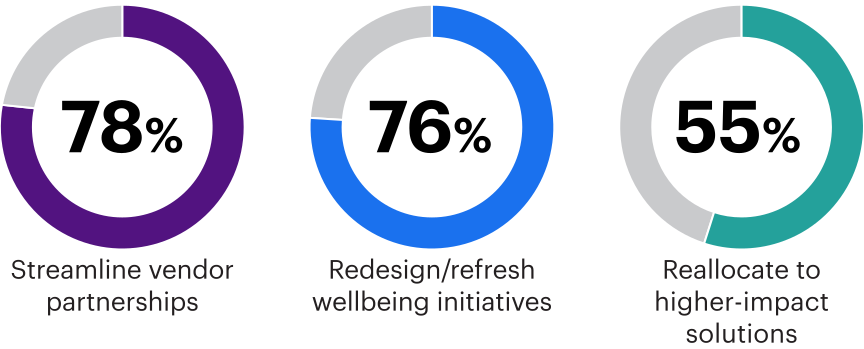
Getting better value: streamlining, redesigning, reallocating
Source: 2026 WTW Wellbeing Diagnostic Survey, India
Closing the gap between employer and employee priorities
One of the most notable insights is the disconnect between employer priorities and employee concerns, with financial wellbeing emerging as the largest gap.
Nearly half of employees (46%) identify financial wellbeing as a key priority, yet only 21% of employers consider it a key area of focus. Employees are looking for practical support such as budgeting tools, savings programmes and financial coaching. However, many employers remain concentrated on financial education rather than practical tools and interventions.
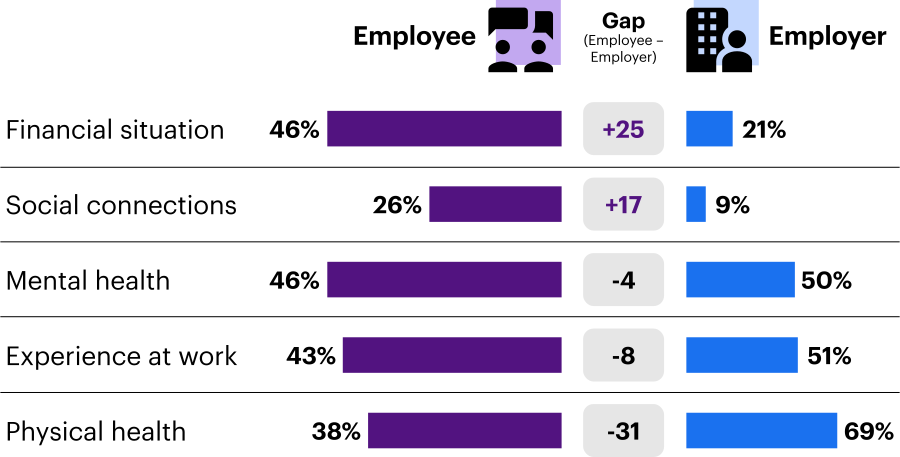
The financial wellbeing gap: employees want more than employers give
Source: 2026 WTW Wellbeing Diagnostic Survey, India
A mixed picture of workforce wellbeing
The data also reveals that progress across wellbeing dimensions has been uneven.
Physical wellbeing has improved significantly as employers have expanded preventive health initiatives and condition management programmes.
Emotional wellbeing has also improved, reflecting increased adoption of resilience programmes, counselling services and enhanced employee assistance programmes.
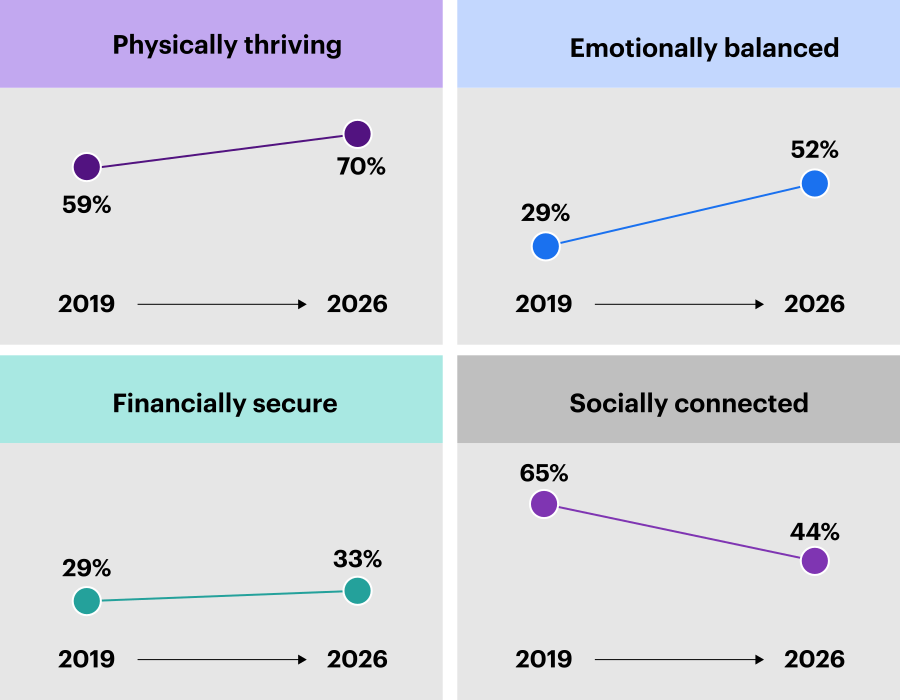
Employers have improved in most areas – except social
Source: 2026 WTW Wellbeing Diagnostic Survey, India
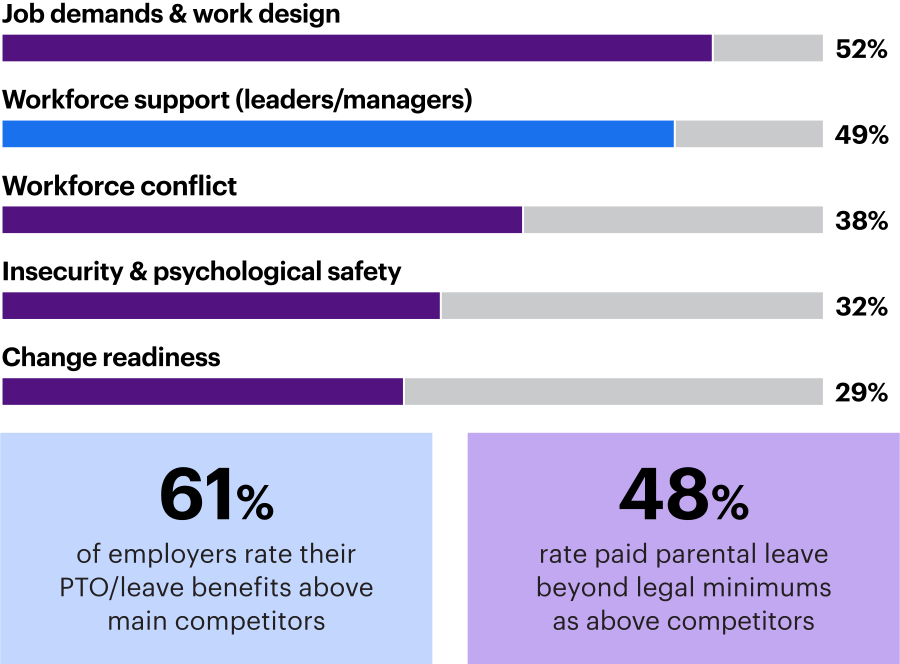
Psychosocial risk priorities for the next two years (ranked top two)
Source: 2026 WTW Wellbeing Diagnostic Survey, India
However, social wellbeing has deteriorated sharply since 2019. Fewer employees report feeling socially connected, potentially reflecting the effects of hybrid work models, changing workplace dynamics and increased job demands.
Over the next two years, employers are expected to move beyond traditional wellbeing programmes and place greater emphasis on work design, manager effectiveness, psychological safety and team connection.
The survey also highlights a widening support gap for employees with greater health risks. These employees consistently report lower satisfaction with employer wellbeing programmes, despite accounting for a disproportionate share of healthcare costs and productivity challenges.
This points to the need for more personalised and targeted interventions rather than broad, one-size-fits-all solutions.
Building a future-ready wellbeing strategy
To build a future-ready wellbeing strategy, employers should focus on five priorities:
- Rebalance benefits investment around workforce value, not solely programme cost.
- Close the financial wellbeing gap through savings support, budgeting tools and financial coaching.
- Strengthen social wellbeing by addressing work design, manager capability and psychosocial risks.
- Target support for high-risk employee populations using data-driven segmentation.
- Invest in governance and measurement, ensuring wellbeing outcomes are linked to business objectives such as retention, productivity and healthcare cost management.
The survey also highlights strong interest in AI-enabled wellbeing solutions, with 86% of employers considering their use. However, successful adoption will depend on trust, transparency and responsible governance, especially when AI is used in health-related applications.
Wellbeing in India has reached a strategic turning point. The organisations that will lead in 2026 and beyond will not necessarily be those that spend the most, but those that invest with greater precision, stronger governance and a deeper understanding of employee needs. By aligning benefits with workforce resilience, affordability and measurable outcomes, employers can support employee health, build stronger organisations and achieve more sustainable business performance.
Authors


Related solutions

Health and Benefits
We partner with you to build an effective employee benefits program that sustains a healthy, high-performing workforce.
Employee Wellbeing
We unlock the business value of employee wellbeing, boosting the effectiveness of total rewards, increasing employee engagement, and improving work-life balance, performance and productivity.
Employee Experience
We help organizations improve business performance with High Impact Employee Experiences focused on the conditions that deliver productivity, performance and sustainable growth.