
Artificial intelligence (AI) has evolved from a future trend to a business reality. According to the 2026 WTW Global Benefits Attitudes Survey (GBAS), which surveyed employees at medium and large private-sector employers in India, accelerated AI adoption presents both opportunities and uncertainties for the Indian workforce.
AI is now an integral part of the employee experience: 84% of employees have upskilled in AI. Most employees (77%) say it’s important in their daily work, while a vast majority (91%) expect AI to fundamentally change the way they work in the future. Nearly all advanced AI users (96%) report improvements in the quality, volume and efficiency of their work. Despite these positive indicators, AI continues to be a concern among almost half (46%) of employees, who worry that AI disruption could threaten their job security.
As AI becomes embedded in daily work, the challenge is increasingly about people, not technology. Employees who are worried about AI’s impact on their job security are more likely to experience burnout (62%) or stress (50%) and are also less likely to stay with their current employer (30%). These findings suggest that uncertainty about the future of work can negatively impact employee wellbeing.
Building workforce resilience is, therefore, essential. Employers should not focus on technology adoption alone, but also on five fundamental employee needs: job security, career growth, flexibility, health and financial confidence.
Job security remains the leading driver of attraction and retention. Amidst economic challenges, three in four employees (78%) intend to remain with their current employer for the next two years. However, six in 10 would switch employers for a similar job with significantly better benefits, even at the same salary. Career growth also ranks amongst the top three reasons why employees join or stay. The more employees build AI skills, the more confident they are in employer-supported career development. Almost half of employees (48%) also expect flexible work to be a core benefit, not just a perk.
84%
Indian employees have made significant progress developing AI skills
96%
Advanced AI users say it has improved their job performance (quality, amount, speed of work)
61%
Employees would leave their current employer for a similar job with significantly better benefits — even at the same salary
Financial wellbeing remains a major gap for employers to close. Nearly half of employees (46%) rank their financial situation as a top wellbeing priority, yet our 2026 Wellbeing Diagnostic Survey reveals that only 21% of employers plan to focus on financial wellbeing over the next two years.
Health concerns are also a significant pressure point for the Indian workforce. Many employees report feelings of loneliness (40%); over a quarter (27%) say they are managing a mental health condition; and one in five (20%) live with a chronic health condition. The projected annual increase of nearly 13% in medical costs in India underscores the need for employers to adopt more targeted health investments.
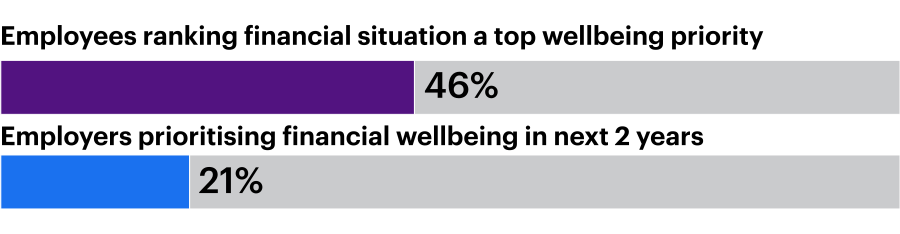
The perception gap: financial support
Source: 2026 WTW Wellbeing Diagnostic Survey, India and 2026 WTW Global Benefits Attitudes Survey (GBAS), India
Despite the uncertainty caused by AI-driven workplaces, our research shows that employee trust remains strong. In all four areas of wellbeing, over half of employees (53% to 60%) expect their employers to play an active, supportive role. This confidence extends to benefits decisions, with 75% of employees believing their employer can secure better benefits deals than they could obtain on their own, and 73% trusting the products and providers recommended through their employer-sponsored programmes.
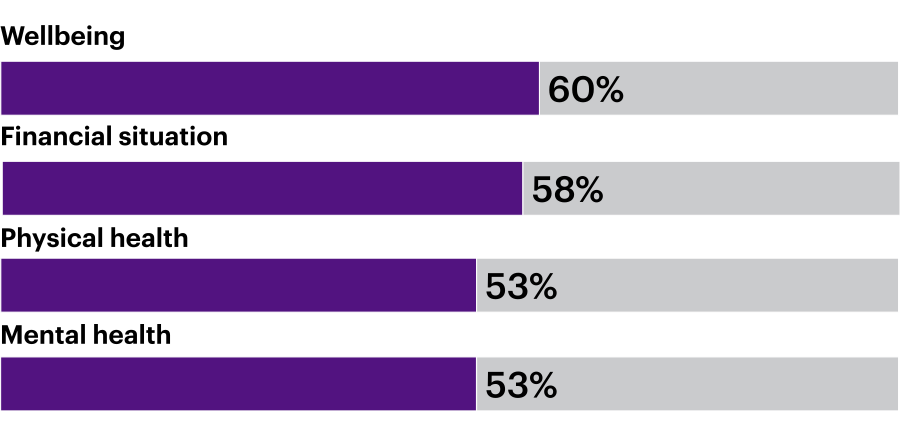
Percentage of employees wanting an active employer role, by area
Source: 2026 WTW Global Medical Trends Survey
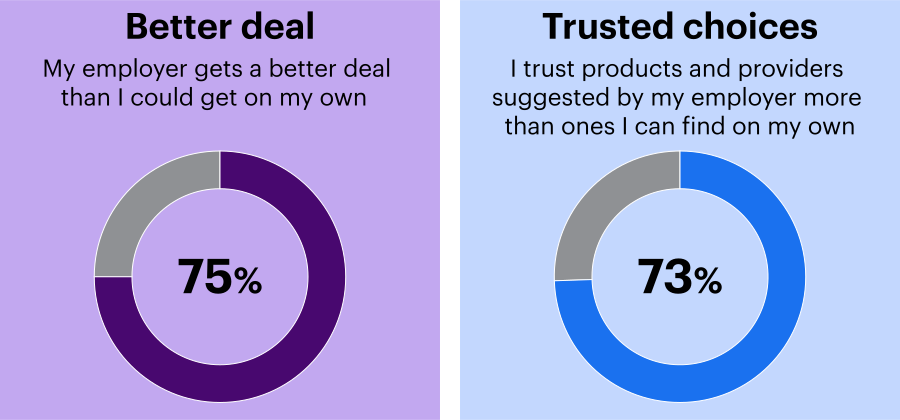
Many employees trust employers on benefits
Source: 2026 WTW Wellbeing Diagnostic Survey
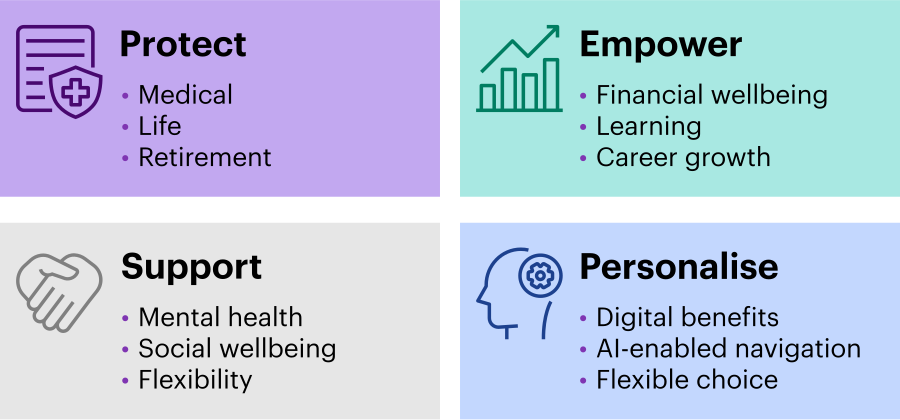
The future-ready benefits model
Source: 2026 WTW Global Benefits Attitudes Survey (GBAS)
WTW's 2026 GBAS study reveals that while employees are willing to adopt new technology and adapt to changing ways of working, concerns around job security and wellbeing remain. AI may be accelerating change, but the fundamentals of a thriving workforce remain the same. Employees need to feel secure, supported and equipped for the future. For employers, this creates a clear mandate: move beyond technology adoption and invest in the health, financial wellbeing, career growth and resilience of their people. Those that do will be better positioned not only to manage disruption, but to unlock the full potential of AI and human talent together.
Sources
2026 WTW Wellbeing Diagnostic Survey, India
2026 WTW Global Medical Trends Survey
2026 WTW Global Benefits Attitudes Survey (GBAS)
Authors


Related solutions

Health and Benefits
We partner with you to build an effective employee benefits program that sustains a healthy, high-performing workforce.
Employee Wellbeing
We unlock the business value of employee wellbeing, boosting the effectiveness of total rewards, increasing employee engagement, and improving work-life balance, performance and productivity.
Employee Experience
We help organizations improve business performance with High Impact Employee Experiences focused on the conditions that deliver productivity, performance and sustainable growth.