
Income investing is under the spotlight
Demand for income is rising across all investor types. Defined benefit (DB) schemes are turning to Cashflow Driven Investing (CDI) as they approach their endgames, while wealth clients are prioritising stable, predictable income in long-term planning. At the same time, defined contribution (DC) schemes face the decumulation challenge – often referred to as the “nastiest, hardest problem in finance”.
These investors may have different goals, but they are all trying to solve the same problem: how to generate reliable, resilient income in an uncertain environment.
However, traditional approaches are under pressure. Portfolios built around fixed cashflows and narrow asset classes can seem predictable, but they often struggle to keep pace with inflation, adapt to market shifts, or capture new opportunities.
It is time to rethink how income portfolios are constructed. This is where a Total Portfolio Approach (TPA) offers a more effective framework.
The problem: Stable income isn’t the same as resilient income
Many investors say they want stable income. What they actually need is resilient income; income that maintains its purchasing power and adapts over time.
Fixed, contractually defined cashflows can feel secure, but even modest inflation erodes their real value. Over long horizons, particularly in retirement, that erosion becomes material.
This is the core flaw in many traditional income strategies: they prioritise stability of payments over sustainability of outcomes.
The shift: From asset labels to outcomes
TPA changes the starting point. Instead of asking: is this an income asset? We ask: does this investment help us deliver the income outcome we need?
Under TPA, income is not an asset class. Portfolios are built around outcomes, not labels. Every investment must justify its role in delivering those outcomes.
Broadening the portfolio opportunity set
Income portfolios have traditionally relied on a relatively narrow toolkit: government bonds, investment grade corporate credit and possibly high yield.
Under a TPA framework, a much wider range of investments can contribute to income, including private credit, real assets, insurance-linked securities and selective equity exposure.
The result is greater resilience: higher return potential and more diversified income streams across borrowers, regions and collateral types, helping to reduce the risk of any single source of income being impaired. The key principle is simple: every idea competes on merit.
Why dynamism matters
Income portfolios are often built with a "set and forget" mindset, but markets don’t stand still. Objectives evolve. Opportunities emerge. Risks change.
TPA treats change as a feature, not a risk, allowing portfolios to adapt over time and stay aligned with their objectives.
A typical “static” approach focusses on assets with long term cashflows, aligned with the liabilities you are trying to meet. This reduces reinvestment risk (the risk of buying income bearing assets in the future at an unknown price) but may lead to worse outcomes. With a TPA mindset, holding assets providing more income than you need in early years provides an opportunity – the flexibility to adjust the portfolio as opportunities arise and risks evolve, whilst also maintaining a buffer to meet unexpected liabilities.
Portfolio example: how dynamism captures opportunities in investment grade corporate credit?
We favour a ‘buy-and-maintain’ approach to investment grade corporate credit: hold high-quality bonds to maturity and capture their full return potential while monitoring the portfolio and responding to evolving opportunities and risks.
This is not a static strategy. Markets move, and portfolios must adapt. TPA combines long-term discipline with dynamic management, enabling investors to respond to changing spreads and valuations through the TRI-fecta of Tilt, Rotate and Increase, supporting more resilient income outcomes over time (Figure 1).
Figure 1: Tilt, Rotate and Increase over time
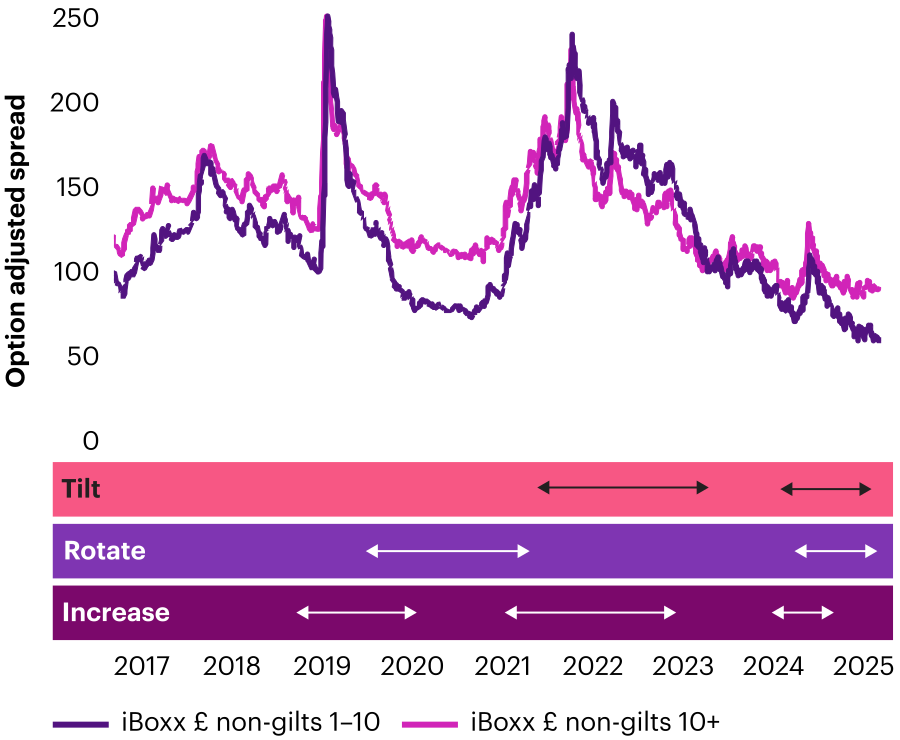
The TRI-fecta of Tilt, Rotate and Increase
Source: iBoxx
Tilt: Using shorter dated credit when spreads are low can provide opportunity to extend duration when spreads widen. In addition, market pricing could point towards opportunistic trades to tilt from longer duration to benefit from higher spreads in shorter dated bonds.
Rotate: Don’t just ride credit to the bottom and stay there. Recycle capital into better opportunities such as rotating into high‑quality ABS to pick up 50-100bps or move into insurance‑linked securities offering 200-300bps higher yield (net of expected losses), for those willing to take higher but uncorrelated risk and a truly diversified income stream.
Increase: Have a clear and efficient frameworks to act when spreads widen. Locking in exposure at spreads 50–100 bps higher can materially lift portfolio income and improve long‑term outcomes.
What this means in practice
- Define income in real terms
- Move beyond asset-class constraints
- Broaden the opportunity set
- Build flexibility into portfolios
- Manage dynamically over time - the TRI-fecta of Tilt, Rotate, Increase
A different investment approach
For investors willing to rethink their approach, there is a clear opportunity: Think beyond asset labels, Act dynamically, and Invest with long-term income outcomes in mind. That is what it takes to design income that lasts.
- Establish clear goals
- Consider range of opportunities with goals in mind
- Outcome focussed portfolio construction
- Establish monitoring framework for TRI-fecta
- Performance assessment across multiple metrics consistent with goals
Independent research from WTW’s Thinking Ahead Institute shows TPA adopters have achieved a ~1.3% p.a. performance uplift over a decade versus traditional strategic asset allocation (SAA) peers for traditional return seeking portfolios. Whilst income portfolios are generally lower returning, given TPA’s mission‑aligned decision framing and its competition‑for‑capital discipline, we see no reason why a higher‑return potential should not extend to income‑focused portfolios that prioritise reliability and resilience while retaining optionality.
To understand how TPA can help you build a more resilient, goal-drive portfolio, get in touch with a WTW colleague to learn more.
Disclaimer
Towers Watson Limited (trading as Willis Towers Watson) (Head Office: Watson House, London Road, Reigate, Surrey, RH2 9PQ) is authorised and regulated in the United Kingdom by the Financial Conduct Authority (FCA Register Firm Reference Number 432886, refer to the FCA register for further details) and incorporated in England and Wales with Company Number 05379716
This material is based on information available to WTW at the date of this material or other date indicated and takes no account of developments after that date. In preparing this material we have relied upon data supplied to us or our affiliates by third parties. Whilst reasonable care has been taken to gauge the reliability of this data, we provide no guarantee as to the accuracy or completeness of this data and WTW and its affiliates and their respective directors, officers and employees accept no responsibility and will not be liable for any errors, omissions or misrepresentations by any third party in respect of such data.
This material may not be reproduced or distributed to any other party, whether in whole or in part, without WTW’s prior written permission, except as may be required by law. In the absence of our express written agreement to the contrary, WTW and its affiliates and their respective directors, officers and employees accept no responsibility and will not be liable.
This material is intended for investors with long-term investment time horizons. The value of all investments and the income from them can go down as well as up. This means you could get back less than you invested. Past performance does not predict future returns.
Risk warnings
- This document is based on information available to Willis Towers Watson at the date of issue, and takes no account of subsequent developments
- Towers Watson Limited has approved this document for issue to recipients categorised as Professional Clients only.
- This material is intended for investors with long-term investment time horizons
- The value of all investments and the income from them can go down as well as up. This means you could get back less than you invested.
- Past performance does not predict future returns.
- Expected performance does not predict future returns.
- Tax treatment depends on the individual circumstances of each investor and may be subject to change in the future.
- The securities and derivatives investment activities which the Fund engages in may be speculative and involve a substantial risk of loss.
- The fund may be exposed to credit and/or default risk of issuers of debt securities that may be held within the fund.
- The issuers of any bonds within the fund may default or not be able to pay the bond income as expected.
- If the fund is denominated in a currency other than your home currency, movements in exchange rates may, if not hedged, have a significant impact on the value of (and income from) your investment.
- Shares/units in the fund may become illiquid and investors may redeem their investments only as stated in the fund’s prospectus.
Authors