
In an industry full of jargon, noise and technical detail, there is a real risk that we lose sight of what we are actually trying to achieve. Many defined benefit (DB) schemes are now in a far stronger position than they were just a few years ago.
Clarity matters at moments like this. In practice, nearly every strategic decision comes back to two simple questions:
- Mission – what are we trying to achieve?
- Risk – what could stop that happening?
These questions are intuitive. The complexity only creeps in once we lose sight of them. Borrowing a famous Yogi Berra-ism – “if you don’t know where you are going, you might wind up somewhere else!”
Mission
Mission can often be conflated with strategy, and that is where the confusion can start – they mean fundamentally different things. Mission is what we are trying to achieve, strategy (for example journey planning and the setting of risk budgets, return targets and so on) is how we plan to achieve that, and risk (covered in the next section) is why we might not achieve this.
Reaching 10X% funded on a gilts +Y% pa measure of the liabilities” is a strategy, not a mission. The mission will populate the X and Y in this strategy, but very careful thought needs to be given to determine that mission and its variables. If trustees and sponsors disagree on mission, no amount of technical sophistication in strategy will fix that.
10 years ago, we were in a different place, and arguably we could take a short cut to articulating the mission. Namely 100% funded on a gilts +0.5% pa measure of the liabilities was probably good enough to cover us from both a mission and strategy perspective, with a plan to revisit when the funding level got a bit closer.
Well, a silver lining for many schemes from the September 2022 gilts crisis and move to a higher yield environment was an acceleration of that plan. In addition, regulatory developments (e.g., the DB Funding Code) and policymaker objectives (e.g., surplus access under the Pensions Schemes Act 2026) have also presented more options for mission. There is no more kicking this can down the road. This needs to be the top discussion point on trustee meeting agendas.
What are we trying to achieve?
The primary purpose of a pension scheme is to support people in retirement. Each pension scheme’s trust deed and rules sets out the specifics, but from an overarching real-world perspective that’s the point.
At one end of the spectrum, “support” is defined narrowly: paying contractual benefits as they fall due, with security achieved by transferring responsibility to an insurer. At the other end, “support” is broader and longer-term: preserving purchasing power, exercising discretions where appropriate and potentially generating surplus to improve outcomes for members and sponsors over time.
Neither is inherently right or wrong. But they are different missions and they imply different approaches to strategy and risk.
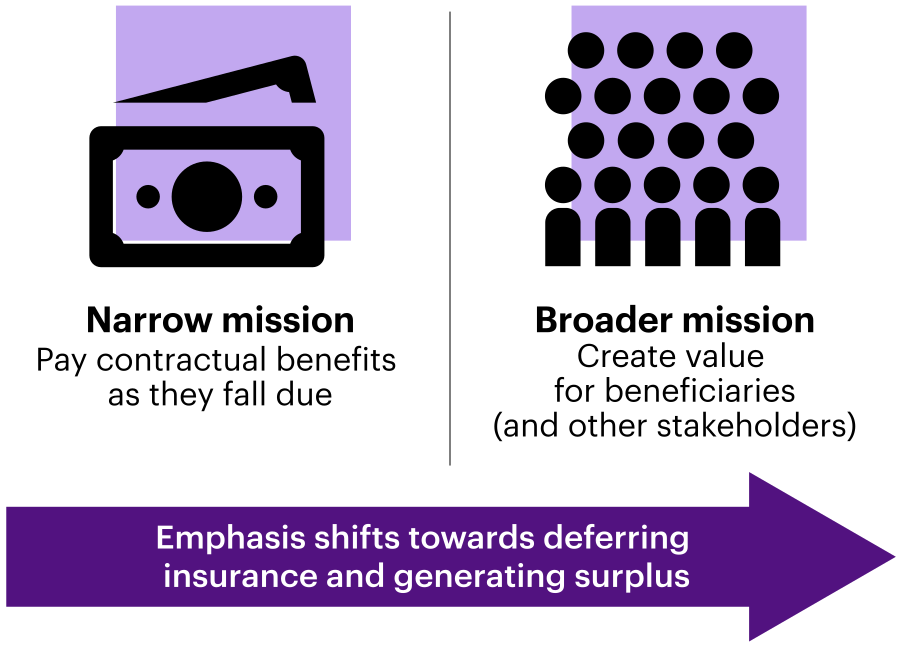
Narrow mission versus broader mission
“Our industry must challenge the idea that trustees are automatically duty-bound to insure as soon as they’re able. That is not defined in regulation nor prescribed in the vast majority of pension scheme governing documentation - there are legitimate choices available. These choices are about confidence in future decision-making, alongside what is genuinely in members’ interest.” – David Farmer, Trustee Director, IGG
With more clarity around our what we are ultimately looking to achieve we can now start to flesh out our mission. Ultimately, pension schemes follow three phases as shown in the diagram below.
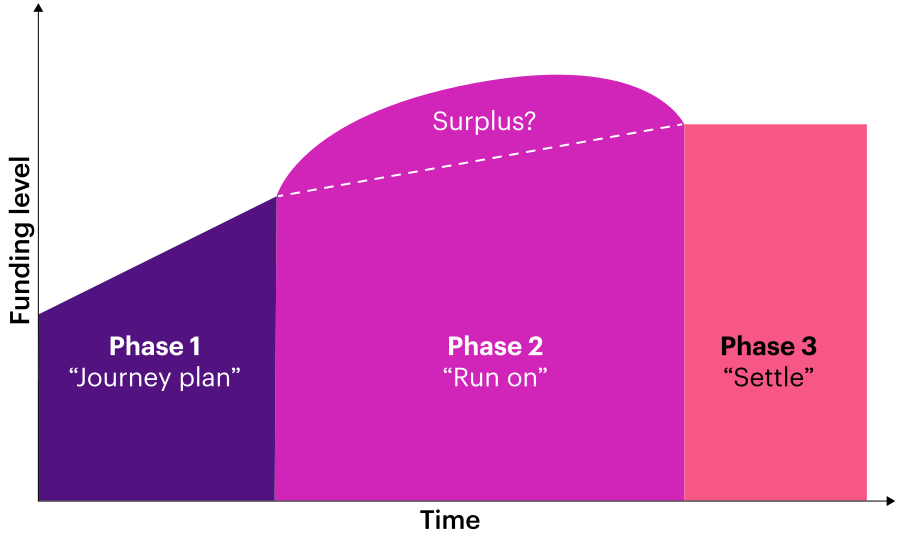
The lifecycle of a defined benefit scheme
The relevant question to answer here is “how long will your scheme spend in the run on phase?” and we can boil down our mssion statement as the answer to that question, namely:
- “Our focus is on securing the contractual benefits by transferring responsibility to an insurer and so we want to minimise the amount of time in Phase 2.”
- “We have the ability and willingness to create value for our beneficiaries and stakeholders, so we want to maximise the amount of time we spend in Phase 2”
- “Flexibility is important to us. So, while we plan to remain in Phase 2 for the foreseeable future, we would like the ability to change as necessary.”
“Sitting in the middle feels sensible - keeping options open and flexible. But that flexibility isn’t free. You’re paying a premium for that option, whether that’s lower returns by avoiding good assets, or taking a half-committed approach to being buy-in ready. The mistake is drifting into that position by default because it feels comfortable. Make sure you have a clear rationale, such as allowing time to extract value from illiquid assets or data improvement projects, not just convenience.” – David Farmer, Trustee Director, IGG
What this means in practice depends on a number of factors: the size of the surplus opportunity, how it could realistically be used (e.g., enhance member benefits, provide Sponsor refunds, cover costs, build risk buffers etc), and the balance of powers set out in the scheme rules.
“Many sponsors already see the value in running on to support DC contributions. The idea of repaying surplus will take longer to gain widespread acceptance, but innovators are showing what’s possible.
As ever, theory only goes so far. The conversation really changes when you put a number on it and compare it with other capital allocation decisions.” – David Farmer, Trustee Director, IGG
WTW recently surveyed around 135 schemes which suggested that the first of those factors – scheme size – will be an influential factor on the ultimate strategy. Insurance solutions continue to dominate for most schemes below £250 million, whereas run-on strategies become relatively more attractive for larger schemes (with over half of schemes over £1 billion opting to run-on indefinitely or for a specific period linked to surplus use).
Risk
What is clear from the context described at the start of this article is that Risk cannot be captured in a single metric. Risk is not Value at Risk or tracking error or peer comparisons. Risk is mission impairment – the events that stop us achieving our mission – and that needs to become our mindset across the DB industry.
When considering mission impairment, no single approach to risk measurement is likely to be appropriate for all risks to which a scheme is exposed. We need to be more agile by identifying ‘setback scenarios’ up front and accepting that multiple approaches to risk measurement will usually provide a richer insight than any single metric. Put simply: if a risk metric doesn’t tell you something useful about your ability to achieve your mission, it’s at best incomplete and at worst misleading!
“If you’ve done better than everyone else but still not achieved the ultimate objective – that’s not success. But equally, if you achieve what you want but lag behind your peers, that’s not failure either. We need to define what success means for each individual situation, so that we can better articulate what risk means to us.” – David Farmer, Trustee Director, IGG
A case in point: The Four Horsemen of the Apocalypse
Most return/risk models seek to predict the future by extrapolating past patterns. Simply, we assume the future “rhymes” with the past and typically the more recent past (i.e. using data from the last 20-30 years or so). That approach can work in a stable regime, but what if the next 20–30 years do not look like the last? Can we still rely on assumptions rooted in past dominance and industrial-era dynamics?
A helpful technique in this instance to add to our toolkit is reverse stress testing. Here rather than applying scenarios to the current state to predict the future state, we instead identify a future state that hurts us (e.g., funding level falls by X% which leads to mission impairment) and we seek to identify what could have caused that.
If we look back through history, we see four key risks (perils) that cause material losses to investors:
The Four Horsemen (perils)
| Peril | Sub-peril | Past | Present/new |
|---|---|---|---|
| Debt | Hyper inflation, default | Weimar Republic, Great Depression, GFC | Overindebted major economies |
| Conflict | Access to funds (cyber or capital), Value of funds (Civil war, world war) | Capital — 1930s, WW1, WW2 | US tariffs, Russia/Ukraine, Middle East |
| Nature | Pandemic climate, biodiversity | Plague, flooding | COVID-19 |
| Innovation | Bubbles, stranded assets | Dot Com, canals | AI, climate transition |
This technique has been used by insurance companies for decades to assess the resilience of their portfolios. With investment risks generally lower across DB schemes, it’s these tail risks that hurt.
Bringing this to life, consider a DB scheme that has largely de-risked into a simple portfolio of investment grade credit and liability matching assets. It has reduced investment risk (as measured by tracking error, VaR, and so on), buying safe assets providing cashflows to pay pensions. Job done, right?
AI is in almost every topic of conversation today and represents the innovation horseman under our perils above. So, let’s create a scenario where AI ‘works’ – what could that do to our safe portfolio? [1]
- Productivity increases, deflation occurs = our carefully constructed hedging portfolio generates losses as our index-linked exposures fall in value but our pension payments floor out at zero.
- ‘Old world’ companies become obsolete = many of our previously investment grade corporate bond holdings default.
- Unemployment rises, tax receipts fall = UK fiscal crisis resulting in our gilt holdings collapsing
- AI discovers miracle cures = a material increase in liabilities from longevity improvements.
The old rules would tell us that we’ve managed our risks – we’ve reduced our Value at Risk by selling equities and hedging our liabilities. But in this scenario one of the very things that would help us goes against those old rules and what risk models would tell us to do – holding technology-sector equities. The point here isn’t to predict that any of these outcomes will happen, it’s to recognise that the risks which matter most are often the ones least visible in standard risk frameworks.
“The risks that matter most to a scheme are often the hardest to model. Longevity is a good example – it improves quietly over time, then suddenly becomes material. If your risk framework can’t cope with that, it’s giving you a false sense of security.” – David Farmer, Trustee Director, IGG
Conclusion
Trustees don’t need another metric, another dashboard or another debate about whether one risk number is better than another. What they need is clarity about what they are trying to achieve, and about the things that could genuinely stop them achieving it.
When mission is clearly articulated, strategy becomes easier to design. And when risk is understood as mission impairment rather than a single number, it becomes possible to have more constructive, more confident conversations about trade-offs, uncertainty and opportunity.
As David Farmer at IGG observes, success in DB is about achieving the right outcome for your scheme, your members and your stakeholders – not outperforming peers or avoiding regret.
The DB landscape has changed. Many schemes now have real choices about what that endgame should look like. Rising to that opportunity means resisting easy narratives and being prepared to ask the fundamental questions.
Getting real about mission.
Getting real about risk.
And being deliberate about the journey.
We can help you navigate risk and achieve your endgame. Get in touch with a WTW collleague today to find out how.
Footnote
- Clearly there are some interacting offsetting factors across these points, e.g., productivity-led improvements in GDP mitigating the fall in tax receipts. Return to article