


Expanding diversification while maintaining disciplined liquidity
Semi-liquid funds can broaden access to private markets, offering potentially higher returns while diversifying income sources. However, they require investors to accept limited and conditional liquidity in exchange for exposure to largely illiquid assets. WTW believes semi-liquid strategies can add value when paired with disciplined manager selection, stress testing, and portfolio-level oversight.
60/40 is less diversified than ever
The traditional 60/40 public portfolio has become less reliable as the correlation between stocks and bonds has switched from being reliably negative to positive in recent years, diminishing the diversification benefits on which investors have historically relied. As investors seek alternative sources of return and diversification, private market strategies have become increasingly attractive. These strategies have historically delivered attractive risk-adjusted returns for long-term institutional investors, particularly relative to public equity comparators.
Private Markets vs MSCI World PME (%)
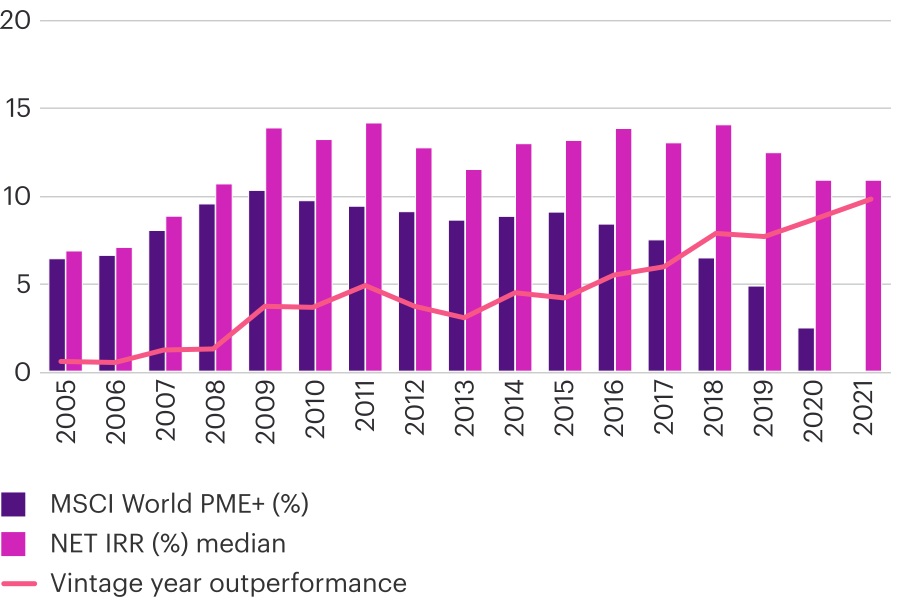
Private market returns have exceeded MSCI World PME+ across most vintages.
Source: Preqin Data to June 2024. Net IRR shown for the Preqin Private Capital Quarterly Index. Vintage Year Outperformance represents the outperformance of the private markets net IRR relative to the MSCI World PME for each vintage year.
Rolling 3yr Stock/Bond Correlation
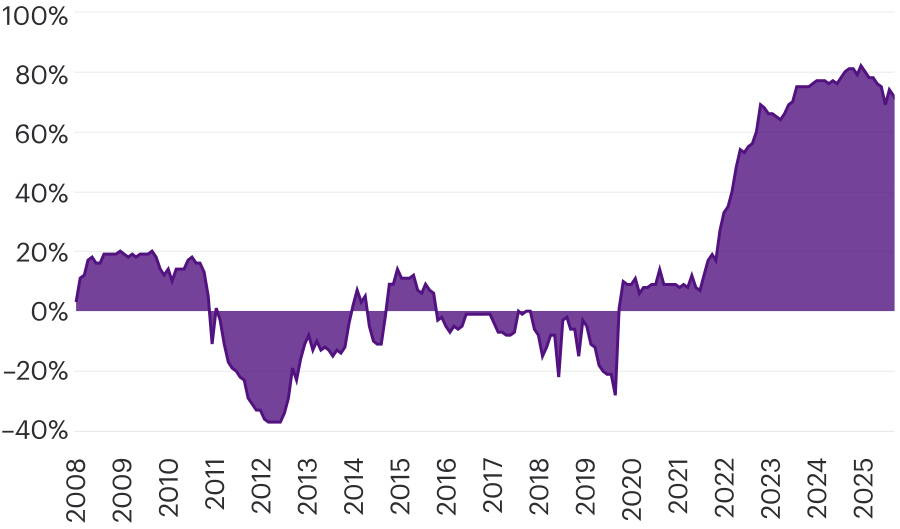
The correlation between stocks and bonds has switched from being reliably negative to positive in recent years.
Source: MSCI World Index (Net Total Return, USD) and Bloomberg Global Aggregate Index (USD Hedged). Data obtained from Dream (June 2026). Correlation is calculated using rolling 3-year windows of annual returns.
Understanding unique requirements of private markets
Access to these opportunities has traditionally been limited to institutional investors, but evergreen semi-liquid private market vehicles are expanding to wealth investors. However, to fully capture the benefits of private markets, investors must be prepared to invest over long-time horizons and accept reduced liquidity.
While redemption features can provide some liquidity, they are not guaranteed and may be subject to limits designed to protect investors and the fund's long-term strategy. Investors who do not fully understand these provisions may overestimate the liquidity available to them, particularly during periods of market stress.
In extreme scenarios, when many investors seek to redeem simultaneously, funds may implement additional liquidity management measures that further limit or delay withdrawals. Consequently, investors may be unable to access capital when and to the extent they expect.
Semi-liquid vehicles offer better design for wealth investors
Private markets have historically been accessed through closed-end structures with long lockups, intentionally aligning asset liquidity with investor capital commitments. Semi-liquid vehicles (e.g., interval or tender offer funds) introduce periodic redemption features—typically around 5% of NAV per quarter—but this liquidity is provided at the fund level, not guaranteed at the individual investor level.
In practice, this means investors may only receive a portion of requested redemptions during periods of elevated demand, particularly in stressed market environments. The perceived flexibility of these vehicles can therefore lead to misaligned expectations, especially if investors treat them as more liquid than they are.
This dynamic introduces several key risks:
- Redemption uncertainty during periods of stress
- Potential gating or prorating of withdrawals
- Failure to meet expected return outcomes
- Behavioral risks, including premature selling expectations
- Portfolio liquidity mismanagement if assumptions are incorrect
Education is key to successful adoption
Semi-liquid private markets solutions can be a valuable addition to investor portfolios. To incorporate them effectively, investors should align expectations, total portfolio construction, and manager selection with the realities of underlying asset liquidity.
- Adopt a long-term investment horizon of 5–10 years, regardless of stated redemption frequency
- Treat periodic liquidity as conditional—not guaranteed—and plan accordingly
- Incorporate liquidity budgeting at the total portfolio level
- Select experienced managers with demonstrated capability in managing liquidity, stress testing, and secondary transactions
| Access benefits (What investors can gain) |
Redemption benefits (What liquidity really means) |
|---|---|
| Access to private markets (private credit, private equity, infrastructure, real assets) | Periodic liquidity through scheduled redemption windows |
| Exposure to less efficient markets with potential for higher returns | Liquidity is conditional, capped, and subject to fund terms |
| Improved diversification versus public-only portfolios | Redemption may be prorated or deferred during stress |
| Lower correlation to public markets | Liquidity risk is shared across investors |
| Opportunity set expands | Exit timing and certainty are limited |
WTW’s approach to semi-liquid funds
Semi-liquid funds can enhance portfolios when their structural features, risks, and governance are clearly understood and aligned with investor goals. Due to the variability in fund structures and liquidity terms, continuous evaluation and oversight are essential.
WTW brings over 25 years of experience managing multi-manager evergreen semi-liquid vehicles, supported by deep expertise in portfolio construction and liquidity management to help mitigate risk. Our approach offers a level of flexibility that we believe differentiates us from other market participants. We encourage investors to connect with WTW to explore how semi-liquid strategies may fit within their portfolios and to learn more about our approach to managing these vehicles.
Disclaimer
Towers Watson Limited (trading as Willis Towers Watson) (Head Office: Watson House, London Road, Reigate, Surrey, RH2 9PQ) is authorised and regulated in the United Kingdom by the Financial Conduct Authority (FCA Register Firm Reference Number 432886, refer to the FCA register for further details) and incorporated in England and Wales with Company Number 05379716
This material is based on information available to WTW at the date of this material or other date indicated and takes no account of developments after that date. In preparing this material we have relied upon data supplied to us or our affiliates by third parties. Whilst reasonable care has been taken to gauge the reliability of this data, we provide no guarantee as to the accuracy or completeness of this data and WTW and its affiliates and their respective directors, officers and employees accept no responsibility and will not be liable for any errors, omissions or misrepresentations by any third party in respect of such data.
This material may not be reproduced or distributed to any other party, whether in whole or in part, without WTW’s prior written permission, except as may be required by law. In the absence of our express written agreement to the contrary, WTW and its affiliates and their respective directors, officers and employees accept no responsibility and will not be liable.
This material is intended for investors with long-term investment time horizons. The value of all investments and the income from them can go down as well as up. This means you could get back less than you invested. Past performance does not predict future returns.
Risk warnings
- This document is based on information available to Willis Towers Watson at the date of issue, and takes no account of subsequent developments
- Towers Watson Limited has approved this document for issue to recipients categorised as Professional Clients only.
- This material is intended for investors with long-term investment time horizons
- The value of all investments and the income from them can go down as well as up. This means you could get back less than you invested.
- Past performance does not predict future returns.
- Expected performance does not predict future returns.
- Tax treatment depends on the individual circumstances of each investor and may be subject to change in the future.
- The securities and derivatives investment activities which the Fund engages in may be speculative and involve a substantial risk of loss.
- The fund may be exposed to credit and/or default risk of issuers of debt securities that may be held within the fund.
- The issuers of any bonds within the fund may default or not be able to pay the bond income as expected.
- If the fund is denominated in a currency other than your home currency, movements in exchange rates may, if not hedged, have a significant impact on the value of (and income from) your investment.
- Shares/units in the fund may become illiquid and investors may redeem their investments only as stated in the fund’s prospectus.
Authors
Contact

Private Equity Investment Solutions
Invest in forward-thinking companies that are shaping the world around us