
Once considered an emerging investment opportunity, private market assets, which are not traded on public exchanges, now represent a growing share of global investor portfolios[1], marking a notable shift in how wealth is built and diversified. Investors are increasingly considering private markets for their potential benefits of higher returns, diversification and inflation protection.
Though portfolio construction is evolving, wealth managers continue to face unique challenges such as high fees, limited liquidity and a lack of transparency, meaning allocations to private markets are still well below those in institutional portfolios (read our previous article, What wealth portfolios are missing)
In this article, we will dive into the trends from WTW's Thinking Ahead Institute Global Wealth Study 2025 while exploring the barriers to innovation and outlook facing the industry.
Global wealth portfolio positioning
Historically, global wealth portfolios have maintained a conservative stance, with approximately 70% of assets allocated to traditional public equities and bonds[2]. However, the landscape is evolving. Across APAC, Europe, the UK and North America, allocations to private equity, private debt and other alternatives are increasing and wealth investors globally are diversifying beyond the traditional asset mixes[3].
Why the focus on accessing private markets?
Over the past two decades, private equity has consistently delivered double-digit net returns, substantially outperforming public equities, which have achieved on average 6–8% annualised returns.[4] So why is there still limited uptake?
According to our survey, high fees, limited liquidity and lack of transparency are the principal obstacles to broader adoption of private markets (Figure 1).
Regional differences are notable, with high fees being the primary concern in North America and Europe, liquidity in the UK and long lock-up periods in APAC.
A potential solution: The rise of evergreen funds in private markets
Innovative structures such as evergreen funds are transforming access to private markets. Unlike traditional closed-end funds, evergreen funds have no fixed term, allowing continuous investor subscriptions and redemptions. These vehicles typically provide periodic liquidity, lower minimum investment thresholds and streamlined onboarding. At the end of 2024, evergreen funds represented approximately 14% of private markets AUM (~$2.7 trillion), and forecasts suggest their market share could expand by nearly 60% by the end of the decade.[5]
Figure 2: Evergreen fund growth projections
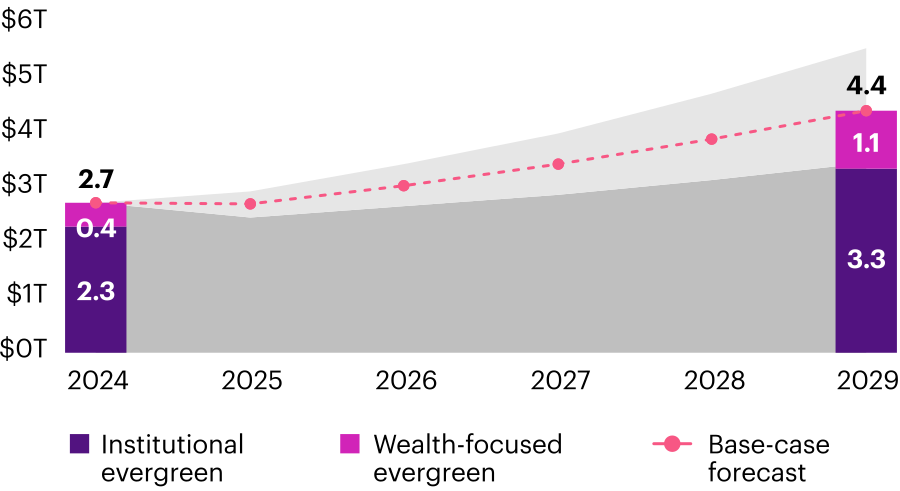
Forecasted increase in evergreen funds
Source: PitchBook, Geography: Global "Note: Forecasts were generated on April 14, 2025. "Institutional evergreen" includes insurance AUM from Blackstone, KKR, Blue Owl Capital, The Carlyle Group, Ares Management, Apollo Global Management, and Brookfield."
How do they stack up?
- Fee structures: Evergreen funds typically feature carried interest of 10–15%, compared to 20% for traditional closed end funds, with total expense ratios that are comparable to, or lower than, closed end funds over a ten year horizon.[6]
- Performance: Early data (figure 3) shows a significant dispersion in returns across strategies, with private equity primary funds and secondaries focussed strategies outperforming other asset classes. However, most evergreen vehicles remain untested through extended periods of economic uncertainty. This reality, combined with the long‑term performance characteristics of the underlying assets, makes drawing inferences based on short‑term results highly speculative.
Figure 3: Five-year evergreen fund returns
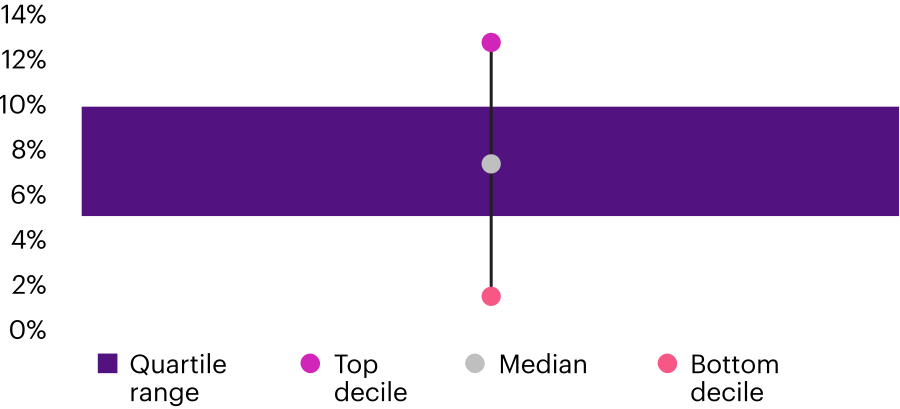
Dispersion of returns across strategies
Source: PitchBook, Geography: Global, June 2025. 40 constituent funds.
What if investors lack expertise, breadth or scale?
The complexity of due diligence and ongoing monitoring is driving a trend towards outsourcing private market allocations. While equities and bonds are often managed in-house, private markets are increasingly entrusted to specialist managers and platforms (figure 4).
Figure 4: Outsourcing private market allocations
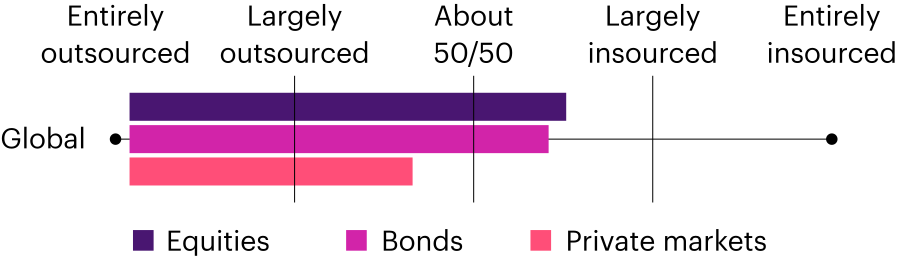
Distribution of outsourcing across private market allocations
Source: Thinking Ahead Institute: Global Wealth Study, August 2025.
Product innovation and digital platforms are broadening access, making private markets available to a wider spectrum of investors beyond institutions and ultra-high net worth individuals[7].
The need to evolve valuation and reporting practices
Investors are demanding transparency and the industry is responding. Quarterly and monthly valuations are becoming standard in evergreen and semi-liquid funds, yet most funds still depend on valuations from their underlying managers, with only a minority using independent third-party sources.[8]
Notably, over 70% of gains in SEC-registered evergreen funds since 2021[9] remain unrealised, underscoring a need for enhanced valuation and reporting standards to validate underlying exposures and performance[10]. Technology and data-driven tools are accelerating improvements in transparency, reporting and portfolio monitoring. With integration into investment managers' regimes set to continue.
Our research shows that, among the categories presented below, private markets rank as the second most promising source of investment opportunity for wealth investors, after tech innovation (figure 5).
This is notwithstanding the likely overlap across opportunities, such as the concentration of technology and innovation investments in private market asset classes like private equity and venture capital.
In conclusion
Asset allocation in the wealth management industry is evolving. Factors such as product innovation, outsourcing trends and the quest for diversified sources of risk and return are contributing to increased interest in private markets.
The coming months may represent an important phase in how wealth investors engage with private market investments, as access routes continue to broaden. At the same time, outsourcing, due diligence, market research and improvements in reporting standards will remain critical for providing clarity on liquidity, transparency and risk considerations. These elements will play a key role in helping investors position themselves on the right side of the evolving return story.
Looking ahead, we will be exploring more of these wealth management themes in our Key Trends for 2026 paper which we will release early this year alongside our annual Global Investment Outlook.
Footnotes
- Thinking Ahead Institute: Global Wealth Study, August 2025 Return to article
- Thinking Ahead Institute: Global Wealth Study, August 2025 Return to article
- Thinking Ahead Institute: Global Wealth Study, August 2025 Return to article
- WTW analysis, October 2025. Return to article
- PitchBook Analyst Note: The Return of Evergreen Funds Return to article
- The Price of Perpetuity Return to article
- Thinking Ahead Institute: Global Wealth Study, August 2025 Return to article
- WTW analysis, June 2025. Return to article
- Evergreens: The Tree That Never Sheds – A Closer Look at Performance, Risk, and Valuation Practices in Private Equity Evergreens, October 2025 Return to article
- Evergreens: The Tree That Never Sheds, October 2025 Return to article
Disclaimer
Towers Watson Limited (trading as Willis Towers Watson) (Head Office: Watson House, London Road, Reigate, Surrey, RH2 9PQ) is authorised and regulated in the United Kingdom by the Financial Conduct Authority (FCA Register Firm Reference Number 432886, refer to the FCA register for further details) and incorporated in England and Wales with Company Number 05379716
Author

Contacts