
In our 31 March 2025 update we summarised some of the areas many companies will be considering in relation to their Defined Benefit pension schemes. Given the change in the regulatory landscape, coupled with the improvement in funding levels, determining the long-term strategy for a pension scheme is likely to be at the forefront of many agendas. For example, is the goal to transfer the responsibility of paying members' benefits to an insurance company or a consolidator (such as a superfund), or is it to keep running the scheme with a framework in place around points such as the investment strategy and utilisation of surplus? There will of course be several considerations from both companies and trustees when agreeing on any strategy, however the accounting implications will likely form part of these, which again highlights the importance of carefully selecting appropriate actuarial assumptions when it comes to valuing pension obligations.
Key assumption trends
Discount rate assumptions
The discount rate assumption is used to place a value on the expected benefits payable over the lifetime of a pension scheme. There has been a notable increase in the discount rate assumptions being adopted over the year, driven by the rise in yields on AA-rated Sterling corporate bonds over that period (a similar trend has also occurred with yields on UK Government bonds, "gilts").
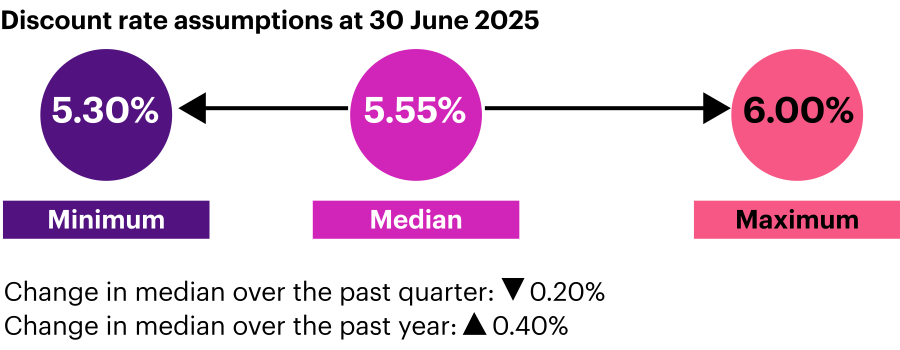
Discount rate assumptions at 30 June 2025
Inflation assumptions
Inflation assumptions are used to estimate how members' benefits might increase in the future. There has been a decrease in inflation assumptions over the year, with this typically reflecting the change in investors' views of future inflation (as the assumption is typically set with reference to market data).
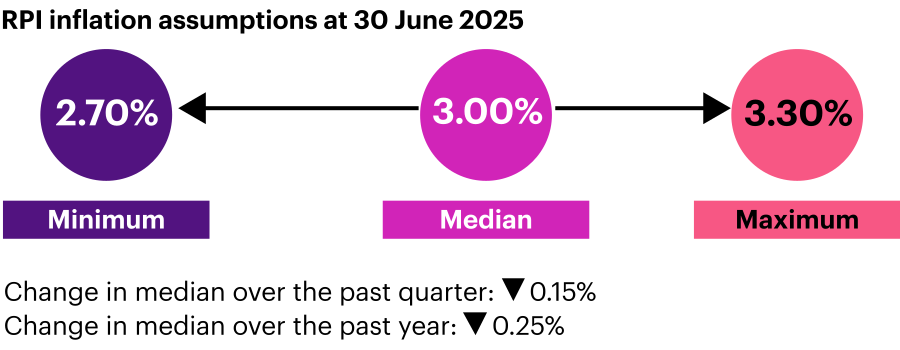
RPI inflation assumptions at 30 June 2025
Life expectancy assumptions
Assumptions around life expectancies estimate how long benefits will be paid to members and their dependants. Over the year, life expectancies have remained broadly unchanged. This was driven by the majority in our 30 June 2024 and 30 June 2025 surveys adopting the CMI 2023 mortality projections model, as the CMI 2024 model was released at the end June 2025. Going forwards, we expect to see life expectancies increase slightly as the recently published CMI 2024 model is adopted reflecting the latest post-pandemic mortality improvements.
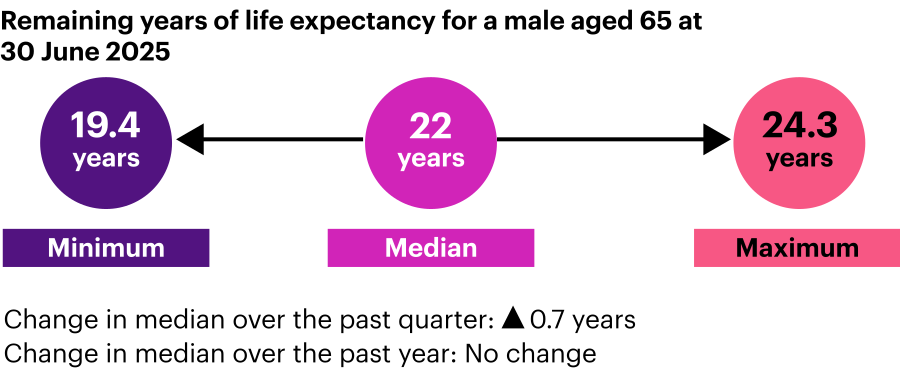
Remaining years of life expectancy for a male aged 65 at 30 June 2025
What does this mean for UK pension scheme disclosures?
Taking the above into account, we would generally expect liability values to have reduced over the year. In terms of the net balance sheet position, however, the extent to which this will have changed will depend on the specific circumstances of schemes (in particular, the investment strategy adopted over the year).
Contacts




Get the latest pensions news
Join the conversation on LinkedIn and keep up to date on industry trends, insights and thought leadership.