


When it comes to providing quality account management services at Willis, a WTW business, we pride ourselves on our Willis Claims Advocacy model. When taking out Professional Indemnity (PI) Insurance, it is important to understand the claims notification process to avoid any uncertainty and potential undisclosed claims, discoveries or unresolved circumstances.
The claims notification process provides a route for you (the policyholder) to report any claims or circumstances which may trigger your PI policy to your insurer. Having a clearly defined process enabling timely notification to your insurers in line with the conditions outlined in your policy is key to best practice claims management.
How to know if you have a claim vs. a circumstance to notify
Referring to your policy wording can highlight what is and what is not a claim/circumstance, as these are normally defined. The definitions below may vary depending on your policy wording, emphasising the importance of understanding what to notify.
A claim can be defined as a written or oral accusation of liability, alternatively, a suit or proceedings which may entail mediation, or alternative dispute resolution processes. Claims can also include formal investigations or disciplinary proceedings from professional bodies.
A circumstance can be a situation/activity which may reasonably give rise to the above definition of a claim. Although a circumstance does not always lead to a claim, they should still be notified as there is a potential exposure. Circumstances should be treated with the same sense of urgency as a claim since they may give rise to one in the future. Typically, we find that if you feel the urge to contact your Willis Claims Advocate to discuss a ‘circumstance’, then it probably is a circumstance that should be notified. However, at Willis, our expert Claims Advocates are here on hand to support our clients in navigating the more complex claims.
When to notify a claim or circumstance
- Claims should be notified via written notice to insurers as soon as reasonably practicable.
- Circumstances should be notified as soon as reasonably practicable, regardless of the possibility of it succeeding or if it exceeds your self-insured retention.
Any delay in notification once you are aware of a claim/circumstance may lead insurers to question its validity and compromise their ability to investigate further, which in turn could lead insurers to charge additional fees or the claim thrown out in its entirety.
Policy wordings may vary regarding the time and method, i.e. written notice via your intermediary or direct to insurers, in which you should report a claim/circumstance. Some policies state you should report claims/circumstances as soon as reasonably practicable, whilst others will allow for quarterly reporting via bordereau.
Claim notification process
The diagram below sets out the clear process from becoming aware of a circumstance or claim and the internal protocols that should be followed, and when to engage your Willis Claims Advocate. All circumstances and claims must be reported to your COO/Risk Partner and notified to your insurer via your Willis Claims Advocate. As above, it is important to have clear, defined procedures in place to ensure smooth claims handling, ultimately impacting the speed at which claims are settled.
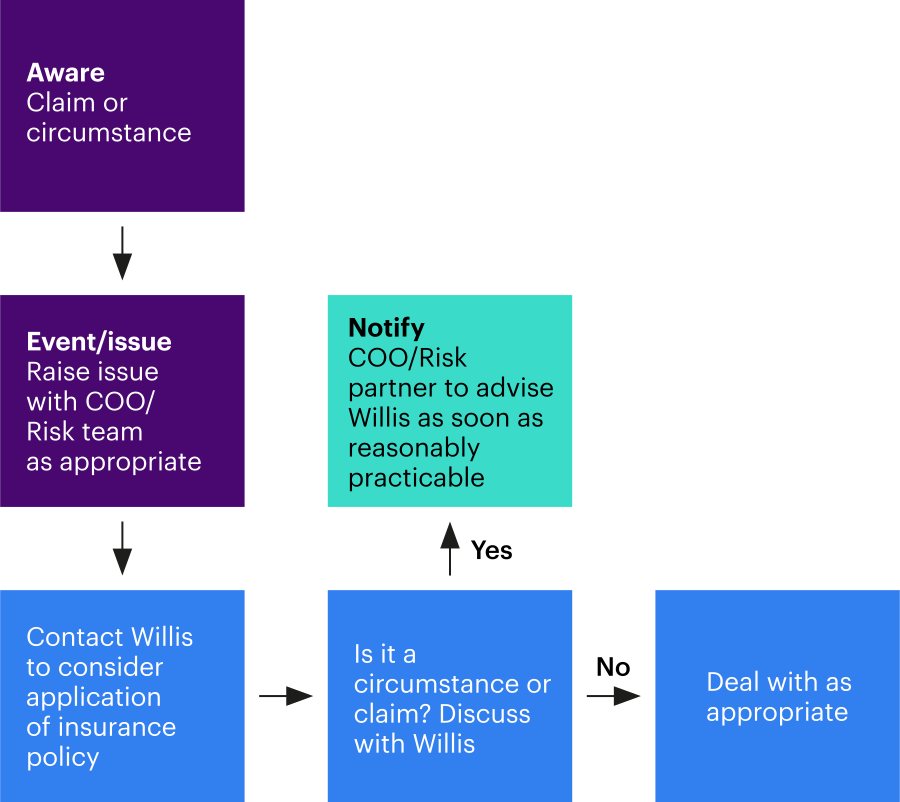
Claims notification process
During a claim: When engaging with insurers
When engaging with insurers, there are a few examples of what not to do and what practices to follow to ensure a smooth process. See below for helpful guidance:
| Actions you must refrain from | You are required to |
|---|---|
|
|
How Willis claims advocates protect your interests

Pre-notification advice
Your Willis claims advocate will provide pre-notification advice on how your insurance policies work and how to avoid common pitfalls in notification and claims management. Our experience informs us that it is critical that a Claims Advocate is involved from the outset to prevent insurers from becoming entrenched in any potential misunderstanding of a claim. Optimal results are achieved when claims advocacy starts before the notification of a claim. They will respond quickly to new issues and notifications and guide you through any fast-moving situations that may arise. In addition, your Willis claims advocate can provide workshops tailored to your needs, which may include horizon scanning and notification workshops or sessions to talk through case studies and how your policies may respond in the event of a claim.

Ongoing support that ensures timely and economic settlement
Your Willis claims advocates will provide ongoing advice and support for claim notifications and ensure the timely and economic settlement of claims. Our scheduling of regular claims review meetings allows us to discuss open and potential notifications efficiently and effectively while maintaining transparency, handling and progressing claims. Regular claims review meetings enable us to keep insurers updated and to identify and advise you on any red flags before disputes escalate.

Effective management across all parties
Your Willis claims advocate also helps relieve some of the pressure by liaising with your internal legal team, external counsel, insurers and their counsel, whilst facilitating with you to build relationships with claims underwriters. In doing so, we establish regular contact to discuss with them their claim philosophy, authority levels and any potential process improvements. This regular dialogue assists with the prompt and efficient handling of claims when they do arise.
Authors



Professional indemnity insurance contact