


AI is reshaping work, but much of the conversation around it remains either somewhat technical (e.g., LLMs, agents, tokens) or unnecessarily alarmist (i.e., headcount reduction). For HR leaders, neither perspective is particularly helpful.
What matters is understanding how AI truly changes the organization’s operating model, what it means for work and skills and how HR can lead — rather than react to — this shift.
The impact of AI is multidimensional, not unidimensional
It’s important for HR and business leaders to realize that AI is not a single intervention with a predictable outcome. Like all transformative technologies, its impact plays out across multiple dimensions of the organizations — and those dimensions move at different speeds (Figure 1).
Figure 1. AI impacts multiple organizational dimensions
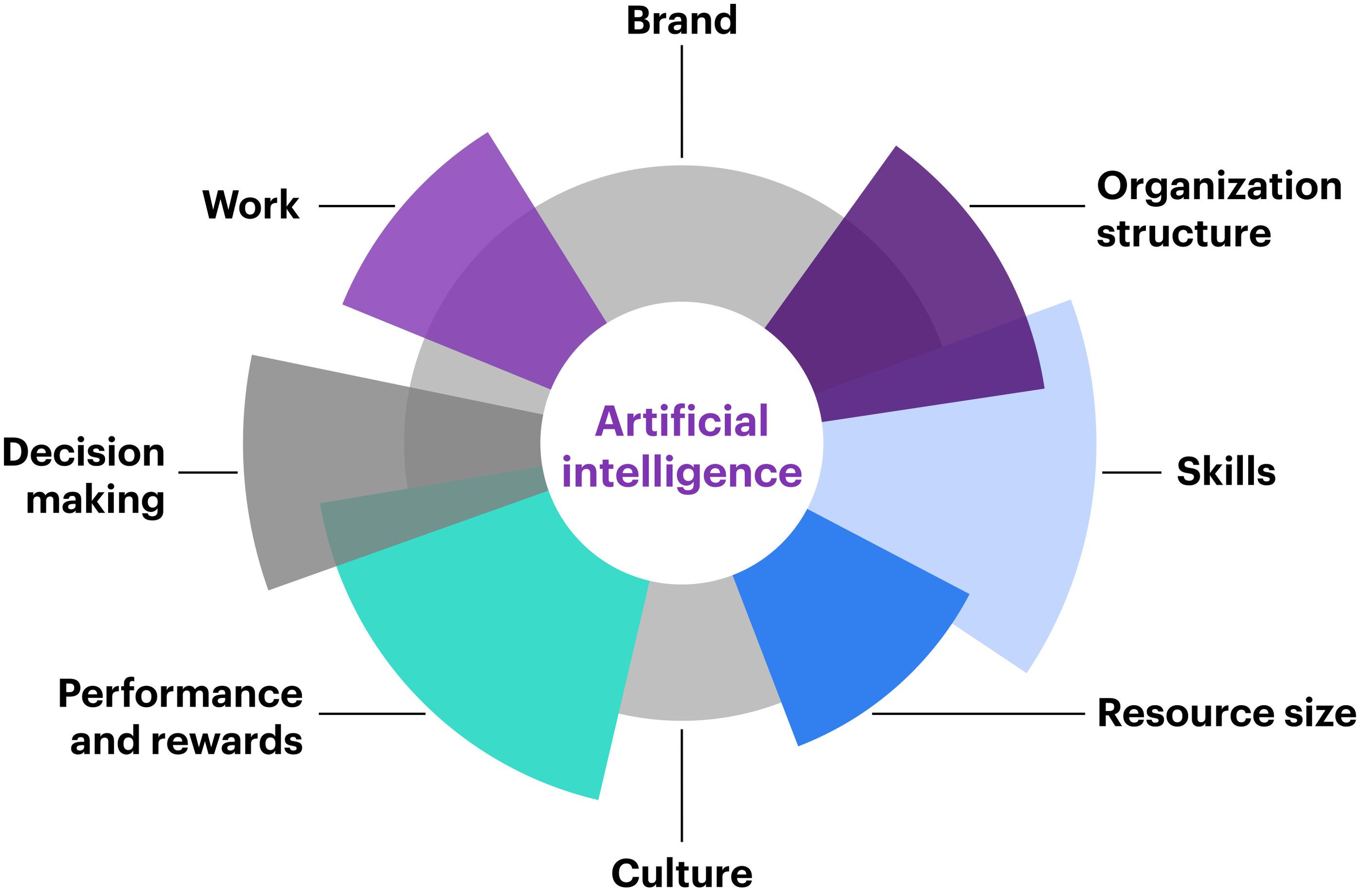
AI influences multiple dimensions of the organization simultaneously. HR leaders must address these interconnected changes as part of a broader enterprise transformation agenda.
AI affects:
- How work is organized and delivered
- Which skills matter and how quickly they change
- How value is created and rewarded
- The expectations placed on leaders and the culture they shape
- Who makes decisions and how that is visible to the organization
- How much capacity is required to get the work done
- How managers and employees spend their time
- Risks that the company is exposed to and, consequently, the company’s reputation and brand
The key point is that AI does not change one thing at a time. Progress in technology without corresponding shifts in skills, governance or organization design limits value and increases risk. For CHROs, this means AI cannot be treated as a discrete “technology initiative.” Rather, it’s an enterprise change agenda, with people, work and culture at its core. And to make matters more complex, AI-driven change is non-linear, so is affecting different elements of the business and organizational models asynchronously.
Case example: AI that spans organizational operations
One of the world’s leading car makers based in Europe is using AI across its entire operations to:
- Achieve improved quality performance (a level of inspection not possible by humans)
- Reduce the cost of operations by increasing efficiency and throughput
- Improve employee satisfaction through the democratization of AI tools
The company is empowering employees at all levels to engage with AI and foster a culture of continuous improvement and digital literacy. Non-technical staff can use AI to accelerate their learning and take on responsibilities that typically were out of bounds for them.
More importantly, their governance model has moved from small, local pilot projects and separate ethical guidelines to one centralized platform. As their divisions scale generative AI and meet regulations like the EU AI Act, governance is now built directly into the tools employees use. This helps ensure everything stays secure and compliant.
Addressing the noise around job displacement
There has been no shortage of commentary predicting widespread AI-driven job losses. While it’s understandable that this narrative creates anxiety, it oversimplifies what actually is happening in organizations.
For example, a large proportion of recent job losses in the technology sector are due to a shift in capital and product priorities — not the work going away because of AI. “The phenomenon of AI taking jobs and reducing hiring is somewhat artificial,” according to Tom Davenport and Laks Srinivasan in a recent Harvard Business Review article (subscription required).
AI is less about eliminating jobs and more about changing the dynamics of work, eventually leading to new operating and economic models for the company. At an individual level, AI enables the automation or augmentation of tasks, leading to greater effectiveness and more capacity. When AI is applied to workflows at scale, it creates capacity for undertaking new forms of work. This translates into a redesign of existing jobs or completely new types of jobs being created.
A more useful way to frame the opportunity, then, is that in an AI-enabled organization headcount should increasingly no longer be the primary constraint on getting work done or achieving growth. Organizations will be able to scale output, quality and innovation without adding — or eliminating — people at the same rate. That shift has implications for workforce planning, productivity measurement and how we think about value creation, but it doesn’t equate to a straightforward reduction in jobs.
HR has an important role to play in reframing this conversation, moving it away from fear toward capability, adaptability and opportunity. HR should actively shift the conversation away from using AI to reduce headcount to seeing AI as an enabler of getting work done differently. In fact, one could go as far as saying it’s quite likely that, as companies grow, they likely will need more resources — but it would be to do things that weren’t done before.
The impact of AI on work and skills
The most immediate and lasting impact of AI is on the nature of work itself — and, by extension, the skills required to perform it. Three dynamics are happening simultaneously (Figure 2):
- New skills are emerging, particularly related to AI, data and adjacent domains
- Existing roles are changing as AI is used to improve speed, quality and decision making
- Some current skills are becoming less relevant, especially those linked to routine or rules-based tasks
Figure 2. AI’s impact on work
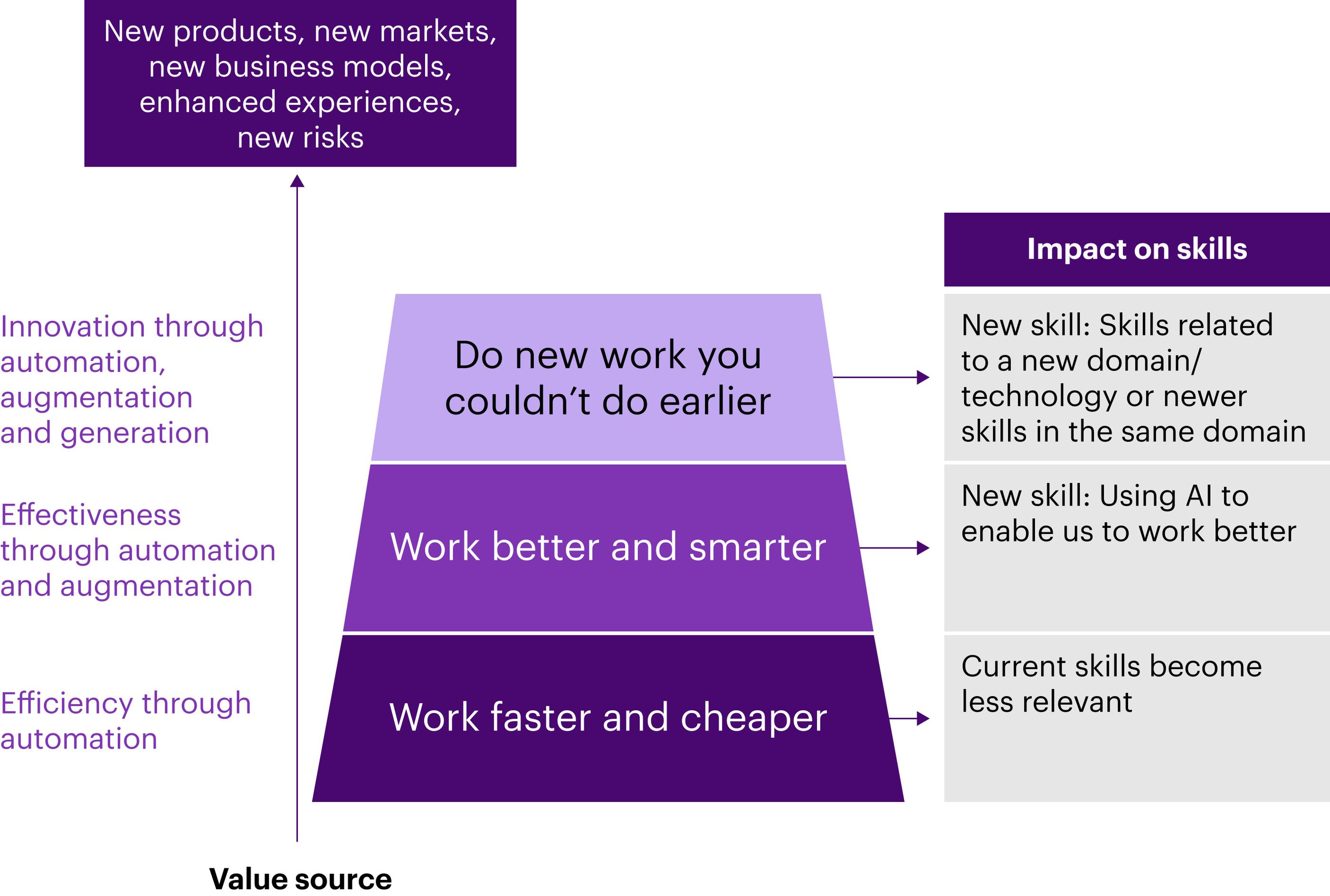
AI reshapes work through three simultaneous shifts: the emergence of new skills, changes to existing roles and the declining relevance of some routine, rules-based skills
At the same time, the long-term trend is clear: There is likely less emphasis on technical or task-related skills and more emphasis on judgment, problem solving, integration, interpretation and creativity — often enabled by AI tools.
For HR, the challenge is redesigning work and creating new skill pathways so people can continue creating value in a changing environment rather than predicting which jobs will disappear. This puts reskilling, workforce mobility and continuous learning at the center of the HR agenda.
The work in different parts of the HR function itself proves to be illustrative. In a “normal” world, a compensation analyst tasked with undertaking market-pricing work or evaluating a request for a pay increase would tediously run Excel spreadsheets with data collected from multiple sources. This effort typically takes about eight to 10 hours, especially if data is not in one location and multiple steps are involved in developing salary recommendations.
With AI, this effort can be reduced to minutes, allowing the human role to focus on engaging internal stakeholders and applying sound judgment to decisions. While in early stages, the human-in-the-loop is probably spending more time than expected in ensuring that the data is accurate. In the longer run, the human will need to strengthen their consultative and influencing skills.
The opportunity for HR
AI presents HR with a dual opportunity: Transform how the function itself operates and enable the broader organization to realize value from AI. Within HR, AI can be used to:
- Drive operational efficiency
- Accelerate insight and decision making
- Improve service delivery and employee experience
- Enable innovation across the spectrum of services it provides
This isn’t about automating HR for its own sake. It’s about freeing capacity so HR can focus on higher-value work that addresses its customers’ needs speedily and with impact.
Equally — and perhaps more importantly — HR plays a central role in helping the organization deploy AI effectively by:
- Building workforce capability through targeted upskilling
- Creating AI fluency across roles and levels
- Establishing governance and guardrails for responsible AI use
- Shaping organization design and culture to support adoption at scale
- Accelerating the organization’s “clock speed” and drive better experiences for customers and employees
- Build middle manager capability in enrolling employees in the use of AI
This is where HR’s influence truly matters. AI will not deliver value without the right skills, structures and leadership behaviors in place (Figure 3).
Figure 3. HR's dual opportunity
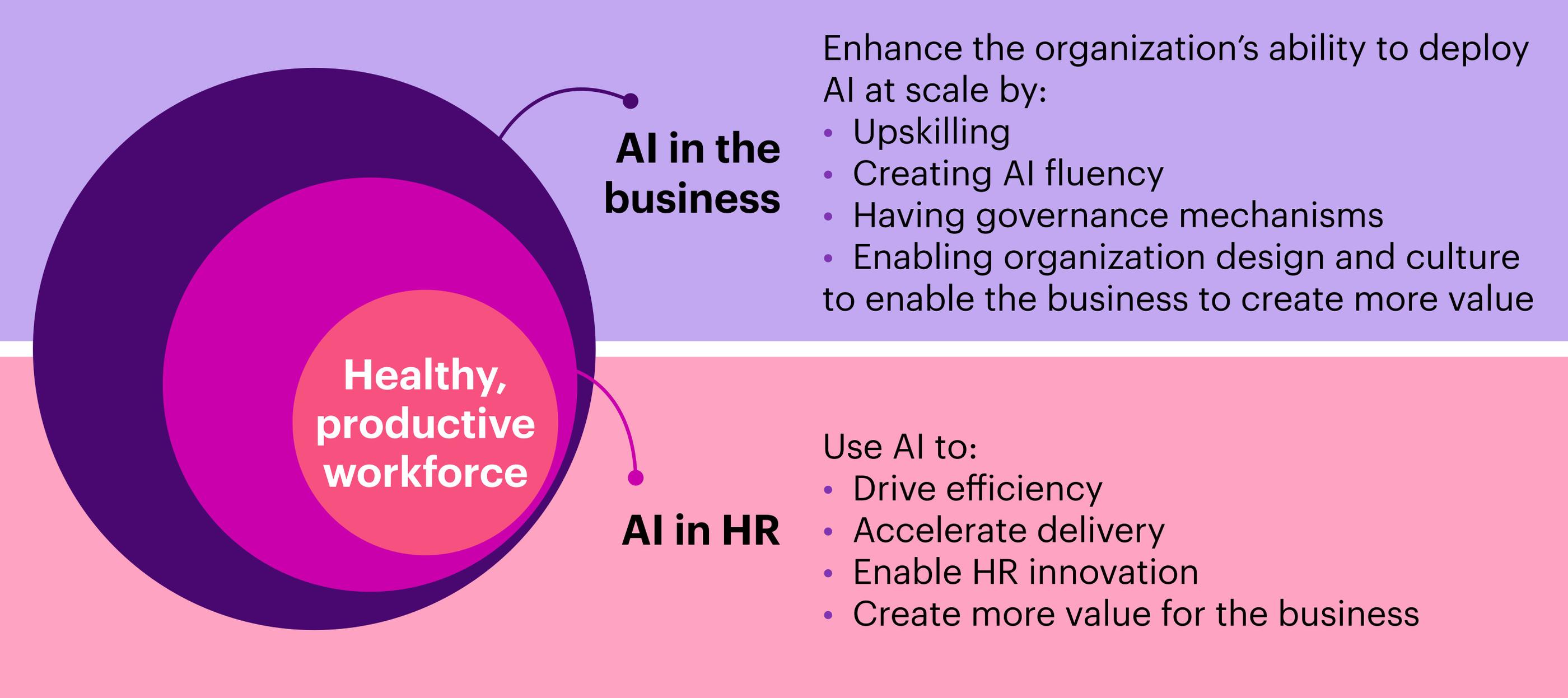
HR has a dual role in the age of AI: Transforming how the HR function operates while enabling the broader organization to build capability, govern AI responsibly and realize business value from adoption.
What CHROs should do now
As AI continues to evolve, the most important move for HR leaders is to shift from observation to intent. A small number of focused actions can help create clarity, build confidence and unlock value.
AI doesn’t create value on its own. Value emerges when AI is aligned with work design, skills, culture and leadership. For CHROs, this isn’t simply another transformation to manage — it’s an opportunity to help shape how work evolves and organizations grow.
HR shouldn’t be on the periphery of this conversation. It should be leading it.
Author

Learn how we can help
Let’s connect to find solutions for your organization’s unique challenges.
AI Workforce Transformation
Turn AI ambition into workforce redesign for real business value.
Featured content
WorkVue
See work more clearly so you can change it with precision.