


Part of this increased take-up is a growing awareness that some of the challenges traditionally associated with illiquid assets may not be as testing as previously thought. Illiquid assets can be critical to many investors looking to help deliver their required returns in a challenging environment; if you are not among them, it may pay to consider being an early adopter.
Most commentators would agree that returns are hard to come by right now, thanks to historically low yields in many public markets. Following a long positive run, the scope for further growth in mainstream assets also looks more limited. Meeting the investment objective in this environment might therefore mean increasing market exposure, or relying more heavily on active managers, neither of which are without their risks.
Instead, more institutional investors are turning to private market opportunities, where the rewards associated with illiquidity and complexity can bridge the return gap but where assets also aren’t generally as ‘illiquid’ as the label might suggest. Investing in areas that others cannot enter (for example, due to a short investment timeframe or relative lack of governance) can mean attractive prices, a high return for relatively low risk and a wider array of exit options than perhaps expected.
Nothing talks louder than returns and recent evidence points to superior returns from private markets compared to public markets. In recent years private markets have outperformed public markets by 4.8% pa, as illustrated in the figure below ”Katie Sims | Head of Multi-Asset Growth Solutions
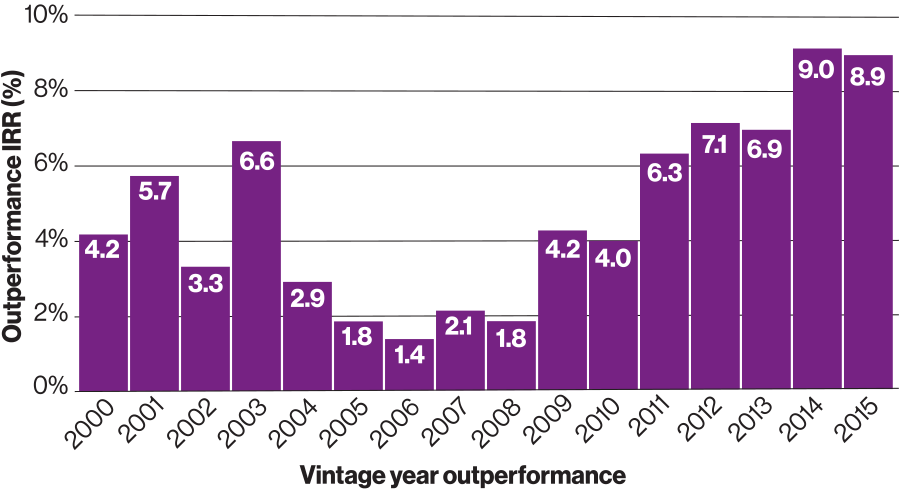
Performance of private markets relative to public equities
Source: Preqin data to Q4 2018
Please note that investment returns can fall as well as rise and that past performance is not a guide to future investment returns.
Download the full article to learn how investors, with a long enough time horizon and enough governance, can access these assets which can provide an attractive return premium.
Download
| Title | File Type | File Size |
|---|---|---|
| The case for illiquid investmentsPDF | .9MB |