

Zurich / Lausanne / Geneva, July 9, 2026 – Swiss pension funding levels recovered sharply in the second quarter of 2026, with WTW’s Pension Index rising by more than 6%. The rebound marks a return to positive momentum after the decline recorded in the first quarter and was driven primarily by strong investment performance, while pension liabilities remained broadly stable. The improvement underlines the resilience of Swiss pension funds. Looking ahead, the continued sensitivity of funding levels to market movements reinforces the need for a disciplined, long-term approach in an uncertain economic and geopolitical environment.
WTW’s Pension Index increased by more than 6% during the second quarter of 2026, rising from 123.5% to 130.2%, reflecting a significant improvement in company pension balance sheet positions. Discount rates increased marginally by 2 basis points during the quarter, from 1.10% to 1.12%. As a result, defined benefit obligations remained broadly flat. At the same time, pension fund assets posted a strong gain of 5.6%, which was the principal driver behind the improvement in funding levels. The second-quarter results therefore reversed the negative trend seen at the start of the year.
The pension fund index of WTW’s Swiss Pension Finance Watch is published quarterly by the consultancy and is based on the International Accounting Standard 19 (IAS19) and US GAAP FASB ASC 715. The index gives an indication of how the general funding position under these accounting standards has changed from quarter to quarter, as opposed to giving the typical funding ratio of Swiss pension plans.
Strong asset gains drive recovery in Swiss pension funding
The strong improvement in funding levels during the quarter reflects both favourable market developments and the robust financial foundations of Swiss pension schemes. “The second quarter illustrates how quickly company pension balance sheet positions can recover when there is strong asset performance and stable liability developments,” says Adam Casey, Head of Corporate Retirement Consulting at WTW Switzerland.
In his view, the recovery observed reflects the benefits of maintaining sound funding foundations and a disciplined long-term approach to asset management. “Generally healthy local reserving levels continue to provide an important cushion against short-term market fluctuations, allowing pension schemes to remain focused on their long-term objectives.”
Constructive markets lift funding levels, but uncertainty remains
The second quarter of 2026 was characterized by a more constructive environment for institutional investors. Although market participants remained attentive to developments in international trade, geopolitical tensions and global growth prospects, market conditions improved compared with the beginning of the year.
Central banks continued to follow different policy paths during the second quarter. Expectations regarding future interest-rate developments evolved throughout the period as monetary easing continued in Europe, while the U.S. Federal Reserve maintained a more cautious stance. These developments contributed to ongoing volatility in bond markets.
Equity markets regained momentum, supported by solid corporate earnings, continued enthusiasm for artificial intelligence-related investments and evolving expectations regarding monetary policy.
WTW Pension Index - Switzerland
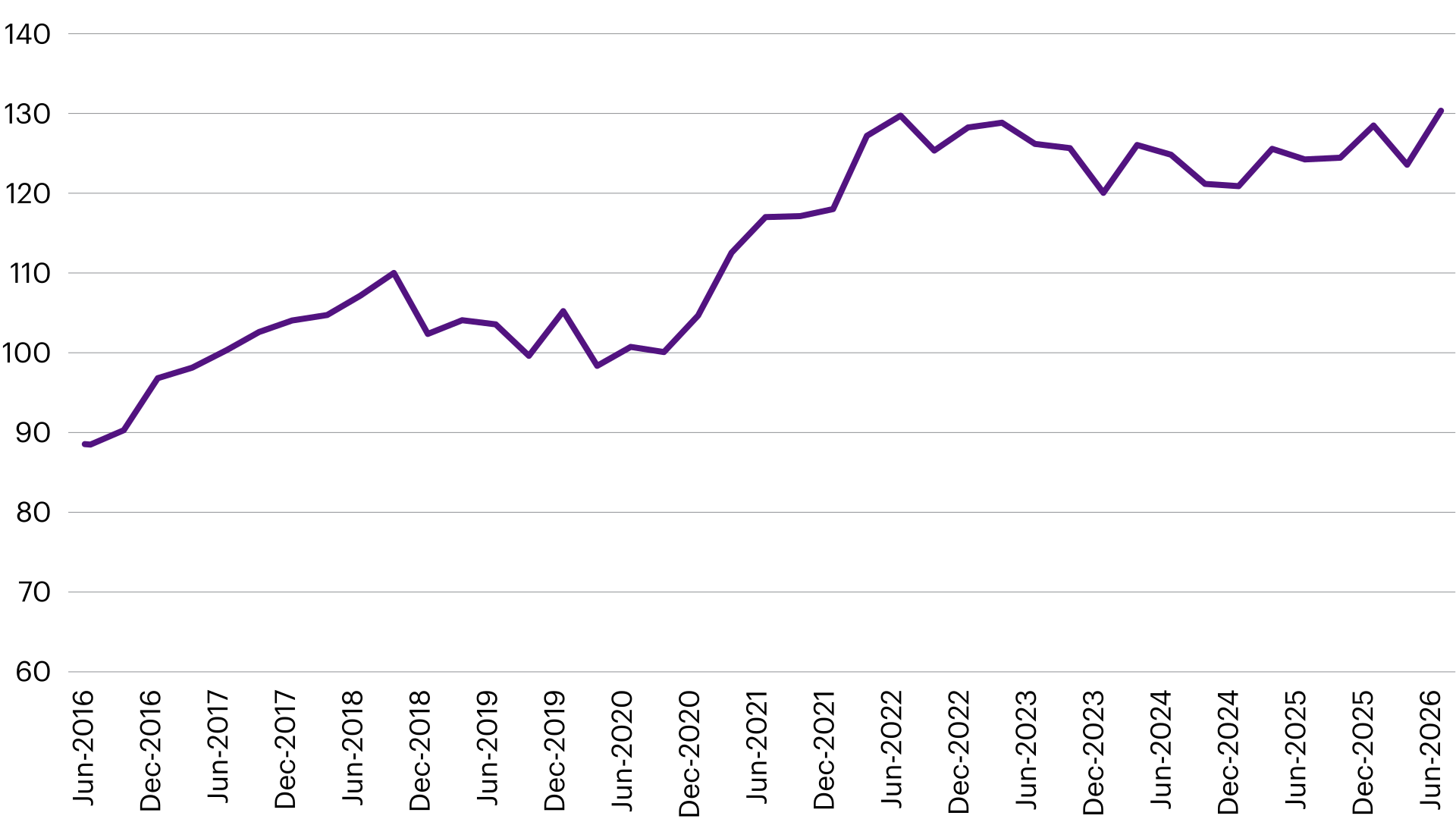
The Pension Index measures the movement in the ratio of the assets to the defined benefit obligation of a sample pension plan with index level 100% on 31.12.2006.
Long-term discipline remains key for pension schemes
Alexandra Tischendorf, Head of Investment at WTW Switzerland, says the second quarter reinforces the need to assess market developments in the context of long-term funding objectives. “Following the volatility experienced at the beginning of the year, investors increasingly focused on economic fundamentals and longer-term growth prospects, contributing to stronger market performance during the quarter,” she adds. “While market conditions improved during the second quarter, the outlook remains subject to a range of evolving economic and geopolitical factors. In this environment, robust governance and a long-term perspective remain essential for achieving sustainable outcomes for pension funds and their beneficiaries.”
Background information on the study
Swiss Pension Finance Watch reviews quarterly how capital market performance affects pension plan financing in Switzerland. The study is part of the Global Pension Finance Watch from WTW which includes results back to 2000 for major retirement markets worldwide. The results are published quarterly with a focus on linked asset/liability results. It covers pension plans in Brazil, Canada, the Euro-zone, Japan, Switzerland, the U.K., and the U.S.
The impact of capital markets on these pension plans is two-fold:
- Investment performance on fund assets
- Changes in economic assumptions on plan liabilities (as measured by international accounting standards)
WTW’s model defines a benchmark pension plan that is intended to be representative of the pension liabilities and plan assets (including asset mix) that are typically found in each global market. The impact of movements in capital markets on assets and liabilities is combined to produce a Pension Index which reflects the movement in the funding level of the benchmark pension plan.
About WTW
At WTW (NASDAQ: WTW), we provide data-driven, insight-led solutions in the areas of people, risk, and capital. Leveraging the global view and local expertise of our colleagues serving 140 countries and markets, we help organizations sharpen their strategy, enhance organizational resilience, motivate their workforce, and maximize performance.
Working shoulder to shoulder with our clients, we uncover opportunities for sustainable success - and provide perspective that moves you.
In Switzerland WTW is based with offices in Zurich, Geneva, and Lausanne.