
Humanity is developing at an astonishing rate, with the population of the globe recently assessed as having passed 8 billion in November 20221. The trend toward living in urban environments is also accelerating with over 65% of people projected to be living in cities after 20502. For most this means striking improvements in prosperity, but there are significant downsides.
Our urban environments are imperfect; 58% of cities are prone to at least one kind of natural disaster2. They may overheat or flood and, with the effects of climate change, the burden of drought and disease are putting the provision of food and health services under stress.
The built environment itself often amplifies natural hazards. Hard surfaces contribute to urban heat islands, accelerate run off during rainstorms and contribute to reduced water quality. The construction materials we use also hasten climate change and the amounts of materials we are using is accelerating. Globally cement contributes 8% of global emissions4. Between 2011 and 2013, China poured more cement than the US in the entire 20th century3. There is every indication that this trend has been sustained5. With emissions as high as this there is a clear need to seek solutions which don’t have such a high environmental cost.
We are exceeding the capacity of the natural environment to carry us and have to modify our behaviours…
We are exceeding the capacity of the natural environment to carry us and have to modify our behaviours so as to close the loop on our impacts. We need to remember that there is no economy without the ecosystems which give us life support. The pressing need to find sustainable solutions has featured highly in recent deliberations like the talks at COP15 and COP27.
Nature Based Solutions (NBS) have the potential to answer some of these questions and mitigate many of the pitfalls of traditional engineering. There is a wealth of different takes and names for what comprise NBS. Essentially, they all seek to provide services using natural and sustainable habitats. These services might include but are not limited to flood management, clean water, disaster risk management or food, sometimes all at once.
For example, under the guidance of the University of Arizona, the city of Tucson is buying up flood prone lots and converting them into combined play areas and flood ponds, incidentally enhancing recharge in an arid region. Across Australia urban authorities are collaborating to form the Australasian Green Infrastructure Network. One of their aims is to establish city planning practices encouraging the adoption of green walls, roofs and facades to mitigate extreme heat and flooding.
Alongside city scale interventions governments are changing their approach and developing standards and guidelines. In the UK CIRIA C802 2022 sets guidelines for fluvial flood managers. A number of jurisdictions (especially UK, Netherlands, US and Canada) have cooperated in the production of the USACE Natural and Nature based solutions Guidelines 2021 and the University of Waterloo in Ontario has published guidance which is due to be adopted in Canada.
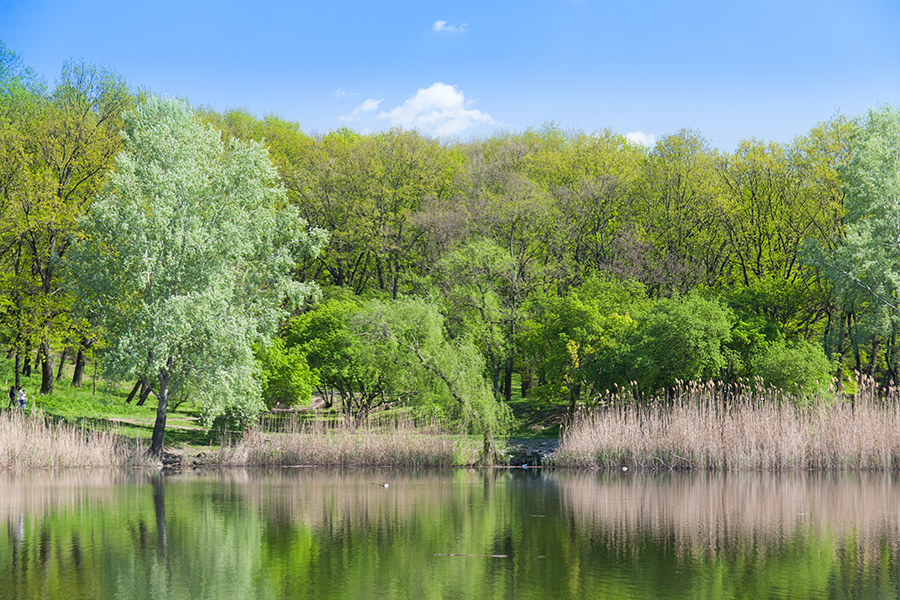
Image of willows on a riverbank.
Some interventions like the use of willow spilling to manage riverine erosion are ancient and nearly lost crafts. Many measures are effective and frequently used. But we live in an age where the quantification and the measurement of benefits for business case development are paramount to the selection of preferred options and the understanding of risk. Nature based solutions are enticing but sometimes struggle in the face of quantitative cost-benefit analysis. Not because they are ineffective but because it is more complex to apply cost benefit analysis to natural systems than engineered solutions. This can act as a barrier to proposing and implementing NBS.
Sometimes though the benefits are well described. Within the USACE guidelines the use of reefs to mitigate the affects of storm surges is illustrated as follows:
Across 3,100 km of the U.S. coastline :-
1m of coral reefs prevents the 100-year flood from growing by 23%
53,800 people (62% of the population) avoid flooding effects
US $2.7 billion in damages to buildings avoided
US $2.6 billion in indirect economic effects7 avoided
This kind of precision is very helpful to proponents of NBS and is more common with coastal flood management projects. Though there are exceptions, the potential for fluvial flood management or water quality management are less clearly elucidated. Even with well understood topics the assessment of whole life costs and benefits and post implementation monitoring are acknowledged to need more research7.
In fluvial contexts benefits are often harder to find, meeting societal expectations of flood risk reduction with NBS alone is often beyond the reach of catchment based approaches. Land earmarked for use for flood management may be required for a range of other uses such as energy generation, food production or housing. Therefore inland NBS may be a component of overall land and water management activities.
Almost all NBS projects have extensive co-benefits, perhaps to tourism, fisheries, water quality or in carbon sequestration. Like the intended benefits they are tricky to assess and require post construction monitoring to be assured of benefits realisation. There is a tendency for proponents of NBS to view proposed solutions through the lens of their discipline, seeking benefits from within their silo. There are good examples of where this has been addressed at inception stage but there are barriers to best practice.
The UK government recently published “Nature Markets: A framework for scaling up private investment in nature recovery and sustainable farming8”. This provides helpful guidance as to how to untangle the complexities around silos. The framework explains the concepts of bundling or stacking benefits to allow them to be claimed for or sold to investors. Bundled benefits may be sold collectively in a single unit whereas stacked ones may be sold individually. For example, planting woodlands may sequester carbon and reduce flood risk. If stacked, the benefits of carbon capture might be sold to or funded by a different beneficiary to the flood management benefit. Bundled benefits would be bought together. Nature Markets is a recommended read as it sets out a range of positions on the state of (UK) markets with principles to ensure integrity and good social outcomes as well as suggesting rules and standards. There is undoubtably more work to do to make sure that there is a level playing field.
With NBS we should seek to improve ways of assessing projects. With more novel techniques there may be many more questions to answer. The Green Finance Institute aims to steer public and private capital in the transition to a resilient and sustainable economy. They recognise that for investors this means secure and profitable schemes which are based on credible evidence. Furthermore, such schemes should allow for maintenance and assurance.
As the world warms agroecological zones will migrate. Simplistically this means that where a species or ecosystem once flourished, it is likely to need to move to cooler locations by moving poleward or upward. Practitioners of ecosystem restoration need to reassure investors that their proposals are resilient to the pressure of climate change. This can be achieved by creating additional reservoirs of habitat to supplement any damage, by providing insurances which repair damaged ecosystems or choosing options with a lower sensitivity to change.
Apart from the common sense understanding that there is only one planet, and we have damaged the ecosystems which nurture and support us, the drivers to deepen and widen the use of NBS are growing. The existing Taskforce on Climate related Financial Disclosure (TCFD) is now complemented by the Taskforce on Nature-related Financial Disclosure (TNFD). The TNFD aims to shift financial flows from nature negative outcomes toward nature positive ones. That should be welcomed.
References
1 Population United Nations Department of Economic and Social Affairs, Population Division (2022). World Population Prospects 2022: Summary of Results. UN DESA/POP/2022/TR/NO. 3.
Download
| Title | File Type | File Size |
|---|---|---|
| WTW Research Network Annual Review 2023: Science for ResiliencePDF | 12.8MB |
Author

Practitioners of ecosystem restoration need to reassure investors that their proposals are resilient to the pressure of climate change.