
As 2026 forges ahead, the workforce landscape is undergoing one of the most significant transformations in decades. Artificial intelligence (AI), automation, and digital platforms are no longer emerging technologies — they are now core drivers of how work is designed, valued, and experienced.
For HR leaders across Australia, understanding these shifts is critical to building a workforce that is not only future-ready, but resilient, competitive and human-centered.
Reshaping the workforce landscape with AI
AI is fundamentally reshaping the nature of work. Roles are being redefined as routine and transactional tasks become more automated, while demand continues to grow for roles that require complex problem-solving, creativity, and technological skills.
One of the most visible impacts is at the entry level. Traditional feeder roles are shrinking as AI tools take on administrative, analytical, and operational tasks that once served as stepping stones for early-career talent. Simultaneously, demand for AI-related skills is industry agnostic — including skills for data analytics, machine learning, automation design, and digital ethics.
Navigating AI’s impact on entry-level talent acquisition
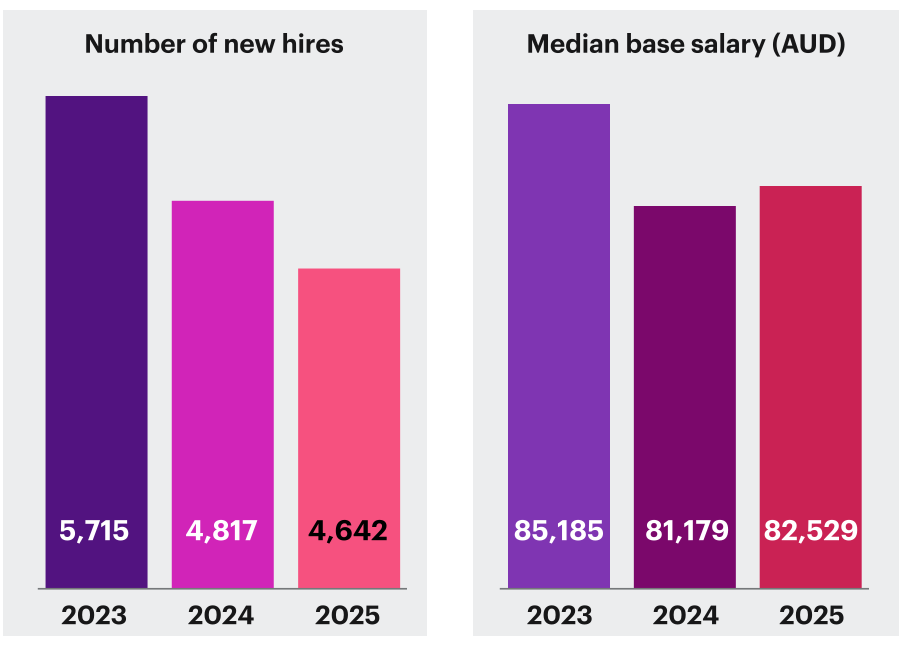
Number of professional entry levels roles (P1) in Australia and median starting salary.
Chart shows the number of new professional entry level hires in Australia decreasing from 5,715 in 2023 to 4,817 in 2024 and 4,642 in 2025, and the median base salary at AUD $85,185 in 2023, $81,179 in 2024 and $82,529 in 2025.
AI factor in driving a decline in entry-level hiring while prompting shifts in salaries to align with evolving skills demands.
The growing imbalance between supply and demand has driven significant wage premiums for technical and AI-adjacent roles, often outpacing compensation growth in more traditional fields. Organisations that understand these dynamics are better positioned to:
- Rethink workforce composition and role design
- Invest in reskilling, upskilling and internal mobility
- Prepare employees for roles that are augmented, rather than replaced, by AI

EXpresso Moments 2026
High-impact webinars for HR professionals.
The challenge for HR in 2026 is more than managing job creation or displacement, but orchestrating workforce transitions at scale.
Pay intelligence: data and trends
As roles evolve, so too does the complexity of remuneration. In an AI-disrupted labour market, pay decisions increasingly require forward-looking data-driven insight rather than reliance on historical benchmarks alone.
Remuneration intelligence continues to show clear industry differentiation in Australia. The Compensation Competitiveness Index shows that the Financial Services sector remains the highest-paying sector, closely followed by Renewable Energy and Technology. This reflects sustained competition for scarce digital, analytical and industry-specific technical skills.
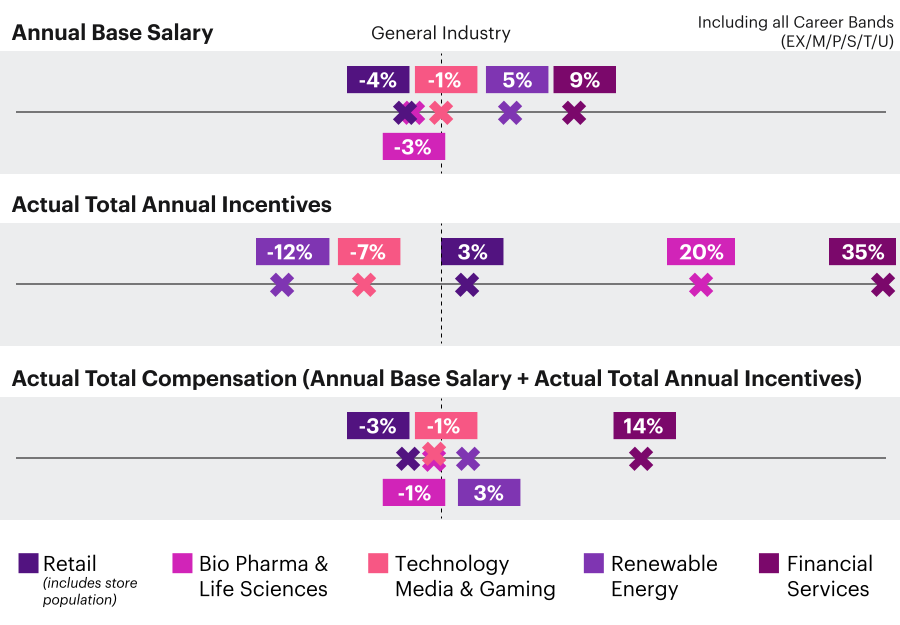
2025 market competitiveness index by industry
Chart displaying Annual base salary vs General Industry for Retail: -3%, Bio pharma & life sciences: -4%, Technology Media & Gaming -1%, Renewable Energy: 5%, and Financial Services: 9%. For Actual Total Annual Incentives : Retail: 20%, Bio pharma & life sciences: 3%, Technology Media & Gaming -7%, Renewable Energy: -12%, and Financial Services: 35%. For Actual Total Compensation (Annual Base Salary + Actual Total Annual Incentives: Retail: -1%, Bio Pharma & Life Sciences: -3%, Technology Media & Gaming -1%, Renewable Energy: 3%, and Financial Services: 14%.
Overall median pay comparison by industry in Australia
The challenge for HR in 2026 is more than managing job creation or displacement, but orchestrating workforce transitions at scale.
Across industries, median pay increases have stabilised at around 3.5%, signalling cautious optimism amid ongoing economic uncertainty.
Median overall remuneration increases across key industries in Australia
Median overall salary increase across key industries, including zeros, in Australia| Industry in Australia | 2025 Actual Salary Increases | 2026 Projected Salary Increases |
|---|---|---|
| General Industry | 3.5 | 3.5 |
| Aerospace & Defense | 3.9 | 3.5 |
| BioPharma and Life Sciences | 3.5 | 3.5 |
| Construction & Engineering | 3.5 | 3.5 |
| Energy & Natural Resources | 3.5 | 3.5 |
| Financial Institutions | 3.5 | 3.5 |
| Insurance | 3.6 | 3.5 |
| Retail and Manufacturing | 3.5 | 3.5 |
| Technology/Media/Telecommunications | 3.5 | 3.4 |
For HR leaders, this means:
- Understand not only what competitors pay, but why certain skills command premiums
- Balance market competitiveness with internal equity
- Use data to anticipate future pressure points rather than reacting after the fact
3.5% Projected salary increase in Australia
In 2026, pay strategy is as much about strategic positioning as it is about reward.
The new work-life equation
While AI is accelerating productivity, it is also prompting organisations to rethink how work fits into people’s lives. Australian employees continue to prioritise mental health, flexibility, and sustainable workloads. This was a shift accelerated by the pandemic and now firmly embedded in workforce expectations.
Flexible work arrangements, hybrid models, and mental health support are no longer seen as discretionary benefits; they are now essential to the employee value proposition.
Flexible work arrangements, hybrid models, and mental health support are no longer seen as discretionary benefits; they are now essential to the employee value proposition.
AI-enabled tools can support this shift by:
- Optimising workloads and identifying potential burnout risks
- Enabling flexible scheduling and outcome-based performance models
- Supporting more personalised employee experiences
Organisations that succeed in 2026 will be those using AI to enhance human wellbeing, not undermine it.
An AI-enabled HR function
As AI reshapes the workforce, it is also transforming the HR function itself. By 2026, high-performing HR teams are no longer testing or piloting AI solutions — they are embedding them into everyday work to improve speed, consistency and strategic insight.
One of the most impactful applications is AI-enabled job levelling and role architecture. AI tools can analyse job content, skills, responsibilities, and market data to create more consistent and scalable job frameworks. This reduces subjectivity, supports internal equity, and allows HR teams to respond more quickly as roles evolve.
AI and digital platforms are also redefining compensation benchmarking and market analysis. AI-powered compensation tools provide real-time insights into market movements, emerging skill premiums, and industry pay trends. This enables HR leaders to make informed, timely decisions on remuneration, ensuring competitiveness while maintaining governance and cost discipline.
In recruitment, AI is streamlining the end-to-end hiring process. From intelligent candidate sourcing and screening to predictive assessments and interview scheduling, AI reduces administrative burden and improves time-to-hire. More importantly, it allows HR and hiring managers to focus on higher-value activities — evaluating potential, engaging candidates, and making informed hiring decisions — rather than managing transactional tasks.
Looking ahead: HR’s strategic mandate in 2026
This year HR will sit at the intersection of technology, people, and purpose. AI will continue to disrupt roles, remuneration structures, and ways of working — but the ultimate differentiator will be how organisations respond.
Those that succeed will:
- Use AI to augment human ability, not replace it
- Ground workforce decisions in data, fairness, and transparency
- Design work in ways that balance performance with wellbeing
By understanding and embracing the transformative role of AI, the future of HR is not human or machine — it is human and machine, working together to shape a more adaptive, inclusive, and sustainable world of work.
Implications for Australian HR leaders
For Australian HR leaders, 2026 represents a critical inflection point. As the pace of AI adoption increases, employee expectations evolve, and skills shortages continue –incremental change is no longer enough.
To remain competitive, HR leaders must:
Ultimately, HR’s role in 2026 is more strategic. By embracing AI as an enabler, not a replacement, HR leaders can build a workforce that is adaptable, equitable and equipped to thrive in an increasingly complex future of work.
Author

In 2026, pay strategy is as much about strategic positioning as it is about reward.