

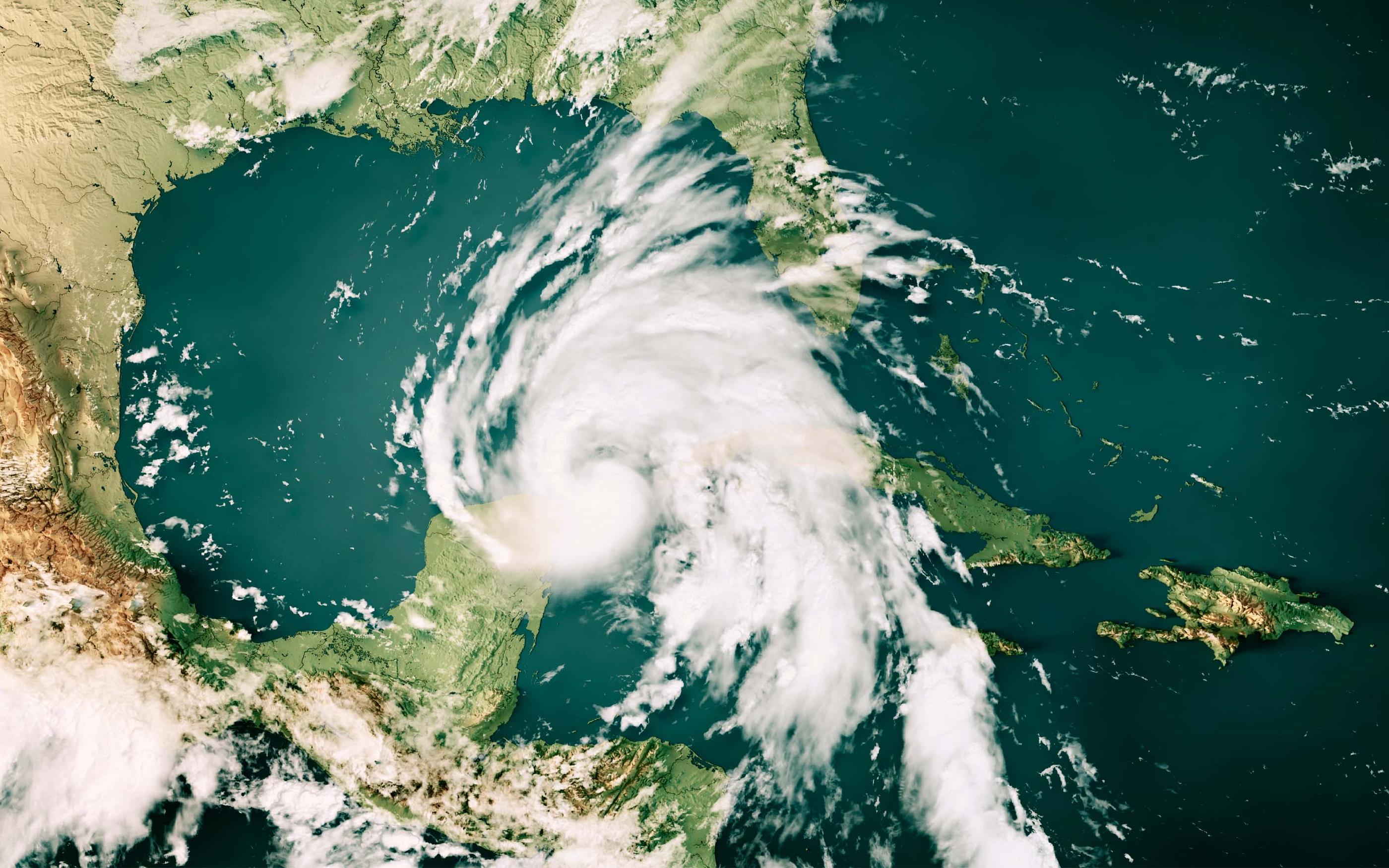
North Atlantic hurricanes are a major contributor to global insured losses. Therefore, a key area of research for insurers has involved understanding how these storms may evolve in a warming climate. This research has primarily focused on how the mean risk will change, specifically the long-term average number of tropical cyclones.[1] However, a recent study led by the National Oceanic and Atmospheric Administration (NOAA) suggests that climate change is also amplifying the variability of North Atlantic hurricane seasons, making very active years—like 2005 and 2020—more common.[2] These very active seasons come with significant loss potential, raising an important question: By focusing on changes in average tropical cyclone numbers, are insurers underestimating the extent to which the extremes are changing?
Average projections overlook tail risks
When assessing the impact of climate change on North Atlantic hurricane losses, many insurers rely on the work of Knutson et al. (2020).[3] This research paper summarizes findings from multiple studies to provide projections for the average number of Category 1-5 and Category 4-5 hurricanes under a 2°C warming scenario. As a result, insurers often adjust their catastrophe models by modifying the average number of hurricane landfalls according to these projections. However, as discussed in a recent WTW Insight article, this approach tends to result in only modest increases in tail risk—a few percentage points—which may well fall within the uncertainty bounds of present-day models.
By focusing on changes in average tropical cyclone numbers, are insurers underestimating the extent to which the extremes are changing?
Meanwhile, groups such as the UK’s Climate Financial Risk Forum have been warning that current scenarios used by insurers likely underestimate tail risks.[4] Why might this be? One reason is that average projections do not fully capture the potential extremes of hazard and loss. While average conditions shift gradually due to climate change, extremes, which disproportionately impact insurers, often exhibit more dramatic changes.[5] Given this knowledge, is it wise for insurers—whose role is to protect against the most catastrophic outcomes—to base their climate change scenarios solely on average risk projections, overlooking other aspects of the frequency distribution?
Increasing variability in hurricane seasons
A new peer-reviewed study led by NOAA has found that since the 1980s, there has been an increase in the interannual variability of both the frequency and intensity of North Atlantic tropical cyclones.[2] The authors find an upward trend in the standard deviation of hurricane counts and Accumulated Cyclone Energy (ACE) over this time (Figure 1). In other words, there are larger year-to-year swings between quiet and storm-packed seasons today compared to a few decades ago.
Figure 1: 20-year running average time series of the standard deviation in Atlantic tropical cyclone activity since 1970, showing the number of cyclones of at least tropical storm strength (a) and the overall seasonal activity represented by the ACE index (b). Source : H. Lopez, based on all storms with lifespans exceeding two days from the HURDAT2 dataset.
This matters for insurers because both the increase in variability and the shift towards more active seasons mean that extremes—like very quiet seasons or the hyperactive years of 2005 and 2020—are becoming more common. This makes future seasons harder to predict and raises the risk of high-impact years.
What’s interesting is that climate models also show this trend, with projections suggesting that by mid-century the variability in hurricane activity will increase by 36%. The authors link the increasing variability in hurricane activity to increasing interannual variability in sea surface temperature (SST) differences between the Pacific and Atlantic Oceans, which is likely due to human-induced climate change. These SST differences influence factors such as vertical wind shear and atmospheric stability, which in turn affect hurricane activity.
Rethinking climate change scenarios
A key question arising from this research is how increasing year-to-year variability may affect insured losses. To explore this, we consider a hypothetical scenario where the number of Category 4 and 5 hurricanes increases by 20% and adjust a catastrophe model using two alternative methods to assess the impact (Figure 2). In the first approach (gray bars), we apply the traditional method, where extra storms are spread randomly across all years to represent an average increase in risk. This results in a larger percentage increase in losses at lower return periods. For instance, the 1-in-2-year loss rises by 16%, while the 1-in-200-year loss sees a smaller increase of 7%.
Related content
Figure 2: The impact of adjusting a catastrophe model by adding 20% more Category 4 and 5 hurricanes to the event set, comparing two methods: distributing them randomly across all years (gray bars) and concentrating them in the most active years (purple bars). Active years are defined as the top 20% of years, ranked by both the number of Category 3+ landfalls and overall Category 1+ landfalls.
In the second approach (purple bars), we assume a worst-case scenario where these extra storms fall during the most active years, like 2005 or 2020. The picture changes significantly with this method: Compared to randomly spreading the storms across all years, concentrating them in highly active years has a larger impact on longer return periods. For example, while the 1-in-2-year return period sees a modest 2% increase, the 1-in-200-year return period jumps by 12%. This approach increases the differences between quiet and busy years in the model, thereby increasing interannual variability.
It should be noted that this second approach is a simplified example, which assumes that increased variability can be represented by adding storms to years that are already very active. In reality, increased variability might play out in different ways—like an increase in storms during moderately active years. Our example also doesn’t factor in the increased frequency of quiet years found in the NOAA-led study, which would reduce losses at shorter return periods.
Nonetheless, the experiment in Figure 2 demonstrates how assumptions about hurricane distribution across years can fundamentally shape scenario outcomes, influencing insurers' approaches to future hurricane risk. This highlights the need to evaluate how expert judgments can shape model outcomes and inform decision-making, relevant to both current catastrophe models and future climate scenarios.
Risk management implications
The main takeaway from this research is that focusing just on averages could leave insurers underestimating how often extremely active hurricane years will occur as the climate warms. When it comes to risk management, this perspective has implications in a few areas. First, insurers should evaluate whether their capital can withstand an increase in the likelihood of extremely active hurricane seasons. Second, outward reinsurance needs to be reviewed to make sure that coverage levels are appropriate in light of the increased risk. And finally, insurers will need to consider approaches to managing the risk through portfolio and exposure management (e.g. diversification) to better cope with the growing variability of North Atlantic hurricane activity.
At WTW, we help clients navigate the uncertainties of climate-related risks by providing both present-day views of risk and future scenarios that account for a range of potential outcomes—not just averages. This smarter way to risk provides our clients with broader perspectives that helps them better prepare for what might lie ahead.
References
- e.g. Jewson S. (2024), Projecting future tropical cyclone frequencies by combining uncertain empirical estimates of baseline frequencies with climate model estimates of change, Journal of Catastrophe Risk and Resilience, 01 (01). Return to article
- Lopez H. et al. (2024), Projected increase in the frequency of extremely active Atlantic hurricane seasons, Science Advances, 10(46). Return to article
- Knutson T. et al (2020), Tropical cyclones and climate change assessment: Part II: projected response to anthropogenic warming, Bulletin of the American Meteorological Society, 101(3):E303–E322. Return to article
- Climate Financial Risk Forum Guide (2023), Learning from the 2021/22 Climate Biennial Exploratory Scenario (CBES) Exercise in the UK: Survey Report. Return to article
- IPCC (2021), Climate Change 2021: The Physical Science Basis, Chapter 11. Return to article
Authors


This highlights the need to evaluate how expert judgments can shape model outcomes and inform decision-making…