An unprecedented set of oceanic warning signals
The big signals for this year’s North Atlantic hurricane season lie in the oceans. Unusually high heat arrived in the North Atlantic in early 2023 and has persisted into 2024. Record sea surface temperatures have occurred somewhere in the North Atlantic every day since last summer. Indeed, parts of the North Atlantic were as hot in May 2024 as they typically are in August. This heat is already contributing to impacts with torrential flooding rains across South Florida in mid-June.
It’s not just the ocean surface that is unusually hot. The high heat also extends a few hundred meters beneath the surface. This deep column of hot water is essential to power the most intense hurricanes. Alarmingly, the pattern of heat across the North Atlantic Ocean closely resembles the pattern that has historically produced the most active seasons.
Meanwhile, over in the equatorial Eastern Pacific Ocean, a rapid cooling is under way signaling the imminent arrival of La Niña. History tells us that La Niña boosts seasonal hurricane numbers by limiting strong winds aloft over the tropical North Atlantic, which would otherwise disrupt and break up developing storms.
With a total of 20 named storms, 2023 had the fourth highest tally in recorded history, behind only 2020, 2005 and 2021.
Last year, the looming issue for hurricane forecasters was whether the record heat in the North Atlantic Ocean would win out over the hurricane-suppressing effect of El Niño. In the end, the North Atlantic’s influence was clearly the strongest
This year there is no such competition. I expect the Atlantic and Pacific oceans to work together in the same direction and create an active — perhaps even hyperactive — hurricane season. However, we must also remember that hurricane forecasters are working in uncharted territory. We have never experienced such exceptionally hot conditions in the North Atlantic at the same time as an expected La Niña. Because of the unprecedented heat in the North Atlantic, hurricane experts who forecast the expected number of storms using an analog approach are struggling because none of the previous years have similar conditions.
What can we say about landfall?
A critical component of seasonal storm activity is how much of it will affect land. Yet this is often overlooked because forecasting seasonal landfall activity is so difficult. The National Oceanic and Atmospheric Administration does not comment on landfall in its seasonal outlooks[1]. Its position is that landfall is largely determined by weather patterns as storms get closer to the coast and that these daily weather patterns cannot be predicted in advance of the season.
Colorado State University (CSU) does produce predictions of the probability of storms making landfall along the Atlantic Coast of the U.S[2]. Those landfall forecasts are founded on the observation that storm activity in the western half of the North Atlantic is usually higher during La Niña than El Niño. This association[3] is likely due in part to the fact that atmospheric circulation patterns over the North Atlantic tend to steer storms toward the American coastline during La Niña and away from the coastline during El Niño (Figure 1). In 2023, for example, a strong El Niño combined with a weakened subtropical high to keep most storms away from the coast and safely out at sea.
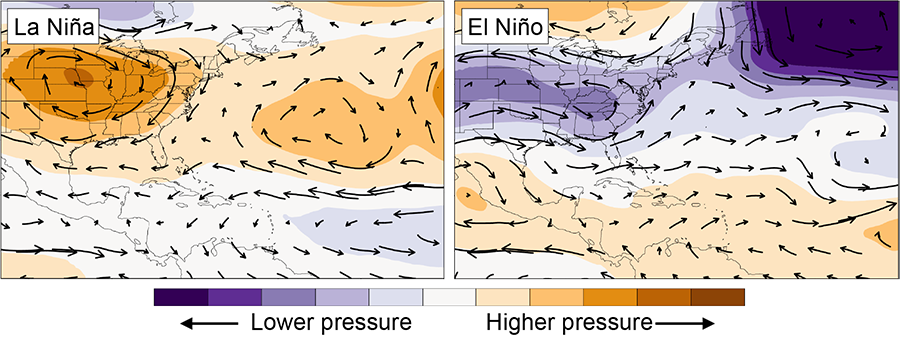
Figure 1. Anomalous summer average steering patterns during historical La Niña (left) and historical El Niño (right) years over the period 1980 – 2022. During La Niña, anomalous high pressure over the mid-latitudes produces anomalous steering flow toward the U.S. During El Niño the opposite anomaly pattern steers storms away from the U.S.
Data source: The European Center for Long-Range Weather Forecasts and the National Oceanic and Atmospheric Administration.
As of June 2024, the North Atlantic subtropical high seems to be getting stronger, and this trend is one of the factors underlying CSU’s forecast of higherthan-normal landfall risk. At present, CSU’s group anticipates the probability of at least one major hurricane making landfall in the U.S. to be 50% higher than the average hurricane season. But again, forecasting hurricane landfall is more difficult than predicting the total number of storms. The uncertainty in seasonal landfall is reflected in the large range of U.S. landfalling hurricane numbers among CSU’s analogue years (1878, 1926, 1998, 2005, 2010, 2020) of between zero (in 2010) and six (in both 2005 and 2020). And these forecasts also apply to very broad geographic areas: Landfall forecasts are available for the entire U.S. Atlantic Coast, the East Coast and the Gulf Coast. It’s not currently possible to make landfall forecasts in advance of the season specific to particular states or communities.
There is much to learn about our ability to forecast steering flow and landfall activity in advance of the season. Each year, only a few storms occur, providing us with a limited amount of data, which makes it difficult to identify patterns and relationships; however, emerging evidence shows that frequencies of some daily weather patterns may be somewhat predictable in advance of a season[4].
Storm genesis locations may also be important in determining landfall risk. Indeed, new evidence is emerging over many seasons that genesis location is more important than steering flow for determining landfalling storm tracks, 5 and there is opportunity to improve our ability to forecast preferred genesis regions before the start of the hurricane season.
Given the explosion of advanced statistical techniques in the atmospheric sciences, we can expect to see a proliferation of machine-learning-based seasonal hurricane predictions that will no doubt start to produce regional landfall predictions. Improving our ability to estimate the number of storms that cross over to land and their likely trajectories is an exciting and important emerging priority for hurricane research.
In summary, all signals are pointing to a very active season. Perhaps one factor that could make a dent in the forecast is Saharan Air Layer outbreaks. These could mitigate some of the record warming, and the dry and dusty air could interfere with storm formation. Irrespective of any potential mitigating factors, the ceiling on the Atlantic hurricane season numbers has never been so high.
Scenarios for high hurricane activity
Prepare comprehensive 'what-if' scenarios to quantify the heightened physical risks associated with a hyperactive hurricane season. Develop a contemporary view of hurricane exposure that integrates the compound effects of exposure growth, inflation, and climate.Identify hidden risks
Prepare realistic estimates of potential losses that reflect direct damages to physical assets, operational and supply chain disruptions, and complications from emergency measures.Resilience efforts
Support and incentivize mitigation efforts such as the installation of storm shutters and retrofitting buildings for wind resistance
Footnotes
- Rosencrans, M., Wang, H., Harnos, D., Blake, E., Landsea, C., Pasch, R., Goldenberg, S., and Lopez, H. NOAA 2024 Atlantic Hurricane Season Outlook. Issued May 23, 2024. Return to article
- Klotzbach, P.J., Bell, M.M., DesRosiers, A.J., and Silvers, L. Extended Range Forecast of Atlantic Seasonal Hurricane Activity and Landfall Strike Probability for 2024. Issued June 11, 2024. Return to article
- Colbert, A. J. & Soden, B. J. Climatological variations in North Atlantic tropical cyclone tracks. J. Clim. 25, 657–673 (2012). Return to article
- Prein, A. F. et al. Sub Seasonal Predictability of North American Monsoon Precipitation. Geophys. Res. Lett. 49, e2021GL095602 (2022). Return to article
Author

Contact