Metals sit at the center of an emerging economic risk landscape. They are commodities, but also industrial inputs, strategic assets and latent military capacity.
This leaves the sector highly exposed to many of the forces now reshaping the global economy. Trade restrictions and tariffs are reshaping global flows. Energy costs remain structurally high in key production regions. Demand and processing capacity are increasingly concentrated in Asia, limiting flexibility when disruption hits. At the same time, geopolitical tensions, regional conflicts and maritime instability are introducing new layers of risk into supply chains.
For miners, manufacturers and traders, the challenge is no longer managing isolated risks. It is understanding how they interact and how quickly they can cascade across operations, margins and investment decisions.
A new era of economic risk
To understand how metals companies view this changing landscape, Oxford Analytica and Willis, a WTW business, convened and interviewed a panel of senior economists and risk management professionals across metals mining, manufacturing, trading and analysis in Europe and North America. Their insights form the basis of this report and its economic risk radar.
The top five economic risks facing the metals sector
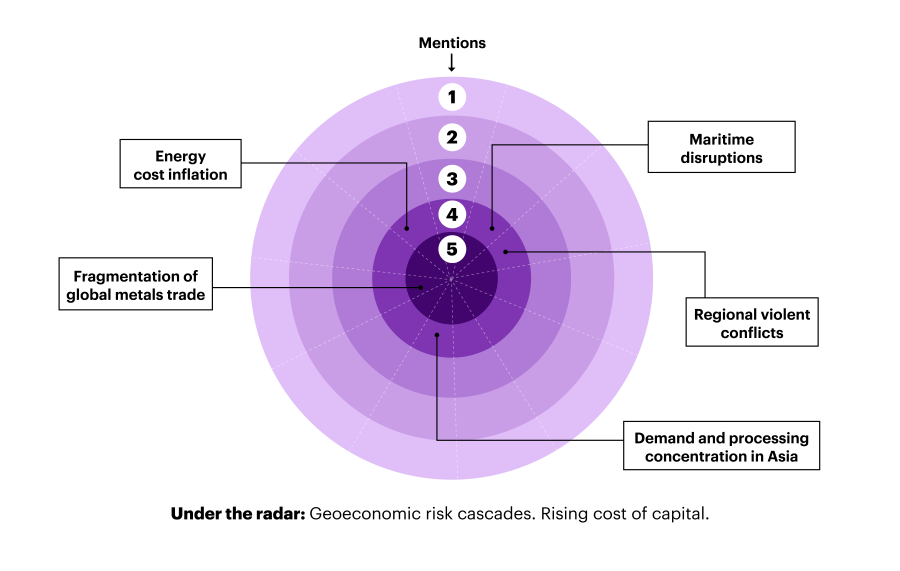
Economic risk radar for the metals sector
Economic risk radar ranked by number of mentions
- Fragmentation of global metals trade: Tariffs, export controls, local-content rules and sanctions are forcing companies to reconfigure supply chains, redirect trade flows and absorb higher transaction costs — making long-term planning significantly more complex
- Energy cost inflation: Structurally elevated energy prices, particularly in Europe, are eroding the competitiveness of metals producers and threatening the investment needed for decarbonization
- Demand and processing concentration in Asia: Asia dominates metals consumption and processing, with much of the world’s ore passing through regional hubs before reaching end markets, creating a significant point of vulnerability for global supply chains if access is disrupted
- Regional violent conflicts: Conflicts can indirectly impact energy prices, insurance costs, shipping routes, sanctions and counterparty risk, reshaping trade flows far beyond their origin
- Maritime disruptions: Disruptions to key shipping routes can rapidly change trade economics, increasing exposure to gray-zone maritime risk
These risks are already reshaping trade flows, cost structures and investment decisions across the metals sector. The report each of these risks and their implications, featuring in-depth essays from Oxford Analytica and insights from Willis specialists to help executives understand the intricate economic forces shaping the future of the metals sector and how to navigate this turbulent environment.
For further information on the report or how to effectively manage your economic and political risk, please contact our team.
Willis Towers Watson Insurances (Ireland) Limited, trading as Willis, WTW is regulated by the Central Bank of Ireland.
Author

Contact
Managing the new economic risks in the metals sector
Read the full report to find out more
In the video, Sam Wilkin summarizes the findings from the 'Managing the new economic risks in the metal sector' report.