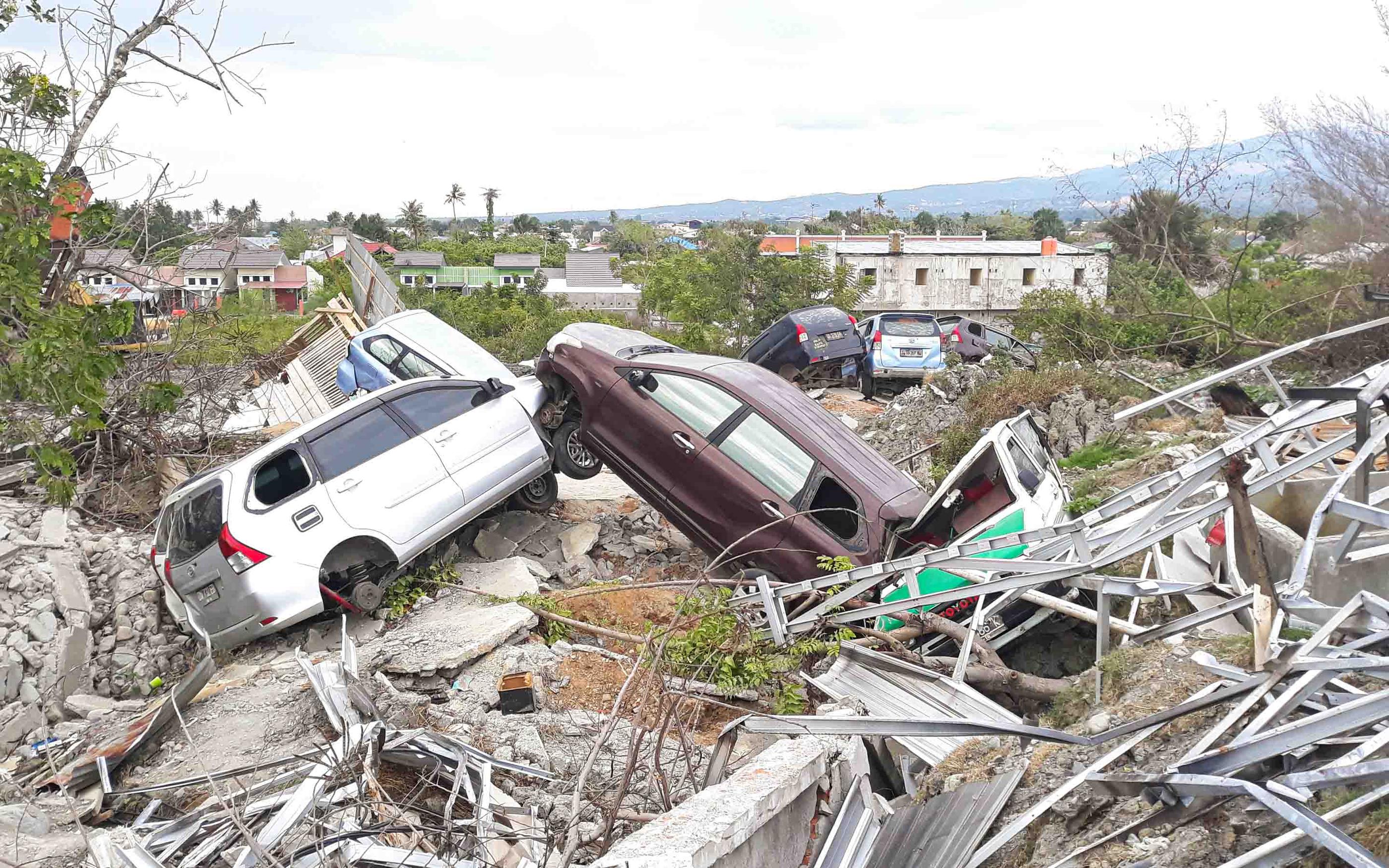
In March 2011, the Mw9.1 Great East Japan Earthquake, commonly referred to as the Tohoku earthquake, caused devastation through primary shaking, but also caused a tsunami that devastated the Japanese coastline. This included damage to the Fukushima nuclear power plant, resulting in cascading failures that led to one of the worst nuclear accidents in decades. Overall, the earthquake and tsunami caused approximately $35 billion USD in insured losses and $210 billion USD in total economic losses (equivalent to $52 billion and $312 billion in 2026), making it the costliest natural disaster in history so far.
The majority of this damage was sustained in Japan, but the tsunami also caused over $20 million in damage to Hawaii, U.S. West Coast harbours, especially Crescent City and Santa Cruz, highlighting the exposure of coastal infrastructure to far-field events. The event also exposed the vulnerability of globally interconnected supply chains, particularly in the automotive[1] and electronics[2] industries, severely affecting manufacturing operations. These disruptions led to delays in the production of essential microcontrollers and semiconductors, which in turn caused months-long setbacks across high-tech industries worldwide.
In 2009, the network established a partnership with Tohoku University focused on developing a Japan tsunami model
Following in the footsteps of the massive human cost caused by the 2004 Indian Ocean earthquake and tsunami, the scale of monetary losses sustained by this event further highlighted the need for catastrophe models to include tsunami propagation and run-up alongside earthquake shaking. Importantly, the WRN had already begun expanding its tsunami research capabilities before the event itself. In 2009, the network established a partnership with Tohoku University focused on developing a Japan tsunami model, reflecting growing recognition that earthquake losses could not be understood through shaking alone.
From earthquake shaking to cascading consequence
The 2004 Indian Ocean tsunami was a significant turning point for the insurance and catastrophe modeling industries, highlighting the need to consider tsunami risk more rigorously rather than earthquake shaking in isolation. But the catastrophe models that probabilistically evaluate tsunami risk were introduced to the market after the Tohoku earthquake. This model was designed to account for both the earthquake ground shaking and the resulting tsunami impacts. The event also triggered the first earthquake-related catastrophe bond payout, releasing the full US$300 million limit.
Research following Tohoku increasingly focused on how tsunami risk could be integrated into practical resilience, infrastructure and loss assessment frameworks. Work with academic partners at Tohoku University and University College London (UCL) helped update and revise tsunami source modelling and fragility functions. This improved understanding of potential tsunami hazard scenarios across the Bay of Bengal, South China Sea and parts of Indonesia.
In October 2016, our contribution on the historical and future tsunami hazard assessment on a global scale based on historical records over the last 400 years was undertaken to increase tsunami awareness as part of World Tsunami Awareness Day. Further activities aimed to extend target areas in Japan to Okinawa and assess disaster risk reduction based on present and planned tsunami countermeasures.
Continued research with UCL helped develop cascading earthquake-tsunami fragility functions for buildings in Japan and Chile, supporting new approaches to tsunami risk assessment, resilient building design and coastal infrastructure planning. This work helped build capacity for risk assessment of hospitals and schools in Sri Lanka and develop tsunami fragility methodology for developing countries with poor tsunami hazard data such as Indonesia.
The WRN has also worked with scientists at the Barcelona Supercomputing Centre to analyse workflows for tsunami Probable Maximum Loss (PML) assessment, helping WTW teams and their clients better account for uncertainties in risk assessment.
A continuing global challenge
Recent earthquakes around Japan and Kamchatka have reinforced that tsunami risk remains a basin-wide challenge capable of generating impacts far beyond the originating coastline. Tsunami remains among the most under-insured of major natural perils and the protection gap varies markedly by region.
Tsunami remains among the most under-insured of major natural perils and the protection gap varies markedly by region.
Although the inclusion of tsunami hazard into most catastrophe models, along with academic research, has led to improvements to tsunami warnings, infrastructure resilience and insurance coverage, there are still challenges that need to be addressed with regard to this peril. The limited availability of high-resolution bathymetry data on a global scale, with much being proprietary to private entities, means mapping tsunami sources such as submarine landslides as well as modelling run-up from coastal topography remains difficult. Model vendors and institutions such as the USGS continue to improve this modelling capacity on a regional basis, going so far as to calculate Average Annualised Losses (AAL) for at-risk coastlines with high-value assets.
At the same time, initiatives such as GEBCO and the Global Tsunami Model reflect growing recognition that understanding tsunami risk increasingly depends on globally connected data, shared modelling frameworks and collaborative science.
Key takeaways
- The 2011 Tohoku earthquake and tsunami demonstrated the catastrophic losses that can be sustained from a large magnitude earthquake event and the resulting tsunami waves impacting coastal infrastructure.
- This event triggered academic research initiatives and vendor action to improve regional catastrophe modelling for tsunami wave propagation and coastal exposure.
- Challenges still exist regarding the global improvement of bathymetry data and modelling of regions outside of the largest insured markets such as Japan, Chile and the US.
Footnotes
- Canis, B., 2011. The motor vehicle supply chain: Effects of the Japanese earthquake and tsunami. Congressional Research Service, Report R41831. Return to article
- How Japanese Chipmaker Renesas Recovered From the Earthquake. Return to article
Authors


20 years of the Willis Research Network

Related content
The event also triggered the first earthquake-related catastrophe bond payout, releasing the full US$300 million limit.