Wildfires have dominated headlines in July 2026. Spain declared its first national wildfire emergency as fires around Madrid merged and forced evacuations;[1] major fires displaced tens of thousands in southwest France;[2] and Canada battled hundreds of active wildfires[3] whose smoke again spread across large parts of North America. Closer to my own home, fires have also affected Scotland and Wales.[4]
For (re)insurers, one question naturally follows: does diversification still provide protection when major wildfires are erupting around the world at the same time? If losses in different regions are being driven by the same underlying conditions, these events may not be independent. Are the recent outbreaks simply coincidence, or are global wildfire risks becoming correlated?
The answer depends on what we mean by correlated. The conditions that create wildfire potential can be correlated across large distances.[5] Whether those conditions actually become fires, and ultimately losses, is largely determined by local factors.
Yes – wildfire conditions can be correlated
Wildfires require dry fuels, weather that supports spread, and an ignition.[6] The first two are far from independent across the globe.
Large-scale atmospheric and oceanic variability can influence temperature, rainfall, drought and vegetation across multiple regions simultaneously. El Niño, for example, can increase fire potential in some parts of the world while reducing it elsewhere. Persistent circulation patterns can similarly produce widespread heat and drought across continents.
Europe in 2026 provides a good example. Persistent high pressure has created unusually warm, dry conditions across much of Europe, elevating fire potential across the continent. Nine European countries—Belgium, France, Ireland, the United Kingdom, Spain, Austria, the Netherlands, Switzerland and Denmark—recorded more than double both their average July fire numbers and burned area (relative to 2012–2025) during July 2026 (Figure 1).
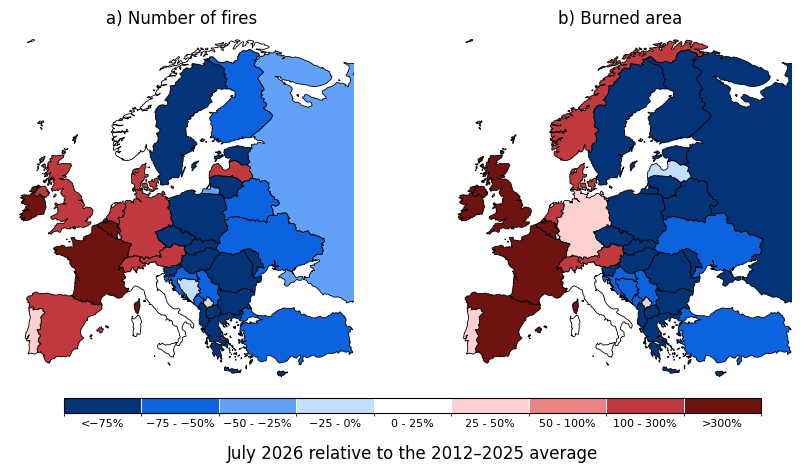
Figure 1 – July 2026 wildfire activity relative to the average July (2012–2025) across Europe, shown for (a) number of fires and (b) burned area. Red indicates above-average activity, blue below-average activity. Data: Global Wildfire Information System, as of July 29, 2026.
But the climate conditions connecting wildfire risk do not necessarily occur at the same time as the fires themselves. Wildfire risk has a memory. In fuel-limited environments, rain months earlier can boost vegetation growth that later dries into fuel. That is particularly relevant in Iberia this year: A wet winter and spring encouraged vegetation growth before repeated summer heat and drying turned that additional biomass into readily available fuel — a form of “hydroclimatic whiplash”. Climate can connect wildfire potential across space and time.
But the climate conditions connecting wildfire risk do not necessarily occur at the same time as the fires themselves. Wildfire risk has a memory.
Climate change adds another dimension. Rising temperatures and increasing atmospheric demand for moisture are making fire-conducive weather more frequent in many regions while lengthening fire seasons in others. By expanding the area and duration of fire-prone conditions, the same weather pattern can elevate fire potential across larger regions simultaneously, increasing the chance of concurrent large fires, as seen across much of Europe during July 2026.
No – the same climate doesn’t mean the same fire
This is where the relationship becomes more complicated. Hotter and drier does not always mean more fire.
The same weather pattern can produce very different wildfire risk because landscapes are constrained differently. In weather-limited environments such as the UK, fuels are abundant but require sufficiently hot and dry conditions to burn. In fuel-limited environments such as the California chaparral, fire weather is common but vegetation sparse. The same climatic conditions can therefore produce vastly different wildfire responses in different regions.
Even within Europe, regions can arrive at synchronous wildfires through different pathways. Across parts of Iberia in 2026, the wet-to-dry transition increased both the amount and availability of fuel. In the UK, by contrast, an unusually warm and dry spring primarily dried existing vegetation. Coincident wildfire activity therefore does not necessarily imply a common cause.
And favourable conditions still do not start a fire. Ignitions are predominantly local. While lightning can be important in some environments, many fires result from human activity, including agricultural burning, infrastructure, machinery, recreation, and deliberate ignition. Land management and suppression then influence whether those ignitions become significant fires. Two regions can therefore experience correlated fire weather without experiencing correlated wildfire activity.
Climate change, vegetation change, land abandonment and fire management can alter what constrains fire in a region.
These local controls are not fixed either. Climate change, vegetation change, land abandonment and fire management can alter what constrains fire in a region. For example, a region that was historically fuel-limited may become greener over time, leaving sufficient vegetation for periods of hot, dry weather to produce much greater wildfire activity than in the past. Historical climate-fire relationships therefore cannot be assumed to remain constant, with important implications for regional wildfire correlation.
Finally, more fire does not necessarily mean more loss. Thousands of small rural fires may generate little insured loss, while a single wind-driven fire reaching the wildland–urban interface can generate billions in claims. Correlation in climate therefore does not necessarily translate into correlation in wildfire activity, nor correlation in wildfire activity into correlation in insured loss.
So, are global wildfires correlated? Yes. And no.
Large-scale climate patterns can create fire-conducive conditions across multiple regions simultaneously, linking wildfire potential across countries. But whether those conditions become fires depends on local factors including fuels, topography, ignitions, land management and suppression, while losses depend on what burns and where.
Apparently independent fires may share underlying climate drivers that elevate risk across multiple regions.
Fires making headlines at the same time should not automatically be assumed to be connected. Equally, apparently independent fires may share underlying climate drivers that elevate risk across multiple regions.
For (re)insurers, assessing wildfire risk across markets and geographies requires understanding not just where fires occur, but why. As the 2026 wildfire season continues, determining whether activity is driven by shared climatic drivers or local factors will be central to assessing accumulation risk. While broad-scale climatic drivers can create genuinely correlated wildfire activity, local factors such as fuels, topography, ignitions, land management and suppression can cause those relationships to break down. Distinguishing between the two is critical for understanding when apparently separate wildfire events may contribute to accumulation across a global portfolio, and when they instead represent independent sources of risk.
Footnotes
- InsuranceBusiness. Spain declares its first-ever wildfire national emergency, France evacuates major tourist area. (2026). Return to article
- BBC News. Firefighters battle wildfire as tens of thousands evacuated near Bordeaux. (2026). Return to article
- Government of Canada. Canadian Wildland Fire Information System. (2026). Return to article
- The Observer. Firefighters battling ‘worst wildfires ever seen in Britain’. (2026). Return to article
- Yin, C., et. al. Increasing synchronicity of global extreme fire weather. (2026). Return to article
- Jones, M. How the key ingredients for destructive wildfire came together to cause record losses in 2025. (2026). Return to article
Author