Why thoughtful active management has a place in modern portfolios
The debate between active and passive investing remains central to portfolio construction in 2025. Passive strategies, which track indices at a low cost, have surged in popularity, especially as many active managers have struggled to consistently outperform their benchmarks, testing investor’s patience. But does it have to be one or the other? We believe there is a place for both in well-balanced, modern portfolios designed to deliver strong returns whilst effectively managing risk.
With the benefit of hindsight, why do anything other than track an index?
Recent years have seen passive funds dominate inflows, with U.K. retail investors withdrawing over £100 billion from active products in favor of trackers and ETFs, according to AJ Bell. This shift is understandable: only about one third of active equity managers outperformed their passive counterparts in 2024, according to AJ Bell’s Manager versus Machine report. The concentration of returns in U.S. mega-cap technology stocks has made it difficult for many active managers to keep pace with indices. It’s no surprise that many investors are turning away from active funds searching for a share of the returns in lower cost passive alternatives.
Looking backwards can be dangerous when building portfolios for the future
Building resilient portfolios requires decision making made under uncertain conditions. While hindsight provides perfect clarity, it is not the best tool available to investors at the point of allocation. Effective investment strategy must therefore rely on forward-looking judgment, robust risk assessment and adaptive frameworks – coupled with retrospective analysis and lessons learnt from decades of managing equity portfolios.
Recent periods like we have seen, with narrow and concentrated markets, and single sectors dominating returns, have not persisted indefinitely in history. Active managers often regain their edge when market leadership broadens. For example, after the dot-com bubble burst, active managers delivered significant outperformance over the following decade. Broader leadership opens opportunities across different geographies and industries. As market conditions fragment and correlations fall, opportunities for stock selection within unconstrained, global portfolios increase. Figure 1 below shows the percentage of managers that outperformed after the dot-com bubble, following on from a challenging five-year period for active managers.
Active managers, with the ability to be selective about the companies they hold, can position themselves for potential outperformance when market sentiment changes.
Is it just market conditions, or has my manager done a bad job?
In periods of challenging performance, it is important to look beyond the headlines and assess whether your manager is doing the right things. Start by understanding the companies they’ve been buying – do these align with the managers stated investment style and philosophy? Next, consider whether those businesses are fundamentally strong – are revenues and earnings growing, and do they have durable competitive advantages? A well-managed portfolio should reflect disciplined stock selection and long-term conviction, even if shorter-term performance has been pressured by market trends. We can see that over the last 12 months, companies with weaker fundamentals that have been loss making have been the biggest winners – a trend we believe unlikely to be sustainable over the long-term (Figure 2).
Having a portfolio underpinned by strong fundamentals, with a focus on high-quality, resilient businesses that are well-positioned for value creation is critical. While short-term market sentiment can drive volatility and favor momentum-heavy benchmarks, these effects tend to average out over time. As sentiment normalizes, a portfolio containing stocks with superior fundamentals should be increasingly recognized by the market, supporting sustained outperformance. But it’s how you get access to those stock selection opportunities that will determine the potential for capturing the upside. This is what we call the power of focused portfolios.
Our approach to building resilience and improving success
We believe it’s essential for investors to take a considered approach to portfolio construction when it comes to active equity investing, aiming to enhance resilience and improve the likelihood of success. This is why we believe in a focused approach, combining investment styles via a multi-manager line-up.
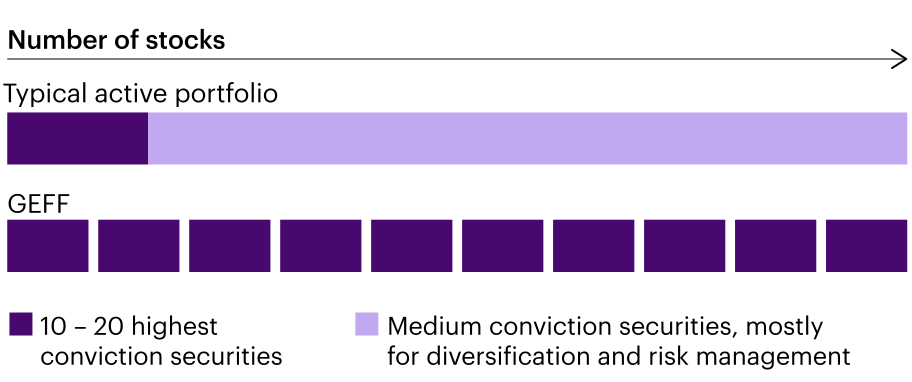
While concentrated portfolios can be more volatile, academic research and practical experience both support the idea that focused portfolios, those built around managers’ highest conviction ideas, outperform more diversified, benchmark-hugging approaches. By selecting managers with different investment styles and approaches, we gain diversification benefits and materially reduce the likelihood of underperforming in the long run. Portfolios with high “active share” (meaning they differ substantially from the index) have delivered compelling long-term returns, even after fees. Concentrated strategies (typically fewer than 35 stocks) have outperformed non-concentrated ones by over 0.8% p.a. net of fees over the last decade.Our approach exemplifies this philosophy: by assembling a multi-manager portfolio where each manager contributes only their top 10–20 ideas, and investors can harness genuine stock selection skill while managing overall risk through diversification across styles, sectors and geographies (Figure 3). We are mindful about having too many managers and therefore reducing active share by overdiversifying the portfolio. Our global manager research team has consistently demonstrated the ability to identify managers with a sustainable competitive advantage in stock selection and so, the key skill that our preferred rated equity managers have is to use fundamental analysis to select individual companies that are capable of delivering higher than average returns over a full business cycle (as opposed to timing markets or taking macro/factor market views).
Figure 3: WTW differentiated approach
Moreover, by leveraging scale across our clients and our relationships with third-party providers, we can keep costs competitive – ensuring that the benefits of this approach are not eroded by fees.
Where to from here?
Active management is difficult, and recent conditions have made it even more challenging. Share prices have been driven more by macroeconomic and geopolitical factors, such as COVID-19, conflicts in Europe and the Middle East, enthusiasm for AI, and shifting trade policies, than by company fundamentals. As a result, global uncertainty has been at its highest point since January 2008, and investors have been switching to more passive investment strategies, which offer simplicity, low cost, and reliable market-matching returns.
However, for investors seeking to outperform, especially in uncertain or changing markets, active management, when done right, remains a powerful tool. The key is to focus on genuine skill, high conviction, and robust portfolio construction. Active strategies that regularly rebalance to ensure stock selection remain the key driver of returns are well-positioned to perform in more rational markets, as long as they remain underpinned by strong fundamentals and focus on high-quality, resilient businesses.
Recent market conditions have underscored the importance of skill and adaptability. Fundamental active strategies – anchored in deep research and long-term conviction – remain essential for identifying resilient businesses and capturing sustainable growth. At the same time, incorporating complementary active approaches, such as quantitative strategies, can enhance portfolio construction by improving diversification, managing risk and responding to short-term market dynamics. We believe that blending quant/smart beta strategies with active management creates a robust investment framework - one that harnesses the systematic discipline and diversification of smart beta alongside the insight, rigor and agility of active positioning. This combination enables investors to benefit from both structured market exposure and dynamic decision-making, positioning them for long-term success.
To learn more about how you can diversify your portfolio with our equity investment solutions, get in touch with a WTW colleague today.
Disclaimer
This document was prepared for general information purposes only and should not be considered a substitute for specific professional advice. In particular, its contents are not intended by WTW to be construed as the provision of investment, legal, accounting, tax or other professional advice or recommendations of any kind, or to form the basis of any decision to do or to refrain from doing anything. As such, this document should not be relied upon for investment or other financial decisions and no such decisions should be taken on the basis of its contents without seeking specific advice.
This document is based on information available to WTW at the date of issue, and takes no account of subsequent developments. In addition, past performance is not indicative of future results. In producing this document WTW has relied upon the accuracy and completeness of certain data and information obtained from third parties. This document may not be reproduced or distributed to any other party, whether in whole or in part, without WTW’s prior written permission, except as may be required by law. In the absence of its express written permission to the contrary, WTW and its affiliates and their respective directors, officers and employees accept no responsibility and will not be liable for any consequences howsoever arising from any use of or reliance on the contents of this document including any opinions expressed herein.
Towers Watson Investment Services Hong Kong Limited is registered with the Securities and Futures Commission for Type 1 (Dealing in Securities), Type 4 (Advising on Securities) and Type 9 (Asset Management) regulated activities (CE No.: AON849). It is also registered with the Mandatory Provident Fund Schemes Authority as a Principal Intermediary. The content of this document is prepared for Professional Investors only and have not been reviewed by any regulatory authority in Hong Kong. If you are in any doubt of the contents of this document, you should obtain independent professional advice.