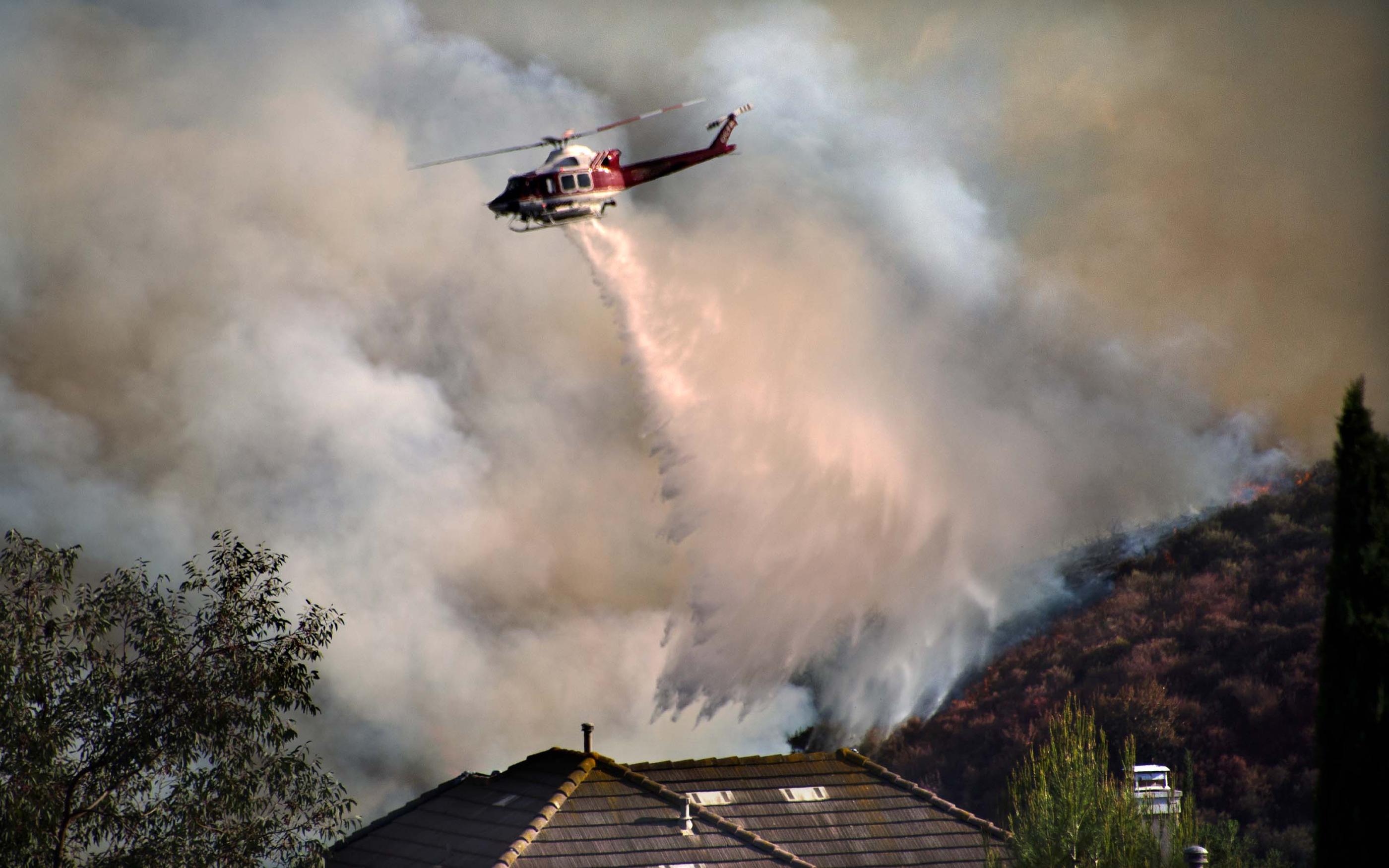
Since 2023, the State of Wildfires Project has been reporting on a spate of high-impact wildfires around the world in a major scientific effort to monitor and explain an emerging global trend towards increasingly intense and severe fires. Headline statistics from our latest report,[1] covering the March 2024-February 2025 global fire season, included:
Global wildfire impacts (March 2024 – February 2025)
$215billion of assets exposed globally
200+direct wildfire fatalities
100 Mpeople exposed globally
8+ Btonnes of CO₂ released
18%of forest carbon offset projects exposed globally
Looking to the calendar year 2025, our continuous monitoring shows that the global area burned by fires was below average, yet several regional fire events caused disproportionate impacts on communities and infrastructure. Severe wildfire impacts occurred across landscapes that differ markedly in vegetation, climate and land use. What links these events is a recurring pattern: the three key ingredients for wildfire are increasingly aligning in the wrong place at the wrong time.
The fire triangle
The fire triangle describes the three ingredients required for wildfire: fuel, fire-prone weather and ignition. When these align in the same place at the same time, fires ignite more easily, spread faster and burn more intensely. Remove any one ingredient and fires are far less likely to occur or sustain themselves.
In practice, wildfire losses are shaped less by extremes in any single driver than by the coincidence of these familiar ingredients where exposure is high. Even moderate conditions can produce severe impacts when they align, while losses often remain limited when they do not.
For insurers and risk managers, this means that the interaction between fuel, weather and ignition increasingly matters more than any single factor in isolation:
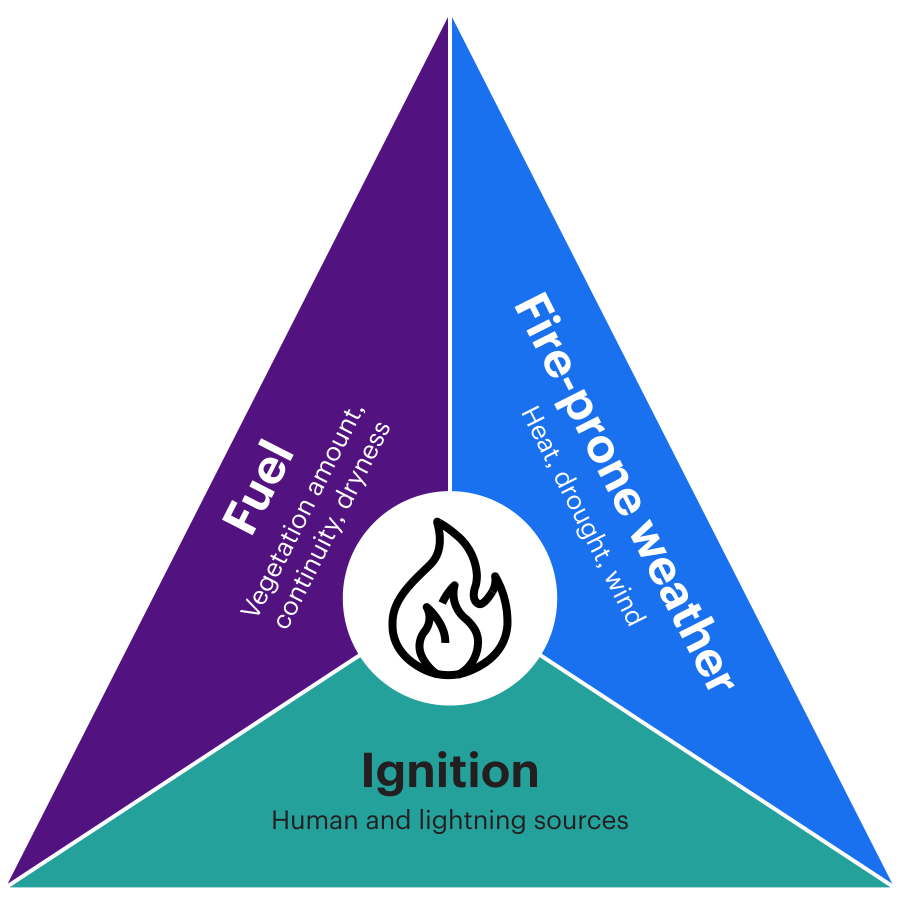
Wildfire risk increases when fuel, weather, and ignition combine—forming the three key drivers of high-impact fires.
A triangular diagram illustrates the three key ingredients required for high-impact wildfires. One side represents fuel, including vegetation amount, continuity, and dryness. Another side shows fire-prone weather, such as heat, drought, and wind. The third side represents ignition sources, including human activity and lightning. A flame icon appears at the center, emphasizing that wildfires emerge when all three factors are present simultaneously.
Fuel: The foundation of the 2025 fire season
At the landscape scale, vegetation fuels — the amount, type, arrangement and dryness of grasses, shrubs or forests available to burn — play a central role in determining whether fires occur, how fast they spread and how intensely they burn.
In Southern California, the January 2025 fires followed two unusually wet years in 2022/23 and 2023/24, producing unusually abundant vegetation across chaparral and coastal sage scrub ecosystems.
This pattern reflects what wildfire scientists increasingly describe as a boom-and-bust cycle, in which productive wet periods generate excess vegetation, followed by drought and intense drying. In a warming world, this cycle intensifies as more intense rainfall increases grass and shrub growth sporadically in many regions.
The role of fuels was also evident across Southern Europe, where wet winter and spring conditions in Iberia increased vegetation growth ahead of the summer heat, and dense conifer forests and shrublands around settlements Türkiye, Greece and Cyprus created continuous fuels that allowed fires to spread rapidly across landscapes.
Fire-prone weather: Severity, timing and persistence
Fire-prone weather — hot, dry conditions that sap moisture from vegetation and strong winds that fan flames across the landscape — formed the second ingredient for extreme fires in 2025.
In Southern California, the most destructive fires occurred following an almost completely dry October–December period. These dry conditions were roughly a one-in-20-year occurrence in today’s climate and around 2.4 times more likely than in a pre-industrial climate.[2] Exceptionally strong Santa Ana winds exceeded 130 km/h, funneling fire through canyons and neighborhoods.
Notably, vapor pressure deficit — a measure of the atmosphere’s “drying power” — during the Los Angeles fires was unusually high for the time of year and arrived after several months of drought which lowered soil moisture to unusually low levels. When strong Santa Ana winds arrived in January amidst the unseasonally dry conditions, the landscape was ideally primed to carry intense and fast-moving fires.
Across Southern Europe, Summer 2025 brought record or near-record temperatures, including temperatures approaching 45°C in Greece. Spain and Portugal experienced extreme heat and drought, producing some of the most hazardous fire-weather conditions in decades.
Conditions of this severity were once rare but now occur more frequently in today’s warmer climate, increasing the likelihood that fuels prepared by wet seasons are later exposed to intense drying.
Ignition: The final piece of the triangle
Ignition sources — either from people or lightning — provide the spark that triggers wildfires.
In Southern California, both the Palisades and Eaton fires ignited in areas with dense urban exposure to wildland fires, where human ignition sources are common. While investigations and legal proceedings continue, some reports suggest that the Palisades fire rekindled from an earlier arson fire presumed extinguished, while the Eaton fire has been linked to power infrastructure failure.
Across Southern Europe, detailed ignition assessments for the 2025 fire season remain incomplete, but a mixture of arson, accidental, and lightning ignitions have been reported. Dry lightning storms during extreme heat and drought sparked several fires drought-impacted mountains of Spain and Portugal, while other events were linked to agricultural burning, arson or roadside ignitions.
From risk understanding to risk action
Viewing wildfire risk as a problem of alignment has direct implications for how risk is managed. Effective responses must address each side of the fire triangle and how they intersect with exposure.
Back to basics, forward to preparedness
Wildfire has always required alignment between fuel, fire-prone weather and ignition, but this alignment now occurs more frequently in places where exposure is high. Fire-prone conditions persist for longer, fuel loads fluctuate more dramatically, and ignition sources are embedded within expanding urban areas. The probability that drivers coincide in loss-relevant ways has increased, even when none of those drivers is extreme in isolation.
Wildfire preparedness cannot rely solely on predicting extreme scenarios — rather, it must mitigate sensitivity to those scenarios be confronting all three sides of the fire triangle. Measures that reduce fuel continuity, limit ignition potential or lower exposure all weaken alignment, even when adverse weather cannot be avoided.
The challenge for risk assessment is not to predict every fire, but to recognize when and where the alignment of fire drivers can lead to catastrophic impact. This behavior places a premium on models and analytics that can represent how fuel, weather, ignition and exposure interact, and how changes in these drivers — particularly fuel growth and expanding exposure — can quickly shift where that alignment becomes loss-relevant.
Footnotes
- Kelley, D.I., et al. State of Wildfires 2024–2025. (2025). Return to article
- Barnes, C. et al. Climate change increased the likelihood of wildfire disaster in highly exposed Los Angeles area. (2025). Return to article
- WTW. Willis and The Nature Conservancy Launch First-of-its-Kind Wildfire Resilience Insurance. (2025). Return to article
Author

Contact