In our first article on 40 years of the BVG, we discussed changes to the entry threshold, coordination deduction, old-age credits and vested benefits.
In this second article, we focus on the constitutional objective set out in the BVG bill drafted half a century ago. Before evaluating whether this objective has been met, let us review the evolution of the retirement age and the conversion rate, two key parameters at the heart of the debate whenever reform attempts are made.
Retirement age
The BVG retirement age is aligned with that of the AHV. For men, it has always been 65, while for women it has changed: In 1985 it was 62, then was adjusted to 63 in 2001 and to 64 in 2005. Finally, the AHV 21 reform, accepted by the people and the cantons on 22 September 2022, standardised the retirement age for men and women at 65 by gradually raising the retirement age for women between 2025 and 2028.
It should be noted that before the BVG, at the beginning of the AHV (1948), the retirement age for women was 65. It was then lowered to 63 (1957) and finally to 62 (1964). As a result, over time, the retirement age has been debated on numerous occasions.
In Europe, the retirement age is currently between 64 and 67. In Denmark, there are even plans to increase it to 70 by 2040. What will happen in Switzerland in the coming years? The trend seems to be towards greater flexibility in the retirement age, maintaining a reference age of 65 whilst making it easier and more attractive to work beyond.
As a reminder, the reference age is primarily a useful time reference for checking the length of contributions to the 1st pillar. Taking into account their own financial resources and the possibilities for flexible retirement ages (the first pillar is between the ages of 63 and 70. The second pillar is between the ages of 58 and 70), individuals can determine their "appropriate retirement age".
Conversion rate
Another key point of the BVG is the conversion rate, the percentage used to convert retirement savings (accumulated savings capital) into a retirement pension. In 1985, it was 7.2%. Put simply, if an insured person had retirement savings of CHF 500,000 at the time of retirement, their retirement pension would be CHF 36,000 per year (CHF 3,000 per month).
This minimum BVG conversion rate, which applies only to the minimum BVG retirement savings, remained unchanged until 2004. From 2005 (year of entry into force of the first BVG revision, resulting from the Federal Council's message of 1 March 2000) onwards, in order to take the steady increase in life expectancy in to account, the conversion rate was lowered from 7.2% to 6.8% over a period of 10 years, i.e. until 2014. More than 10 years later, this rate remains unchanged despite various attempts to lower it. When applying the current minimum BVG conversion rate to our example, the pension decreases to CHF 34,000 per year (CHF 2,833 per month), which corresponds to a reduction of approximately 6%. It should be noted that, even though this pension has decreased by CHF 2,000 per year, given the average increase in life expectancy, the insured person would still receive a higher total pension amount over time.
Increased longevity coupled with low bond interest rates over the past 15 years (around 0.5% on average) easily explain why pension providers have significantly lowered their overall conversion rate, which now stands at around 5.2% on average. It is, of course, necessary to ensure that the pension paid is at least the minimum BVG old-age pension.
Furthermore, recent data shows that a growing number of insured persons are opting for a lump sum payment at retirement rather than drawing a pension, which has somewhat dampened the debate on conversion rates.
Interest on BVG retirement savings
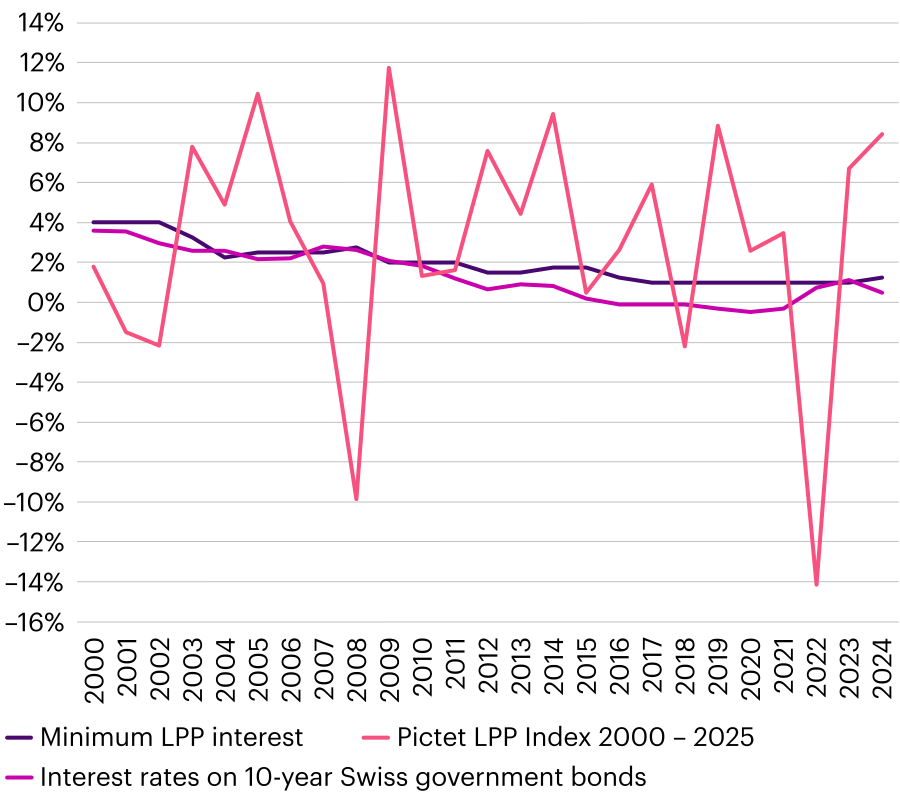
Each year, the Federal Council sets the interest rate on minimum BVG retirement savings based on the performance of Swiss government bonds and, in addition, that of equities and real estate. Over the past four decades, insured persons in a minimum plan have been granted an average minimum BVG interest rate of around 2.7% per annum.
The following chart illustrates the evolution of the minimum BVG interest rate, the interest rate on 10-year Swiss government bonds and, as an example, the annual performance of investments according to the Pictet BVG 2000-25 index (allocation of investments with 25% in equities and 75% in bonds), whose average annual performance is around 2.8% (observation period from 2000 to 2024) and is in line with the average BVG interest rate.
Minimum BVG Interest Rate
In accordance with the Federal Council's decision-making principle, the minimum BVG interest rate (in grey) is slightly above the bond interest rate (in red), while investment performance (in blue) has fluctuated significantly in line with developments on the financial markets.
It is important to keep a close and critical eye on the gap between investment performance and the interest rate paid on retirement savings.
Is the constitutional objective being met?
The social purpose of old-age pension provision is to ensure the financial security of insured persons by maintaining their usual standard of living as far as possible after retirement. Following on from the three-pillar principle of 1972, the Federal Council's message of 19 December 1975 laid the foundations for the BVG and stipulated that: "the previous standard of living can be guaranteed by a total pension (first and second pillar pensions) of 60 per cent of salary for a single person, up to a reasonable upper limit."
In 2025, the 1st pillar (AHV) old-age pension exceeds or reaches 60% up to an annual salary of around CHF 33,000; this indicates an initial reference threshold for a person who has contributed to the AHV for 44 years (for persons in gainful employment: from 1 January of the year in which they turn 18 until the end of their gainful employment; for persons not in gainful employment: from 1 January of the year in which they turn 21 until the reference age). Each missing year of contributions reduces the 1st pillar pension by around 2%. Above this salary level, it is necessary to draw on second pillar benefits to reach the 60% target.
What has become of this target 40 years after the BVG came into force?
Firstly, it should be noted that the maximum annual AHV pension (CHF 30,240 in 2025) represents 33% of the maximum insured salary (CHF 90,720 in 2025) in the minimum BVG pension scheme.
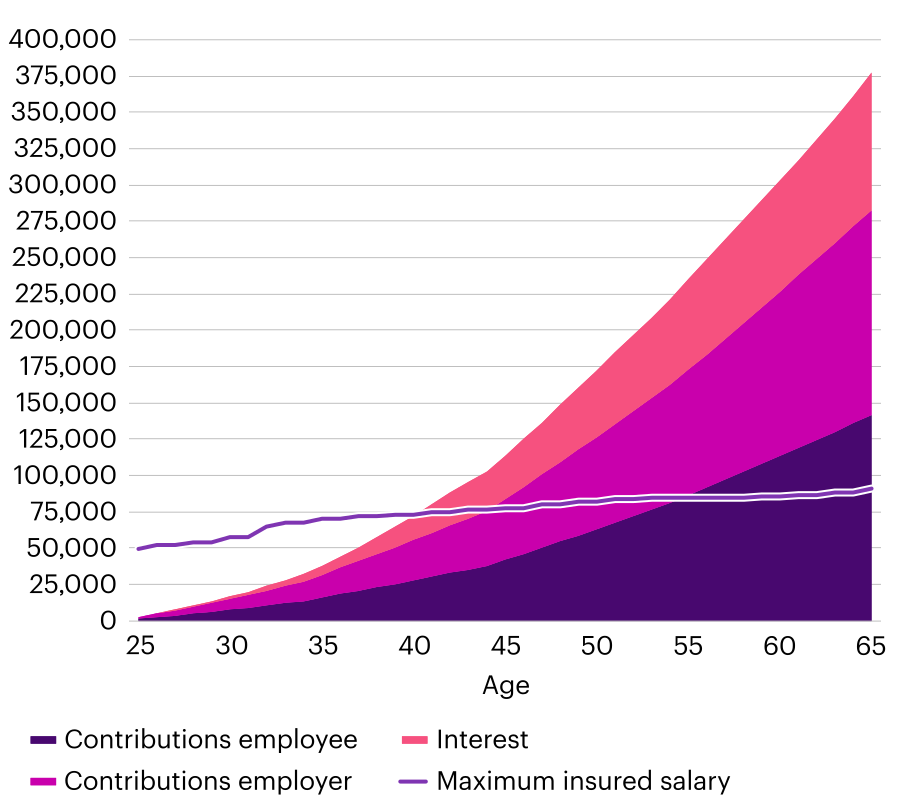
The graph below illustrates the evolution of the minimum BVG retirement savings of an employee born in 1960 who has always earned an annual salary at least equal to the maximum salary. Upon retirement in 2025, their capital will amount to CHF 377,526, (for men; CHF 377,851 for women and remunerated at the minimum BVG interest rate). This translates into an annual pension from the 2nd pillar of CHF 25,672, (377,526 x 6.8%), which corresponds to approximately 28% of their salary. It is also interesting to note that savings contributions account for three-quarters of the retirement capital, with the remaining quarter corresponding to interest received.
Evolution of Retirement Capital
By adding the pension from the 1st pillar to that from the 2nd pillar, the insured person receives a total old-age benefit of CHF 55,912, (30,240 (AVS) + 25,672 (BVG)), or 61.6% of the maximum insured salary ((30,240 + 25,672) / 90,720). It can be seen that the original constitutional objective has been met and that it can be extended to lower salaries, provided that the insured person has not had any interruptions in their employment between the ages of 25 and 65.
For people with an annual salary of more than CHF 90,720, the 1st pillar pension represents less than 33%. In order to achieve the objective, the 2nd pillar pension must therefore be comprehensive (higher than the minimum BVG pension scheme). Using their pension certificate and an estimate of their AHV pension, each insured person can estimate their total retirement benefits and calculate the percentage in relation to their salary. This gives a very good indication of the overall level of old-age coverage and allows everyone to assess any shortfall that can potentially be made up by making voluntary contributions into their 2nd pillar pension fund or through individual pension provision (3rd pillar). Depending on each individual's financial circumstances, use of these two approaches are now essential for achieving the pension target of 60% of final salary, and not just for filling any gaps.
In conclusion
Although we can be pleased that the original constitutional objective has been achieved, formulated on the basis that total benefits from the 1st and 2nd pillar would enable those earning less than CHF 90,000 per annum to maintain their previous standard of living, we may question whether this percentage is adequate. This 60% target should be considered as the minimum for all salary levels in order to ensure a dignified retirement.
It should be noted that the AHV pension is adjusted every two years in line with price and wage trends. It was indexed by an average of 1.5% per year over the period 1985–2025. On the other hand, pensions under the 2nd pillar are adjusted to price changes within the financial limits of each pension fund. It is therefore necessary to aim for a pension target of more than 60% if you want to maintain your standard of living, taking inflation into account.
The issue of the high minimum BVG conversion rate (6.8%), the reduction of which has been rejected several times in referendums, remains a sensitive topic of discussion. However, it has been circumvented by the legal possibilities of supplementary pension provision for the vast majority of insured persons in Switzerland. On this issue, solidarity between generations of insured persons is clearly declining. A conversion rate that is better aligned with life expectancy and interest rates seems to be emerging.
For a company, opting for a comprehensive pension provision represents a higher cost than the mandatory minimum. For an insured person, comprehensive pension provision represents a reduction in net salary due to increased savings contributions. However, both parties can reap the benefits (higher retirement benefits, tax advantages, staff loyalty) in the medium and long term. Comprehensive pension provision combined with the regular but consistent distribution of financial performance remains the best way to improve occupational pension provision.
Good luck, BVG, and keep up the good work so that everyone can enjoy a dignified retirement that is in line with the changing nature of our society.