


Institutional investors have increasingly turned to alternative credit as a scalable way of diversifying beyond corporate risk while achieving higher income and returns than traditional fixed income.
Once considered a niche, the asset class has grown into a $9.6tn trillion[1] market — now larger than the Global investment grade (IG) corporate credit universe ($8.1 trillion) — and it continues to expand. New opportunities are emerging outside the corporate sphere, such as in consumer lending, emerging markets and infrastructure financing. To illustrate, Morgan Stanley Research[2] estimates that the global push toward electrification and AI infrastructure alone will require $1.5–2 trillion in fresh capital, much of which will depend on flexible, non-bank financing. Against this backdrop, alternative credit is moving from optional to essential for robust and resilient portfolios.
Why are portfolios rebalancing
Equity allocations and corporate exposure can stack overlapping risks, particularly during times of volatility. In contrast, exposure to “real economy” borrowers opens the door to uncorrelated sources of return such as sovereign debt, asset-backed lending and renewable energy-backed cash flows.
Alternative credit has delivered an 8% higher average yield compared with a traditional credit index over the past five years with a similar default experience[3].
The “Three I’s” of alternative credit meet today’s challenges
As the asset class matures, it has proven its ability to address today’s challenges that traditional fixed income cannot:
- Income: Alternative credit is inherently more cash flow oriented, reflecting the nature of loans in areas such as infrastructure debt. In fact, up to 80% of the underlying yield in alternative credit can come from income generation[4].
- Inflation: The additional yield over traditional credit acts as a buffer, helping investors keep pace with inflation — a challenge that traditional credit alone has struggled to meet.
- Innovation: With governance resources stretched, asset owners are looking for scalable solutions. Our Global Asset Owner Peer Study, by the Thinking Ahead Institute, highlights that managing growth and governance complexity are two of the top three issues facing leading pension funds today. So investors must seek innovative and efficient strategies. WTW’s flagship Alternative Credit Fund looks to reap the benefits of the asset class in a single solution, but with a well-diversified and dynamic underlying portfolio.
Evidence of accelerating adoption
The momentum is clear. UBS reports[5] that while 73% of fixed income portfolios remain allocated to government bonds, IG credit and agency/municipals, a significant 27% is now in alternative credit strategies — a share that is steadily rising. The appeal is simple: attractive yield pick-up, structural protections and diversification away from overburdened corporate balance sheet risk (Exhibit 1).
Exhibit 1: Representative Asset Owner Investment in Alternative Credit
Canadian leaders in alternative credit
Canada’s largest investors illustrate the strategic role Alternative Credit plays in portfolio diversification and income generation. All the below investors with assets under management (AUM) above C$100 billion.
Illustrative examples of Canadian institutional portfolios allocating to Alternative Credit| Fund | Alternative Credit Weight | Exposure includes |
|---|---|---|
| Fund 1 | 11% | High-yield, emerging market debt and private credit across public and private markets |
| Fund 2 | Embedded in fixed Income (31%) | Quality and high-yield bonds, syndicated loans, EM government debt, real estate and infrastructure finance |
| Fund 3 | 9% | Leveraged loans, high yield and emerging market debt |
| Fund 4 | 10% | Direct non-investment-grade credit investment solutions, in both private and public markets as well as on rescue financing and distressed debt opportunities |
These funds use Alternative Credit to enhance risk-adjusted returns and reduce their dependence on traditional fixed income.
Foundations are also active allocators, driven by the need to support stable annual spending rates. For instance:
- Foundation 1: With 5% spending rate, invests 5% of its portfolio in high yield private debt, multi-strategy credit, and real estate and infrastructure debt.
- Foundation 2: includes private debt and real asset debt within its portfolio to meet a similar 5% annual spending target.
The shift toward diversified credit assets helps these investors manage volatility, improve returns and diversify income sources.
Accessing top-tier alternative credit
While the largest global asset owners have the scale to build sophisticated alternative credit platforms in-house, not all investors can dedicate equivalent resources.
The key to reaping the benefits of alternative credit can often be breadth and depth in the portfolio. You must look across a growing investable universe and find the most well-rewarded areas.
WTW launched its dedicated WTW Alternative Credit Fund over a decade ago to provide low-governance access to a diversified, mature portfolio. Built on an independent multi-manager, fund-of-funds approach, it captures our highest-conviction ideas across public and private markets — including high yield, emerging market debt, securitized credit, direct lending, infrastructure and real estate debt. The portfolio is actively managed to keep pace with the changing market regime and evolving dynamics in the credit space (Exhibit 2).
Exhibit 2: Multi-manager approach. WTW Alternative Credit Fund (ACF) portfolio.
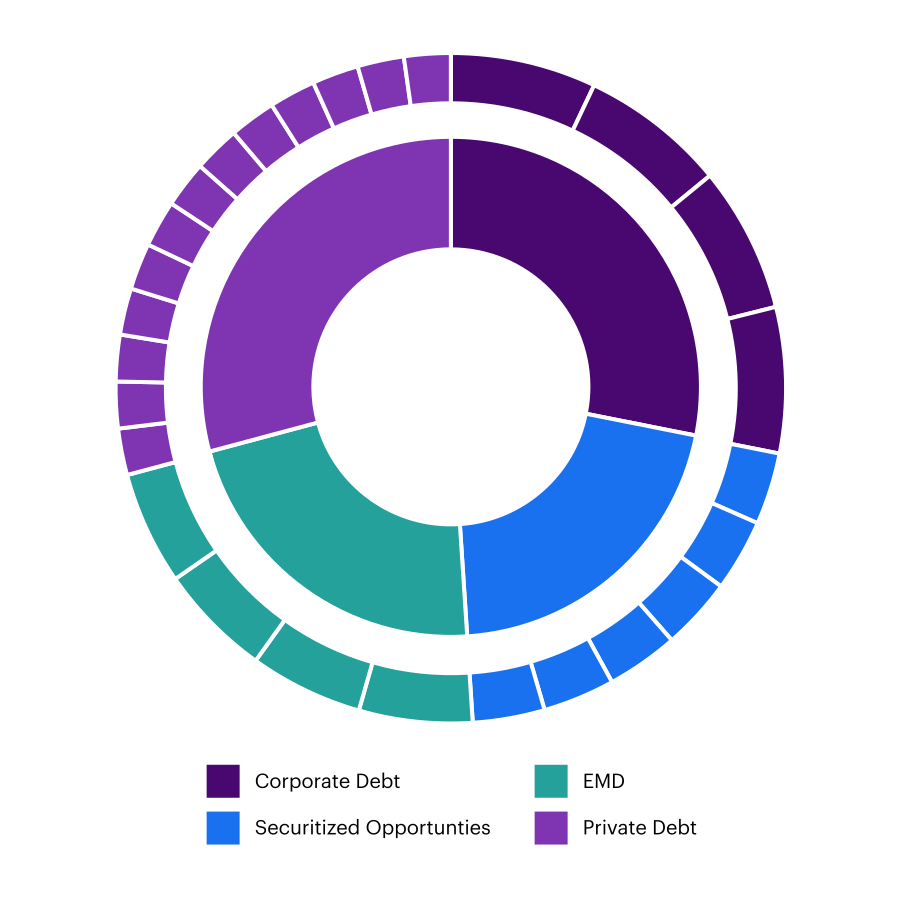
For illustrative purposes, not representative of current allocation. Source: WTW
We’ve achieved robust growth in the accumulation share class over the last 10 years (Exhibit 3). For investors with high spending rates, our distributing share class launched in late 2020, has provided a stable income stream, averaging 4.7% per annum. Distributions have never fallen below 4% and are now approaching 6%, with expectations to exceed that level.
Performance[6] as of 30 June 2025 (Accumulation share class)
ACF’s innovative approach provides exposure to the most attractive pockets across multiple sectors, geographies, and lending structures, with robust underwriting standards ensuring downside protection. Together, these features can deliver a strong income distribution profile while keeping up with inflation. As asset owners adjust to the new market environment challenges, where resilience and return are both increasingly necessary, ACF can provide a timely solution to this dual mandate, providing income, compelling yields and genuine diversification to improve outcomes.
For more information, please connect with a WTW consultant to explore how alternative credit could enhance your portfolio.
Footnotes
- Sources on asset class size: WTW, S&P Global, Fitch Ratings, Sifma, Expert Market Research, McKinsey Return to article
- Source: Morgan Stanley Research - Bridging a $1.5tr Data Center Financing Gap Return to article
- Based on WTW Alternative Credit Fund (ACF) yield to maturity (YTM) over ICE BoA Corporate Index Yield since January 2020. Source: Fred Return to article
- Based on WTW Alternative Credit Fund (ACF) income yield over yield to maturity (YTM) Return to article
- Source: UBS and NMG Consulting study over 90 institutional investors and retail gatekeepers managing over USD 8 trillion in assets Return to article
- Source: Performance for the Towers Watson Alternative Credit Fund (ACF) shown for Z Share Series (USD), net of underlying manager fees and administrative expenses, gross of WTW management fees. Inception date is 1 August 2014. Beta comparator: 1/3 US HY, 1/3 Leverage Loans and 1/3 EMD Hard Currency. Source: BNY Mellon Fund Services (Ireland) Limited, Bloomberg LLP and ICE Benchmark Administration. 30 June 2025. Return to article
Disclaimer
In Canada, Towers Watson Canada Inc. and WTW Investment Management Canada Limited have implemented an OCIO service, WTW Delegated Investment Services (“WTW DIS”). WTW Investment Management Canada Limited is registered with the Provincial regulatory authorities, the Yukon and Northwest Territories as a portfolio manager and exempt market dealer; as a registered investment fund manager in Newfoundland and Labrador, Ontario and Quebec.
WTW has prepared this material for general information purposes only and it should not be considered a substitute for specific professional advice. In particular, its contents are not intended by WTW to be construed as the provision of investment, legal, accounting, tax or other professional advice or recommendations of any kind, or to form the basis of any decision to do or to refrain from doing anything. As such, this material should not be relied upon for investment or other financial decisions and no such decisions should be taken based on its contents without seeking specific advice.
We incorporate sustainable investment considerations, including sustainability risks, into our investment research, due diligence and manager assessments. We believe that sustainability risks and wider sustainability considerations can influence investment outcomes from a risk and return perspective. Where sustainability risks and other sustainability considerations are most likely to influence investment risk and return, we encourage and expect fund managers to have a demonstrable process in place that identifies and assesses material sustainability risks and the impact on their investment strategy and end portfolio.
This material is based on information available to WTW at the date of this material and takes no account of developments after that date. In preparing this material we have relied upon data supplied to us or our affiliates by third parties. Whilst reasonable care has been taken to gauge the reliability of this data, we provide no guarantee as to the accuracy or completeness of this data and WTW and its affiliates and their respective directors, officers and employees accept no responsibility and will not be liable for any errors, omissions or misrepresentations by any third party in respect of such data.
This material may incorporate information and data made available by certain third parties, including (but not limited to): Bloomberg L.P.; CRSP; MSCI; FactSet; FTSE; FTSE NAREIT; FTSE RAFI; Hedge Fund Research Inc.; ICE Benchmark Administration (LIBOR); JP Morgan; Markit Group Limited; Russell; and, Standard & Poor’s Financial Services LLC (each a “Third Party”). Details of the disclaimers and/or attribution relating to each relevant Third Party can be found at this link Index vendor disclaimers
This material may not be reproduced or distributed to any other party, whether in whole or in part, without WTW’s prior written permission, except as may be required by law. In the absence of our express written agreement to the contrary, WTW and its affiliates and their respective directors, officers and employees accept no responsibility and will not be liable for any consequences howsoever arising from any use of or reliance on this material or any of its contents.
Authors

Contact

Related solutions
Thinking Ahead Institute
The Thinking Ahead Institute aims to mobilise capital for a sustainable future.