


Defined Benefit (DB) Pension Plans Benchmarking
This section provides a pulse on DB plans risk management on a quarterly basis, including an evolution of funded positions and related observations.
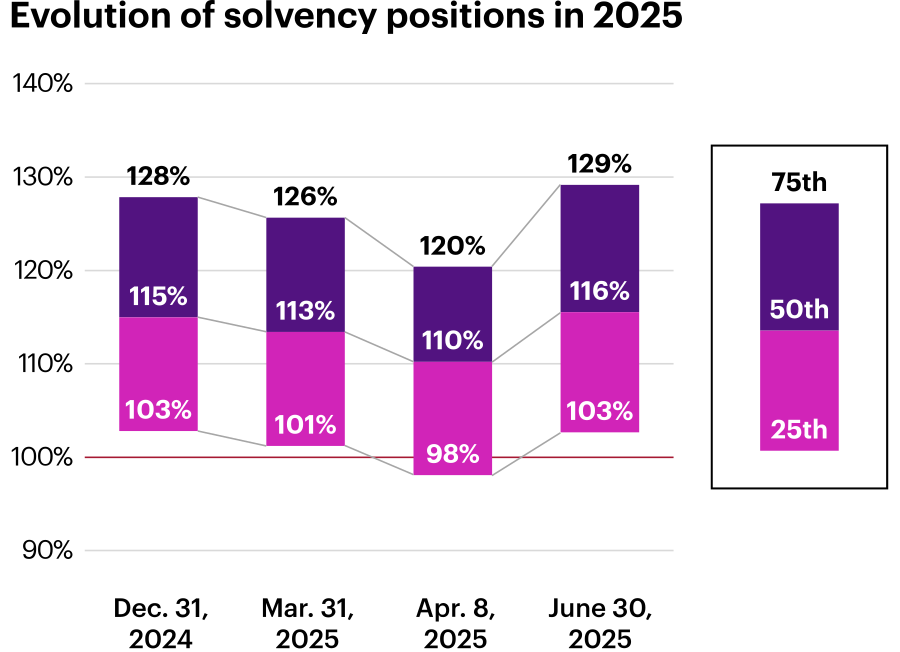
Evolution of solvency positions in 2025
The funded positions of close to 400 DB pension plans for which WTW serves as the appointed actuary in Canada remained resilient through the first half of 2025. Although a brief downturn in early April caused a temporary dip - April 8 marked the lowest funded positions of the year - plans recovered quickly. As expected, those with significant equity exposure experienced the most pronounced fluctuations in funded status over the first six months of 2025. On the other hand, plans with greater exposure to liability-hedging assets, such as bonds or buy-in annuity contracts, were generally able to maintain stable positions during this volatile period. Refer to our previous pulse for an overview of the average asset mix for closed/frozen plans.
At the half mark of 2025, strong market performance and rising interest rates have helped lift funded positions to levels greater than the start of the year (refer to our Canadian Pension finance – Second Quarter 2025 for more details). The vast majority of plans continue to hold healthy surpluses. This recent volatility - and the tools available to manage it - remain central to ongoing discussions with pension plan sponsors. Many are actively reviewing their risk management frameworks in light of this market volatility as well as the Guideline #10, released by the Canadian Association of Pension Supervisory Authorities (CAPSA) in the fall of 2024. Once again, plans with well-structured and proactive risk management strategies appear better positioned to navigate periods of uncertainty with greater agility and fewer unexpected outcomes. WTW can share additional benchmarking including information on how plan sponsors are utilizing surplus upon request.
Group annuity market
Sales volume in 2025 is expected to fall short of the $11.0 billion record set in 2024.
Key 2025 year-to-date highlights
Despite a high number of transactions, the sales volume in 2025 is expected to be significantly below 2024. The current best estimate for the total 2025 group annuity sales is around $7 billion. In fact, despite more transactions expected to be completed in 2025 by WTW, there are fewer jumbo transactions driving lower overall sales.
Last year, small or complex annuity transactions (such as transactions with a high proportion of deferred vested members or complicated plan provisions) resulted in lower participation and many cases were transacted though an exclusive deal. This year, with the lower sales volume, we are seeing a better participation rate on such transactions, with most being concluded through a competitive bidding process. In fact, insurers are sensing the lower sales volume and are also advising clients to come to market as group annuity pricing in 2025 may be at a discount (relatively speaking). Sun Life’s recent article is an example.
Gross yields on non-indexed annuities continue to hover around 5%, which remain significantly above pre-2022 averages, resulting in lower absolute costs.
The CIA recently updated their guidance suggesting that annuity yields for the second half of the year should result in implied spreads of 120 bps above GoC (10 years). The 20 bps spread drop in the CIA Guidance is mostly linked to a drop in corporate bonds credit spread observed since the beginning of the year. Interestingly, our recent annuity transactions indicate slightly higher implied spreads, which can partially be explained by the lower sales volume leading to a more competitive bidding process.
In fact, implied yields offered on annuities are currently comparable to yields on high quality corporate bonds. This translates into a higher probability for transactions to be completed with a balance sheet gain (i.e., annuity premium lower than corresponding accounting liabilities).
The sales volume for CPI-linked annuities dipped to $0.3 billion - well below the $1.4 billion posted mid-2024. In recent past, actual pricing observed by WTW for CPI-linked annuities were 5% cheaper than those suggested by the CIA Guidance. This enticed the CIA to update their guidance effective June 30, 2025, which now suggests an improvement of 30 bps in expected yields offered by insurers for CPI-linked annuities. For a group of retirees with a duration of 10, this represents a 3% reduction in premium, which will reduce the gap between the CIA Guidance and actual annuity pricing in the future.
Fundamentals to support growth in the group annuity market still holds as plans continue to be very well funded. In addition, both absolute and relative yields offered by insurers are close to an all-time high and the balance sheet impact from purchasing annuities is currently at an all-time low. This should maintain a healthy demand for annuities which is expected to continue to be a prevalent risk management strategy for plan sponsors in the upcoming years. This is evident by the number of WTW transactions in 2025 currently surpassing 2024.
Price of group annuities
Using our WTW Real-Time Annuity Tracker, we track the cost of annuities and assess the true competitiveness of quotes received from insurers by reflecting the evolution of credit spreads in real time. In addition, the WTW Real-Time Annuity Tracker reflects the mortality profile of specific cohorts based on socio-economic factors obtained from an analysis of the members’ data and postal codes.
About the WTW Group Annuity Purchase Team
The WTW Group Annuity Purchase Team has extensive expertise and experience in Canadian group annuities, helping to provide the best outcomes for our clients:
#1 firm in Canada over the last five years in terms of volume of annuities placed, including over 50% of the entire market and 90% of the indexed annuities market in 2024.
18 experienced specialists, plus a growing team, at the forefront of innovation.
$20B+ in liabilities transferred through group annuity purchases, representing over a third of the total historical volume in Canada, including multiple $500M+ transactions.
500+ robust and comprehensive financing strategies for pension plans developed by our team.
Authors


Manage Preferences
Subscribe to receive our latest insights